
ELECTRICITY
Note: use the top-right buttons to switch between Chinese / English / side-by-side modes; the left panel is the table of contents.
编者序Editor's Preface
Most of the following pages were written by the late Professor Clerk Maxwell, about seven years ago, and some of them were used by him as the text of a portion of his lectures on Electricity at the Cavendish Laboratory. Very little appears to have been added to the MS. during the last three or four years of Professor Maxwell's life, with the exception of a few fragmentary portions in the latter part of the work. This was partly due to the very great amount of time and thought which he expended upon editing the Cavendish papers, nearly all of which were copied by his own hand, while the experimental investigations which he undertook in order to corroborate Cavendish's results, and the enquiries he made for the purpose of clearing up every obscure allusion in Cavendish's MS., involved an amount of labour which left him very little leisure for other work.
本书的大部分篇章由已故的克拉克·麦克斯韦教授约于七年前撰写,其中一些曾被用作他在卡文迪什实验室电学讲座部分内容的讲义。在麦克斯韦教授生命的最后三四年间,除了作品后半部分的少数零散篇章外,手稿几乎没有新增内容。这部分是因为他投入了大量时间与精力去整理卡文迪什的文稿——这些文稿几乎全部由他亲手誊抄——同时,他为了印证卡文迪什的结论而进行的实验研究,以及为澄清卡文迪什手稿中每一处晦涩引述所作的探究,耗费了如此之多的辛劳,以致他几乎无暇从事其他工作。
When the MS. came into the hands of the present Editor, the first eight chapters appeared to have been finished and were carefully indexed and the Articles numbered. Chapters IX and X were also provided with tables of contents, but the Articles were not numbered, and several references, Tables, etc., were omitted as well as a few sentences in the text. At the end of the table of contents of Chapter X three points to be treated were mentioned, viz.:—the Passage of Electricity at the surfaces of insulators; Conditions of spark, etc.; Electrification by pressure, friction, rupture, etc.: no Articles corresponding to these headings could be found in the text. Some portions of Chapters IX and X formed separate bundles of MS., and
当手稿落到本书编者手中时,前八章似乎已经完成,并且经过了仔细地编制索引、为各条(Article)编了号。第九章和第十章也附有目录,但各条未编号,且若干参考文献、表格等连同正文中的几个句子一并阙如。在第十章目录的末尾提到了三个待论述的要点,即:电在绝缘体表面的通过;火花产生的条件等;由压力、摩擦、破裂等引起的起电——但在正文中找不到与这些标题相对应的条文。第九章和第十章的部分内容以独立的手稿束形式存在,而且
there was no indication of the place which they were intended to fill. This was the case with Arts. 174-181 and 187-192. Arts. 194-196 and 200 also formed a separate MS. with no table of contents and no indication of their intended position.
却没有关于它们应置于何处的任何说明。第 174–181 条和第 187–192 条就是这种情况。第 194–196 条和第 200 条也形成了一份独立的手稿,既无目录,也无其预定位置的说明。
It was for some time under consideration by the friends of Professor Maxwell, whether the MS. should be published in its fragmentary form or whether it should be completed by another hand, so as to carry out as far as possible the author's original design; but before any decision had been arrived at it was suggested that the book might be made to serve the purposes of students by a selection of Articles from Professor Maxwell's Electricity and Magnetism, so as to make it in a sense complete for the portion of the subject covered by the first volume of the last-mentioned work. In accordance with this suggestion, a number of Articles have been selected from the larger book and reprinted. These are indicated by a * after the number of the Article. Arts. 93-98 and 141 are identical with Arts. 118-123 and 58 of the larger treatise, but these have been reprinted in accordance with directions contained in Professor Maxwell's MS.
麦克斯韦教授的友人们曾一度考虑,是应当将这份手稿以其零散的形式出版,还是应当由他人之手将其补全,以便尽可能实现作者最初的构想;但在作出任何决定之前,有人建议,可以借助从麦克斯韦教授《电磁论》(Electricity and Magnetism)中选取若干条文,使本书在某种程度上覆盖上述著作第一卷所涉及的那部分主题,从而使之能为学生所用。根据这一建议,从这部大书中选出了若干条文并予以重印。这些条文在编号之后以星号(*)标示。第 93–98 条和第 141 条分别与大著中的第 118–123 条和第 58 条相同,但它们是按照麦克斯韦教授手稿中的指示重印的。
In the arrangement of the Articles selected from the Electricity and Magnetism care has been taken to interfere as little as possible with the continuity of the MS. of the present work, and in some cases logical order has been sacrificed to this object, so that some subjects which are treated briefly in the earlier portions are reintroduced in the latter part of the book. In Chapter XII some articles are introduced from the larger treatise which may appear somewhat inconsistent with the plan of this book; this has been for the sake of the practical value of the results arrived at. The latter part of the note on pages 149 and 150 may be taken as Professor Maxwell's own comment on the method proposed in Art. 186 written a few years subsequently to that Article.
在编排选自《电磁论》的条文时,已尽量少地干扰本书手稿的连贯性,并且在某些情况下为了这一目的甚至牺牲了逻辑顺序,因此一些在前文仅作简要论述的主题,会在书的后半部分重新引入。第十二章中引入了大著中的若干条文,它们或许与本书的体例略显不符,这样做是为了所得结果的实际价值。第 149、150 页注释的后半部分,可视为麦克斯韦教授本人对第 186 条所提方法的评论,写于该条文之后数年。
All references, for the accuracy of which Professor Maxwell is not responsible, and all Tables, notes, or interpolations inserted by the Editor, are enclosed in square brackets. This system has not been carried out in the table of contents, but the portion of this contained in Professor Maxwell's MS. is stated above.
凡麦克斯韦教授不对其准确性负责的参考文献,以及编者插入的所有表格、注释或插补文字,均置于方括号内。这一体例未在目录中贯彻,但目录中属于麦克斯韦教授手稿的部分已在上文说明。
Of the Author's Preface the portion here given is all that has been found.
作者序仅存此处所载的这一部分。
W. G.
CAMBRIDGE, August, 1881.
加内特 识(W. G.)
剑桥,1881 年 8 月
作者序残篇Fragment of Author's Preface
THE aim of the following treatise is different from that of my larger treatise on electricity and magnetism. In the larger treatise the reader is supposed to be familiar with the higher mathematical methods which are not used in this book, and his studies are so directed as to give him the power of dealing mathematically with the various phenomena of the science. In this smaller book I have endeavoured to present, in as compact a form as I can, those phenomena which appear to throw light on the theory of electricity, and to use them, each in its place, for the development of electrical ideas in the mind of the reader.
本书的宗旨与我的《电磁论》大著不同。在大著中,假定读者熟悉本书中并不使用的那些较高级的数学方法,并且其研读的方向在于使他具备以数学方式处理这门科学各种现象的能力。在这部较小的书中,我则力图以尽可能紧凑的形式,呈现那些似乎能为电学理论提供启示的现象,并在各自恰当的位置运用它们,以在读者心中培育电学的观念。
In the larger treatise I sometimes made use of methods which I do not think the best in themselves, but without which the student cannot follow the investigations of the founders of the Mathematical Theory of Electricity. I have since become more convinced of the superiority of methods akin to those of Faraday, and have therefore adopted them from the first.
在大著中,我有时采用了某些我本人并不认为是最好的方法,但若不采用这些方法,学生便无法跟上电学数学理论奠基者们的研究。此后我越发确信,与法拉第方法相类似的方法更为优越,因而从一开始便采用了它们。
In the first two chapters experiments are described which demonstrate the principal facts relating to electric charge considered as a quantity capable of being measured.
前两章描述了那些实验,它们证明了与电荷(被视作一种可以测量的量)有关的主要事实。
The third chapter, 'on electric work and energy,' consists of deductions from these facts. To those who have some acquaintance with the elementary parts of mathematics, this chapter may be useful as tending to make their knowledge more precise. Those who are not so prepared may omit this chapter in their first reading of the book.
第三章《论电功与能量》由这些事实的推论构成。对于那些对数学的初步内容有所了解的读者,这一章有助于使他们的知识更加精确。尚未作此准备的人,可在初读本书时略去此章。
The fourth chapter describes the electric field, or the region in which electric phenomena are exhibited.
第四章描述电场,即呈现电现象的区域。
第一章 · 起电与电现象Chapter I
实验一 · 摩擦起电Experiment I — Electrification by Friction
1. TAKE a stick of sealing-wax, rub it on woollen cloth or flannel, and then bring it near to some shreds of paper strewed on the table. The shreds of paper will move, the lighter ones will raise themselves on one end, and some of them will leap up to the sealing-wax. Those which leap up to the sealing-wax sometimes stick to it for awhile, and then fly away from it suddenly. It appears therefore that in the space between the sealing-wax and the table is a region in which small bodies, such as shreds of paper, are acted on by certain forces which cause them to assume particular positions and to move sometimes from the table to the sealing-wax, and sometimes from the sealing-wax to the table.
1. 取一根火漆棒,在毛呢或法兰绒上摩擦,然后把它靠近撒在桌上的一些纸屑。纸屑会动起来,较轻的会一端翘起,其中一些会跃向火漆棒。那些跃向火漆棒的纸屑有时会黏附其上片刻,随后又突然飞离。由此可见,在火漆棒与桌面之间的空间中存在着一个区域,纸屑之类的微小物体在其中受到某种力的作用,这些力使它们呈现特定的姿态,并时而从桌面移向火漆棒,时而从火漆棒移向桌面。
These phenomena, with others related to them, are called electric phenomena, the bodies between which the forces are manifested are said to be electrified, and the region in which the phenomena take place is called the electric field.
这些现象以及与之相关的其他现象,称为电现象(electric phenomena);在其间表现出这些力的物体,称为带电体(electrified);发生这些现象的区域称为电场(electric field)。
Other substances may be used instead of the sealing-wax. A piece of ebonite, gutta-percha, resin or shellac will do as well, and so will amber, the substance in which these phenomena were first noticed, and from the Greek name of which the word electric is derived.
除火漆外也可使用其他物质。一块硬橡胶(ebonite)、古塔波胶(gutta-percha)、松香或虫胶均可,琥珀亦然——这些现象最初正是在琥珀中被注意到的,而「电」(electric)一词即源自其希腊文名称。
The substance on which these bodies are rubbed may also be varied, and it is found that the fur of a cat's skin excites them better than flannel.
摩擦这些物体所用的物质也可以变换,并且发现,猫皮上的毛比法兰绒更能激起它们的带电。
It is found that in this experiment only those parts of the surface of the sealing-wax which were rubbed exhibit these phenomena, and that some parts of the surface are more active than others. In fact, the distribution of the electrification over the surface depends on the previous history of the sealing-wax, and this in a manner so complicated that it would be very difficult to investigate it. There are other bodies, however, which may be electrified, and over which the electrification is always distributed in a definite manner. We prefer, therefore, in our experiments, to make use of such bodies.
在这一实验中可以发现,只有火漆棒表面被摩擦过的部分才表现出这些现象,而且某些部分比其他部分更为活跃。事实上,带电在表面上的分布取决于火漆棒此前的经历,其方式如此复杂,以致很难加以研究。然而,还有其他一些可以带电的物体,其上的带电总是以确定的方式分布。因此,我们在实验中宁可使用这类物体。
The fact that certain bodies after being rubbed appear to attract other bodies was known to the ancients. In modern times many other phenomena have been observed, which have been found to be related to these phenomena of attraction. They have been classed under the name of electric phenomena, amber, ἤλεκτρον, having been the substance in which they were first described.
某些物体经过摩擦后似乎会吸引其他物体,这一事实古人早已知晓。到了近代,人们又观察到许多其他现象,发现它们与这些吸引现象相关。它们被归入「电」现象一类,因为琥珀(希腊文 ἤλεκτρον)是最先被描述这些现象的物质。
Other bodies, particularly the loadstone and pieces of iron and steel which have been subjected to certain processes, have also been long known to exhibit phenomena of action at a distance. These phenomena, with others related to them, were found to differ from the electric phenomena, and have been classed under the name of magnetic phenomena, the loadstone, μάγνης, being found in Magnesia*.
其他物体,尤其是天然磁石(loadstone)以及经过某些处理的铁块和钢块,也很早就被发现会表现出超距作用的现象。这些现象连同与之相关的其他现象,被发现与电现象不同,并被归入磁现象一类,因为天然磁石(希腊文 μάγνης)产于马格尼西亚(Magnesia)*。
* The name of Magnesia has been given to two districts, one in Lydia the other in Thessaly. Both seem to have been celebrated for their mineral products, and several substances have been known by the name of magnesia besides that which modern chemists know by that name. The loadstone, the touchstone, and meerschaum, seem however to have been the principal substances which were called Magnesian and magnetic, and these are generally understood to be Lydian stones.
* 马格尼西亚(Magnesia)之名曾用于两个地区,一在吕底亚(Lydia),一在色萨利(Thessaly)。两地似乎都以矿物产品闻名,而且除近代化学家以该名称呼的那种物质外,还有若干物质曾被冠以「马格尼西亚」之名。然而,天然磁石、试金石和海泡石,似乎是最主要的被称为「马格尼西亚的」和「磁性的」物质,而这些通常被认为是指吕底亚的石头。
These two classes of phenomena have since been found to be related to each other, and the relations between the various phenomena of both classes, so far as they are known, constitute the science of Electromagnetism.
此后人们发现这两类现象彼此相关,而就目前所知,两类现象的各种现象之间的关系,构成了电磁学(Electromagnetism)这门科学。
实验二 · 导体的带电Experiment II — Electrification of a Conductor
2. Take a metal plate of any kind (a tea-tray, turned upside down, is convenient for this purpose) and support it on three dry wine glasses. Now place on the table a plate of ebonite, a sheet of thin gutta-percha, or a well-dried sheet of brown paper. Rub it lightly with fur or flannel, lift it up from the table by its edges and place it on the inverted tea-tray, taking care not to touch the tray with your fingers.
2. 取一块任意种类的金属板(一个倒扣过来的茶盘用于此目的十分方便),把它架在三个干燥的酒杯上。现在在桌上放一块硬橡胶板、一片薄古塔波胶片或一张充分干燥的牛皮纸。用毛皮或法兰绒轻轻摩擦它,捏着它的边缘把它从桌上提起,放到倒扣的茶盘上,注意不要让手指碰到茶盘。
It will be found that the tray is now electrified. Shreds of paper or gold-leaf placed below it will fly up to it, and if the knuckle is brought near the edge of the tray a spark will pass between the tray and the knuckle, a peculiar sensation will be felt, and the tray will no longer exhibit electrical phenomena. It is then said to be discharged. If a metal rod, held in the hand, be brought near the tray the phenomena will be nearly the same. The spark will be seen and the tray will be discharged, but the sensation will be slightly different.
会发现茶盘此时已经带电。放在它下面的纸屑或金箔会飞向它;如果把指节靠近茶盘的边缘,茶盘与指节之间会跳过一道火花,人会感到一种异样的感觉,而茶盘将不再表现出电现象。这时就说它已经被「放电」(discharged)。如果手持一根金属棒靠近茶盘,现象大致相同:会看到火花,茶盘被放电,但感觉会略有不同。
If, however, instead of a metal rod or wire, a glass rod, or stick of sealing-wax, or a piece of gutta-percha, be held in the hand and brought up to the tray there will be no spark, no sensation, and no discharge. The discharge, therefore, takes place through metals and through the human body, but not through glass, sealing-wax, or gutta-percha. Bodies may therefore be divided into two classes: conductors, or those which transmit the discharge, and non-conductors, through which the discharge does not take place.
然而,如果手持一根玻璃棒、火漆棒或一片古塔波胶靠近茶盘,则既无火花,也无感觉,也不发生放电。因此,放电通过金属和人体进行,却不通过玻璃、火漆或古塔波胶。物体因而可以分为两类:导体(conductor),即传递放电的物体;以及非导体(non-conductor),即放电不能通过的物体。
In electrical experiments, those conductors, the charge of which we wish to maintain constant, must be supported by non-conducting materials. In the present experiment the tray was supported on wine glasses in order to prevent it from becoming discharged. Pillars of glass, ebonite, or gutta-percha may be used as supports, or the conductor may be suspended by a white silk thread. Solid non-conductors, when employed for this purpose, are called insulators. Copper wires are sometimes lapped with silk, and sometimes enclosed in a sheath of gutta-percha, in order to prevent them from being in electric communication with other bodies. They are then said to be insulated.
在电学实验中,那些我们希望保持其电荷不变的导体,必须用不导电的材料来支撑。在本实验中,茶盘架在酒杯上,就是为了防止它被放电。玻璃柱、硬橡胶柱或古塔波胶柱都可以用作支架,或者也可以用白色丝线把导体悬挂起来。用于此目的的固体非导体称为绝缘体(insulator)。铜线有时裹以丝线,有时则包在古塔波胶护套中,以防止它们与其他物体发生电的连通。这时就说它们被绝缘了。
The metals are good conductors; air, glass, resins, gutta-percha, caoutchouc, ebonite, paraffin, &c., are good insulators; but, as we shall find afterwards, all substances resist the passage of electricity, and all substances allow it to pass though in exceedingly different degrees. For the present we shall consider only two classes of bodies, good conductors, and good insulators.
金属是良导体;空气、玻璃、树脂、古塔波胶、弹性橡胶(caoutchouc)、硬橡胶、石蜡等是良绝缘体;但正如我们以后将会看到的那样,所有物质都阻碍电的通过,同时所有物质也都允许电通过,只是程度差别极大。目前我们只考虑两类物体:良导体和良绝缘体。
实验三 · 正电与负电Experiment III — Positive and Negative Electrification
3. Take another tray and insulate it as before, then after discharging the first tray remove the electrified sheet from it and place it on the second tray. It will be found that both trays are now electrified. If a small ball of elder pith suspended by a white silk thread* be made to touch the first tray, it will be immediately repelled from it but attracted towards the second. If it is now allowed to touch the second tray it will be repelled from it but attracted towards the first. The electrifications of the two trays are therefore of opposite kinds, since each attracts what the other repels. If a metal wire, attached to an ebonite rod, be made to touch both trays at once, both trays will be completely discharged. If two pith balls be used, then if both have been made to touch the same tray and then hung up near each other they are found to repel each other, but if they have been made to touch different trays they attract each other. Hence bodies when electrified in the same way are repelled from each other, but when they are electrified in opposite ways they are attracted to each other.
3. 再取一个茶盘并像之前那样绝缘,然后把第一个茶盘放电,把带电的薄片从它上面移开,放到第二个茶盘上。会发现两个茶盘此时都带电了。如果用一根白色丝线悬挂一个接骨木髓小球*去触碰第一个茶盘,它会立即被第一个茶盘排斥,却朝着第二个茶盘被吸引。如果现在让它触碰第二个茶盘,它会被第二个茶盘排斥,却朝着第一个茶盘被吸引。因此,两个茶盘的带电是相反的两种,因为每个茶盘吸引另一个所排斥的东西。如果用一根系在硬橡胶棒上的金属线同时触碰两个茶盘,两个茶盘都会被完全放电。如果用两个髓球,那么若两者都触碰过同一个茶盘,再并排挂起,会发现它们相互排斥;而若它们触碰过不同的茶盘,则相互吸引。由此可见,以同样方式带电的物体相互排斥,而以相反方式带电的物体相互吸引。
* I find it convenient to fasten the other end of the thread to a rod of ebonite about 3 mm. diameter. The ebonite is a much better insulator than the silk thread especially in damp weather.
* 我发现把丝线的另一端系在一根直径约 3 毫米的硬橡胶棒上比较方便。硬橡胶是比丝线好得多的绝缘体,尤其在潮湿天气里。
If we distinguish one kind of electrification by calling it positive, we must call the other kind of electrification negative. We have no physical reason for assigning the name of positive to one kind of electrification rather than to the other. All scientific men, however, are in the habit of calling that kind of electrification positive which the surface of polished glass exhibits after having been rubbed with zinc amalgam spread on leather. This is a matter of mere convention, but the convention is a useful one, provided we remember that it is a convention as arbitrary as that adopted in the diagrams of analytical geometry of calling horizontal distances positive or negative according as they are measured towards the right or towards the left of the point of reference.
如果我们把其中一种带电称为正电(positive),就必须把另一种称为负电(negative)。我们没有任何物理上的理由把「正」这个名称赋予其中一种而非另一种。然而,所有科学工作者都习惯把抛光的玻璃表面在经涂有锌汞齐的皮革摩擦后所呈现的那种带电称为正电。这纯粹是一种约定,但这个约定是有用的,只要我们记住它同解析几何图形中那样一种约定一样是任意的——即把向右量得的水平距离称为正、向左量得的称为负(相对于参考点而言)。
In our experiment with a sheet of gutta-percha excited by flannel, the electrification of the sheet and of the tray on which it is placed is negative: that of the flannel and of the tray from which the gutta-percha has been removed is positive.
在我们用古塔波胶片经法兰绒摩擦而带电的实验中,古塔波胶片以及它所放置的茶盘的带电是负的;法兰绒以及移去古塔波胶后那个茶盘的带电是正的。
In whatever way electrification is produced it is one or other of these two kinds.
无论以何种方式产生带电,它都无非是这两种之一。
实验四 · 伏打起电盘Experiment IV — The Electrophorus of Volta
4. This instrument is very convenient for electrical experiments and is much more compact than any other electrifying apparatus.
4. 这种仪器用于电学实验十分方便,并且比任何其他起电装置都紧凑得多。
It consists of two disks, and an insulating handle which can be screwed to the back of either plate. One of these disks consists of resin or of ebonite in front supported by a metal back. In the centre of the disk is a metal pin*, which is in connection with the metal back, and just reaches to the level of the surface of the ebonite. The surface of the ebonite is electrified by striking it with a piece of flannel or cat's fur. The other disk, which is entirely of metal, is then brought near the ebonite disk by means of the insulating handle. When it comes within a certain distance of the metal pin, a spark passes, and if the disks are now separated the metal disk is found to be charged positively, and the disk of ebonite and metal to be charged negatively.
它由两个圆盘和一个可以旋到任一圆盘背面的绝缘手柄组成。其中一个圆盘由树脂或硬橡胶正面与一个金属背衬构成。圆盘中央有一根金属针*,它与金属背衬相连,并刚好达到硬橡胶表面的高度。硬橡胶表面用一块法兰绒或猫皮拍打使之带电。另一个完全由金属制成的圆盘,则借助绝缘手柄移近硬橡胶圆盘。当它进入距金属针一定距离内时,会跳过一道火花;若此时把两盘分开,会发现金属盘带正电,而硬橡胶—金属盘带负电。
* [This was introduced by Professor Phillips to obviate the necessity of touching the carrier plate while in contact with the ebonite.]
* (这是菲利普斯教授引入的,为的是避免在与硬橡胶接触时触碰承载盘。)
In using the instrument one of the disks is kept in connection with one conductor while the other is applied alternately to the first disk and to the other conductor. By this process the two conductors will become charged with equal quantities of electricity, that to which the ebonite disk was applied becoming negative, while that to which the plain metal disk was applied becomes positive.
使用该仪器时,使其中一个圆盘与一个导体保持连接,同时将另一个圆盘交替地贴到第一个圆盘和另一个导体上。通过这一过程,两个导体将带上等量的电:贴着硬橡胶盘的那个导体变为负电,而贴着纯金属盘的那个导体变为正电。
电动势Electromotive Force
5. Definition.—Whatever produces or tends to produce a transfer of Electrification is called Electromotive Force.
5. 定义。——凡产生或趋向于产生电荷转移者,称为电动势(Electromotive Force)。
Thus when two electrified conductors are connected by a wire, and when electrification is transferred along the wire from one body to the other, the tendency to this transfer, which existed before the introduction of the wire, and which, when the wire is introduced, produces this transfer, is called the Electromotive Force from the one body to the other along the path marked out by the wire.
因此,当两个带电导体用导线连接、电荷沿导线从一个物体转移到另一个物体时,那种在导线引入之前就已存在、并在导线引入时产生这一转移的趋势,就称为从一个物体沿导线所标出的路径到另一个物体的电动势。
To define completely the electromotive force from one point to another, it is necessary in general to specify a particular path from the one point to the other along which the electromotive force is to be reckoned. In many cases, some of which will be described when we come to electrolytic, thermoelectric, and electromagnetic phenomena, the electromotive force from one point to another may be different along different paths. If we restrict our attention, however, as we must do in this part of our subject, to the theory of the equilibrium of electricity at rest, we shall find that the electromotive force from one point to another is the same for all paths drawn in air from the one point to the other.
要完全定义从一点到另一点的电动势,通常必须指明从一点到另一点所沿的特定路径。在许多情形中(当我们讲到电解、热电和电磁现象时将会描述其中一些),从一点到另一点的电动势沿不同路径可能不同。然而,如果我们像本部分主题所必须做的那样,把注意力局限于静电平衡的理论,我们就会发现,从一点到另一点的电动势,对于在空气中从一点到另一点所画的任何路径都是相同的。
电势Electric Potential
6. The electromotive force from any point, along a path drawn in air, to a certain point chosen as a point of reference, is called the Electric Potential at that point.
6. 从任一点沿空气中画出的路径到某个被选作参考点之点的电动势,称为该点的电势(Electric Potential)。
Since electrical phenomena depend only on differences of potential, it is of no consequence what point of reference we assume for the zero of potential, provided that we do not change it during the same series of measurements.
由于电现象只取决于电势之差,因此我们把电势零点取在哪个参考点上并无关系,只要在同一系列测量过程中不改变它即可。
In mathematical treatises, the point of reference is taken at an infinite distance from the electrified system under consideration. The advantage of this is that the mathematical expression for the potential due to a small electrified body is thus reduced to its simplest form.
在数学论著中,参考点取在所讨论的带电体系无穷远处。这样做的好处是,一个小带电体所产生的电势的数学表达式可由此化为最简形式。
In experimental work it is more convenient to assume as a point of reference some object in metallic connection with the earth, such as any part of the system of metal pipes conveying the gas or water of a town.
在实验工作中,更方便的做法是以某个与大地有金属连接的物体为参考点,例如城镇中输送煤气或水的金属管道系统的任一部分。
It is often convenient to assume that the walls, floor and ceiling of the room in which the experiments are carried on has conducting power sufficient to reduce the whole inner surface of the room to the same potential. This potential may then be taken for zero. When an instrument is enclosed in a metallic case the potential of the case may be assumed to be zero.
通常还方便地假定,进行实验的房间的墙壁、地板和天花板具有足够的导电能力,使房间整个内表面达到同一电势。这个电势即可取为零。当仪器装在金属盒中时,可假定盒的电势为零。
导体的电势Potential of a Conductor
7. If the potentials at different points of a uniform conductor are different there will be an electric current from the places of high to the places of low potential. The theory of such currents will be explained afterwards (Chap. ix). At present we are dealing with cases of electric equilibrium in which there are no currents. Hence in the cases with which we have now to do the potential at every point of the conductor must be the same. This potential is called the potential of the conductor.
7. 如果一均匀导体的不同点处电势不同,就会有从高电势处流向低电势处的电流。这种电流的理论将在后文(第九章)解释。目前我们讨论的是没有电流的电平衡情形。因此,在我们现在所要处理的情形中,导体每一点的电势必须相同。这个电势就称为该导体的电势。
The potential of a conductor is usually defined as the potential of any point in the air infinitely close to the surface of the conductor. Within a nearly closed cavity in the conductor the potential at any point in the air is the same, and by making the experimental determination of the potential within such a cavity we get rid of the difficulty of dealing with points infinitely close to the surface.
导体的电势通常定义为空气中无限接近导体表面的任一点的电势。在导体内部近乎封闭的空腔中,空气中任一点的电势是相同的;通过在这种空腔内实验测定电势,我们就避免了处理无限接近表面的点这一困难。
8. It is found that when two different metals are in contact and in electric equilibrium their potentials as thus defined are in general different. Thus, if a copper cylinder and a zinc cylinder are held in contact with one another, and if first the copper and then the zinc cylinder is made to surround the flame of a spirit lamp, the lamp being in connection with an electrometer, the lamp rapidly acquires the potential of the air within the cylinder, and the electrometer shews that the potential of the air at any point within the zinc cylinder is higher than the potential of the air within the copper cylinder. We shall return to this subject again, but at present, to avoid ambiguity, we shall suppose that the conductors with which we have to do consist all of the same metal at the same temperature, and that the dielectric medium is air.
8. 人们发现,当两种不同金属接触并处于电平衡时,按上述定义,它们的电势一般并不相同。例如,若使一个铜圆柱与一个锌圆柱互相接触,并先令铜圆柱、再令锌圆柱包围一盏酒精灯的火焰,同时使该灯与静电计相连,则灯会迅速取得圆柱内空气的电势,而静电计表明,锌圆柱内任一点空气的电势高于铜圆柱内空气的电势。我们以后还会回到这个主题;但目前,为避免歧义,我们假定所处理的导体都由同温下的同一种金属构成,且介电介质为空气。
9. The region of space in which the potential is higher than a certain value is divided from the region in which it is lower than this value by a surface called an equipotential surface, at every point of which the potential has the given value.
9. 电势高于某一值的空间区域,与电势低于该值的区域,被一个称为等势面(equipotential surface)的面所分隔,该面上每一点的电势都具有这个给定值。
We may conceive a series of equipotential surfaces to be described, corresponding to a series of potentials in arithmetical order. The potential of any point will then be indicated by its position in the series of equipotential surfaces.
我们可以设想描绘出一系列等势面,对应于按等差顺序排列的一系列电势。任一点的电势即可由它在这一系列等势面中的位置来表示。
No two different equipotential surfaces can cut one another, for no point can have two different potentials.
任意两个不同的等势面不可能相交,因为没有哪个点能具有两个不同的电势。
10. The idea of electric potential may be illustrated by comparing it with pressure in the theory of fluids and with temperature in the theory of heat.
10. 电势的概念可以通过把它与流体理论中的压强、以及热理论中的温度相比拟来说明。
If two vessels containing the same or different fluids are put into communication by means of a pipe, fluid will flow from the vessel in which the pressure is greater into that in which it is less till the pressure is equalized. This however will not be the case if one vessel is higher than the other, for gravity has a tendency to make the fluid pass from the higher to the lower vessel.
若使两个盛有相同或不同流体的容器通过管道连通,流体将从压强大的容器流向压强小的容器,直至压强相等。然而,若一个容器比另一个高,则情况并非如此,因为重力有使流体从高处容器流向低处容器的趋势。
Similarly when two electrified bodies are put into electric communication by means of a wire, electrification will be transferred from the body of higher potential to the body of lower potential, unless there is an electromotive force tending to urge electricity from one of these bodies to the other, as in the case of zinc and copper above mentioned.
同样,当两个带电体用导线实现电的连通时,电荷将从电势较高的物体转移到电势较低的物体,除非存在一种电动势,倾向于把电从其中一个物体驱向另一个物体,如上文锌与铜的情形。
Again, if two bodies at different temperatures are placed in thermal communication either by actual contact or by radiation, heat will be transferred from the body at the higher temperature to the body at the lower temperature till the temperature of the two bodies becomes equalized.
再者,若把两个温度不同的物体通过实际接触或辐射而置于热连通之中,热量将从温度较高的物体转移到温度较低的物体,直至两物体的温度趋于相等。
The analogy between temperature and potential must not be assumed to extend to all parts of the phenomena of heat and electricity. Indeed this analogy breaks down altogether when it is applied to those cases in which heat is generated or destroyed.
温度与电势之间的比拟,不可假定能扩展到热现象与电现象的所有方面。事实上,当把这种比拟应用于热量被产生或消灭的那些情形时,它就完全失效了。
We must also remember that temperature corresponds to a real physical state, whereas potential is a mere mathematical quantity, the value of which depends on the point of reference which we may choose. To raise a body to a high temperature may melt or volatilize it. To raise a body, together with the vessel which surrounds it, to a high potential produces no physical effect whatever on the body. Hence the only part of the phenomena of electricity and heat which we may regard as analogous is the condition of the transfer of heat or of electricity, according as the temperature or the potential is higher in one body or in the other.
我们还必须记住,温度对应着一种真实的物理状态,而电势只是一个纯粹的数学量,其值取决于我们可以选定的参考点。把一物体升到高温可能使其熔化或汽化;而把一物体连同包围它的容器一起升到高电势,对该物体并不产生任何物理效应。因此,在电现象与热现象中,我们可以视为类似的部分,只是热量或电荷转移的条件——即哪一个物体的温度或电势更高。
With respect to the other analogy—that between potential and fluid pressure—we must remember that the only respect in which electricity resembles a fluid is that it is capable of flowing along conductors as a fluid flows in a pipe. And here we may introduce once for all the common phrase The Electric Fluid for the purpose of warning our readers against it. It is one of those phrases, which, having been at one time used to denote an observed fact, was immediately taken up by the public to connote a whole system of imaginary knowledge. As long as we do not know whether positive electricity, or negative, or both, should be called a substance or the absence of a substance, and as long as we do not know whether the velocity of an electric current is to be measured by hundreds of thousands of miles in a second or by an hundredth of an inch in an hour, or even whether the current flows from positive to negative or in the reverse direction, we must avoid speaking of the electric fluid.
至于另一种比拟——电势与流体压强之间的比拟——我们必须记住,电与流体相似之处仅在于它能像流体在管道中流动那样沿导体流动。这里我们可以一劳永逸地引入「电流体」(The Electric Fluid)这一常见说法,目的是提醒我们的读者警惕它。它属于这样一类说法:它们一度被用来指称某个观察到的事实,随即被大众拿来含混地意指一整套臆想的知识。只要我们不知道正电、负电或两者应当被称为某种物质,还是某种物质的缺失;只要我们不知道电流的速度应当以每秒数十万英里计,还是以每小时百分之一英寸计;甚至不知道电流是从正流向负还是沿相反方向——我们就必须避免谈论「电流体」。
验电器On Electroscopes
11. An electroscope is an instrument by means of which the existence of electrification may be detected. All electroscopes are capable of indicating with more or less accuracy not only the existence of electrification, but its amount. Such indications, however, though sometimes very useful in guiding the experimenter, are not to be regarded as furnishing a numerical measurement of the electrification. Instruments so constructed that their indications afford data for the numerical measurement of electrical quantities are called Electrometers.
11. 验电器(electroscope)是一种借以检测带电是否存在的仪器。所有验电器不仅能或多或少准确地指示带电的存在,还能指示其大小。然而,这种指示虽然有时对引导实验者十分有用,却不能视为提供了带电的数值测量。那些其指示能为电量的数值测量提供数据的仪器,称为静电计(Electrometer)。
An electrometer may of course be used as an electroscope if it is sufficiently sensitive to indicate the electrification in question, and an instrument intended for an electroscope may, if its indications are sufficiently uniform and regular, be used as an electrometer.
如果静电计足够灵敏,能够指示所讨论的带电,它当然可以用作验电器;而一个本用作验电器的仪器,如果其指示足够均匀而有规律,也可以用作静电计。
The class of electroscopes of simplest construction is that in which the indicating part of the instrument consists of two light bodies suspended side by side, which, when electrified, repel each other, and indicate their electrification by separating from each other.
构造最简单的验电器,其指示部分由两个并排悬挂的轻小物体组成,它们带电时相互排斥,并通过彼此分开来指示带电。
The suspended bodies may be balls of elder pith, gilt, and hung up by fine linen threads (which are better conductors than silk or cotton), or pieces of straw or strips of metal, and in the latter case the metal may be tinfoil or gold-leaf, thicker or thinner according to the amount of electrification to be measured.
悬挂的物体可以是接骨木髓球(镀金的,用细亚麻线悬挂,亚麻线比丝线或棉线导电更好),也可以是麦秆或金属条;在后一种情形中,金属可以是锡箔或金箔,依待测带电的大小而或厚或薄。
We shall suppose that our electroscope is of the most delicate kind, in which gold leaves are employed (see Fig. 1). The indicating apparatus l, l, is generally fastened to one end of a rod of metal L, which passes through an opening in the top of a glass vessel G. It then hangs within the vessel, and is protected from currents of air which might produce a motion of the suspended bodies liable to be mistaken for that due to electrification.
我们假定所用的验电器是最灵敏的那种,即采用金箔的(见图 1)。指示装置 l、l 通常固定在一根金属棒 L 的一端,该棒穿过玻璃容器 G 顶部的开口。于是它悬挂在容器内,免受气流的影响,因为气流可能引起悬挂物体的运动,而这种运动容易被误认为是由带电引起的。
To test the electrification of a body the electrified body is brought near the disk L at the top of the metal rod, when, if the electrification is strong enough, the suspended bodies diverge from one another.
要检测一物体的带电,把该带电体靠近金属棒顶端的圆盘 L,如果带电足够强,悬挂的物体就会彼此分开。
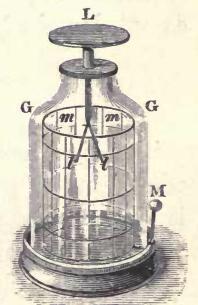
The glass case, however, is liable, as Faraday pointed out, to become itself electrified, and when glass is electrified it is very difficult to ascertain by experiment the amount and the distribution of its electrification. There is thus introduced into the experiment a new force, the nature and amount of which is unknown, and this interferes with the other forces acting on the gold leaves, so that their divergence can no longer be taken as a true indication of their electrification.
然而,正如法拉第所指出的,玻璃外壳本身容易带电,而玻璃一旦带电,就很难用实验确定其带电的数量和分布。这样就在实验中引入了一种其性质与大小均未知的新力,它干扰了作用于金箔上的其他力,使金箔的张开程度不再能作为其带电的真实指示。
The best method of getting rid of this uncertainty is to place within the glass case a metal vessel which almost surrounds the gold leaves, this vessel being connected with the earth. When the gold leaves are electrified the inside of this vessel, it is true, becomes oppositely electrified, and so increases the divergence of the gold leaves, but the distribution of this electrification is always strictly dependent on that of the gold leaves, so that the divergence of the gold leaves is still a true indication of their actual electrical state. A continuous metal vessel, however, is opaque, so that the gold leaves cannot be seen from the outside. A wire cage, however, may be used, and this is found quite sufficient to shield the gold leaves from the action of the glass, while it does not prevent them from being seen.
消除这种不确定性的最好方法,是在玻璃外壳内放置一个几乎包围金箔的金属容器,并使该容器与大地相连。金箔带电时,这个容器的内壁固然会带相反的电,从而增大金箔的张开程度,但这种带电的分布始终严格取决于金箔的带电,因此金箔的张开程度仍能真实地指示其实际带电状态。然而,连续的金属容器是不透明的,无法从外面看到金箔。不过可以用金属丝笼(wire cage),而且发现它足以使金箔免受玻璃的作用,同时又不妨碍人们看到金箔。
The disk, L, and the upper part of the rod which supports the gold leaves, and another piece of metal M, which is connected with the cage m, m, and extends beyond the case of the instrument, are called the electrodes, a name invented by Faraday to denote the ways by which the electricity gets to the vital parts of the instrument.
圆盘 L、支撑金箔的金属棒的上部,以及另一块与笼子 m、m 相连并伸到仪器外壳之外的金属 M,称为电极(electrode)——这是法拉第发明的名称,用以表示电到达仪器要害部位的「通路」(ways)。
The divergence of the gold leaves indicates that the potential of the gold leaves and its electrode is different from that of the surrounding metal cage and its electrode. If the two electrodes are connected by a wire the whole instrument may be electrified to any extent, but the leaves will not diverge.
金箔的张开表明,金箔及其电极的电势与周围金属笼及其电极的电势不同。如果用导线把两个电极连接起来,整个仪器无论带多少电,金箔都不会张开。
实验五Experiment V
The divergence of the gold leaves does not of itself indicate whether their potential is higher or lower than that of the cage; it only shews that these potentials are different. To ascertain which has the higher potential take a rubbed stick of sealing wax, or any other substance which we know to be negatively electrified, and bring it near the electrode which carries the gold leaves. If the gold leaves are negatively electrified they will diverge more as the sealing wax approaches the rod which carries them; but if they are positively electrified they will tend to collapse. If the electrification of the sealing wax is considerable with respect to that of the gold leaves they will first collapse entirely, but will again open out as the sealing wax is brought nearer, shewing that they are now negatively electrified. If the electrode M belonging to the cage is insulated from the earth, and if the sealing wax is brought near it, the indications will be exactly reversed; the leaves, if electrified positively, will diverge more, and if electrified negatively, will tend to collapse.
金箔的张开本身并不表明它们的电势比笼子高还是低,而只表明这两个电势不同。要确定哪个电势更高,取一根摩擦过的火漆棒或任何我们知道带负电的物质,把它靠近承载金箔的电极。如果金箔带负电,火漆棒靠近承载它们的金属棒时它们会张得更大;但如果它们带正电,就会趋向合拢。如果火漆棒所带的电相对于金箔而言相当可观,它们会先完全合拢,但当火漆棒进一步靠近时又会重新张开,表明它们此时已带负电。如果属于笼子的电极 M 与大地绝缘,把火漆棒靠近它,指示将完全相反:金箔若带正电会张得更大,若带负电则会趋向合拢。

If the testing body used in this experiment is positively electrified, as when a glass tube rubbed with amalgam is employed, the indications are all reversed.
如果本实验所用的检测体带正电,例如使用经汞齐摩擦的玻璃管,则所有指示都相反。
By these methods it is easy to determine whether the gold leaves are positively or negatively electrified, or, in other words, whether their potential is higher or lower than that of the cage.
用这些方法,很容易确定金箔是带正电还是带负电,换句话说,确定它们的电势比笼子高还是低。
12. If the electrification of the gold leaves is considerable the electric force which acts on them becomes much greater than their weight, and they stretch themselves out towards the cage as far as they can. In this state an increase of electrification produces no visible effect on the electroscope, for the gold leaves cannot diverge more. If the electrification is still further increased it often happens that the gold leaves are torn off from their support, and the instrument is rendered useless. It is better, therefore, when we have to deal with high degrees of electrification to use a less delicate instrument. A pair of pith balls suspended by linen threads answers very well; the threads answer sufficiently well as conductors of electricity, and the balls are repelled from each other when electrified.
12. 如果金箔的带电相当可观,作用于它们的电力就会远大于它们的重量,它们会尽可能向笼子伸展。在这种状态下,再增加带电不会对验电器产生可见的影响,因为金箔已无法张得更大。如果继续增大带电,往往会发生金箔从支架上被扯脱、仪器报废的情况。因此,当我们要处理高度带电时,最好使用不太灵敏的仪器。用亚麻线悬挂的一对髓球就很合用;亚麻线作为电导体足够好,而两个球带电时会相互排斥。
For very small differences of potential, electroscopes much more sensitive than the ordinary gold-leaf electroscope may be used.
对于极小的电势差,可以使用比普通金箔验电器灵敏得多的验电器。
汤姆孙象限静电计Thomson's Quadrant Electrometer
13. In Sir William Thomson's Quadrant Electrometer the indicating part consists of a thin flat strip of aluminium (see Fig. 2) called the needle, attached to a vertical axle of stout platinum wire. It is hung up by two silk fibres x, y, so as to be capable of turning about a vertical axis under the action of the electric force, while it always tends to return to a definite position of equilibrium. The axis carries a concave mirror t by which the image of a flame, and of a vertical wire bisecting the flame, is thrown upon a graduated scale, so as to indicate the motion of the needle round a vertical axis. The lower end of the axle, dips into sulphuric acid contained in the lower part of the glass case of the instrument, and thus puts the needle into electrical connection with the acid. The lower end of the axle also carries a piece of platinum, immersed in the acid which serves to check the vibrations of the needle. The needle hangs within a shallow cylindrical brass box, with circular apertures in the centre of its top and bottom.
13. 在威廉·汤姆孙爵士的象限静电计(Quadrant Electrometer)中,指示部分由一条薄而扁平的铝片(见图 2)构成,称为指针(needle),固定在一根粗铂丝制成的竖直轴上。它用两根丝纤维 x、y 悬挂起来,从而能在电力作用下绕竖直轴转动,同时又有回到确定平衡位置的趋势。轴上装有一面凹面镜 t,借助它把一束火焰以及一根平分火焰的竖直细丝的像投射到一刻度尺上,从而指示指针绕竖直轴的转动。轴的下端浸入仪器玻璃外壳下部的硫酸中,从而使指针与酸实现电的连通。轴的下端还装有一块浸在酸中的铂片,用来抑制指针的振动。指针悬挂在一个浅圆柱形黄铜盒内,盒的顶部和底部中央有圆形开口。
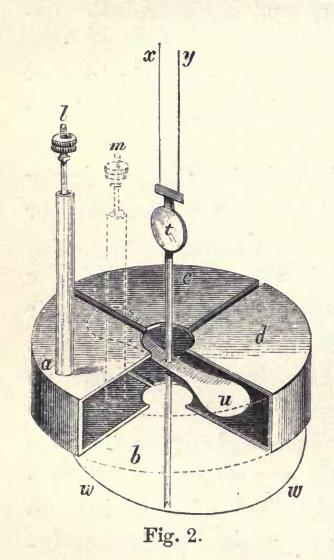
This box is divided into four quadrants, a, b, c, d, which are separately mounted on glass stems, and thus insulated from the case and from one another. The quadrant b is removed in the figure to shew the needle. The position of the needle, when in equilibrium, is such, that one end is half in the quadrant a and half in c, while the other end is half in b and half in d.
这个盒子分成四个象限 a、b、c、d,它们分别装在玻璃杆上,因而彼此以及与外壳相互绝缘。图中象限 b 被移去以显示指针。指针处于平衡时的位置,是其一端一半在象限 a 中、一半在 c 中,而另一端一半在 b 中、一半在 d 中。
The electrode l is connected with the quadrant a and also with d through the wire w. The other electrode, m, is connected with the quadrants b and c.
电极 l 与象限 a 相连,并通过导线 w 与 d 相连。另一电极 m 与象限 b 和 c 相连。
The needle, u, is kept always at a high potential, generally positive. To test the difference of potential between any body and the earth, one of the electrodes, say m, is connected to the earth, and the other, l, to the body to be tested.
指针 u 始终维持在高电势,一般为正。要检验任一物体与大地之间的电势差,把其中一个电极(例如 m)接到大地,把另一个电极 l 接到待测物体上。
The quadrants b and c are therefore at potential zero, the quadrants a and d are at the potential to be tested, and the needle u is at a high positive potential.
因此,象限 b 和 c 处于零电势,象限 a 和 d 处于待测电势,而指针 u 处于高的正电势。
The whole surface of the needle is electrified positively, and the whole inner surface of the quadrants is electrified negatively, but the greatest electrification and the greatest attraction is, other things being equal, where the difference of potentials is greatest. If, therefore, the potential of the quadrants a and d is positive, the needle will move from a and d towards b and c or in the direction of the hands of a watch. If the potential of a and d is negative, the needle will move towards these quadrants, or in the opposite direction to that of the hands of a watch.
指针的整个表面带正电,象限的整个内表面带负电,但在其他条件相同时,电势差最大的地方,带电和吸引力也最大。因此,若象限 a 和 d 的电势为正,指针将从 a、d 向 b、c 移动,即沿钟表指针的方向移动。若 a 和 d 的电势为负,指针将朝这些象限移动,即沿与钟表指针相反的方向移动。
The higher the potential of the needle, the greater will be the force tending to turn the needle, and the more distinct will be the indications of the instrument.
指针的电势越高,使指针转动的力就越大,仪器的指示也就越清晰。
等偏与异偏仪器Idiostatic and Heterostatic Instruments
14. In the gold-leaf electroscope, the only electrification in the field is the electrification to be tested. In the Quadrant Electrometer the needle is kept always charged. Instruments in which the only electrification is that which we wish to test, are called Idiostatic. Those in which there is electrification independent of that to be tested are called Heterostatic. In an idiostatic instrument, like the gold-leaf electroscope, the indications are the same, whether the potential to be tested is positive or negative, and the amount of the indication is, when very small, nearly as the square of the difference of potential. In a heterostatic instrument, like the quadrant electrometer, the indication is to the one side or to the other, as the potential is positive or negative, and the amount of the indication is proportional to the difference of potentials, and not to the square of that difference. Hence an instrument on the heterostatic principle, not only indicates of itself whether the potential is positive or negative, but when the potential is very small its motion for a small variation of potential is as great as when the potential is large, whereas in the gold leaf electroscope a very small electrification does not cause the gold leaves to separate sensibly.
14. 在金箔验电器中,场中唯一的带电就是待测的带电。在象限静电计中,指针始终保持着电荷。凡场中唯一的带电即我们所要检测的带电的仪器,称为等偏(Idiostatic)仪器;凡存在独立于待测带电的带电的仪器,称为异偏(Heterostatic)仪器。在像金箔验电器这样的等偏仪器中,无论待测电势为正还是为负,指示都相同;而当指示很小时,指示的大小近似与电势差的平方成正比。在像象限静电计这样的异偏仪器中,指示偏向这一侧还是另一侧,取决于电势是正还是负;且指示的大小与电势差成正比,而不是与其平方成正比。因此,基于异偏原理的仪器不仅能自行指示电势是正还是负,而且当电势很小时,它因电势的微小变化而产生的运动,与电势很大时一样大;而在金箔验电器中,极小的带电并不能使金箔明显地分开。
绝缘体On Insulators
15. In electrical experiments it is often necessary to support an electrified body in such a way that the electricity may not escape. For this purpose, nothing is better than to set it on a stand supported by a glass rod, provided the surface of the glass is quite dry. But, except in the very driest weather, the surface of the glass has always a little moisture condensed on it. For this reason electrical apparatus is often placed before a fire, before it is to be used, so that the moisture of the air may not condense on the warmed surface of the glass. But if the glass is made too warm, it loses its insulating power and becomes a good conductor.
15. 在电学实验中,经常需要以某种方式支撑一个带电体,使电荷不至于逃逸。为此,最好的办法莫过于把它放在由玻璃棒支撑的架子上,只要玻璃表面完全干燥。但是,除非在极其干燥的天气里,玻璃表面总会凝结有一点湿气。因此,电学仪器在使用之前常放在火前,使空气中的湿气不致凝结在受热的玻璃表面上。但如果玻璃被烘得太热,它就会失去绝缘能力而变成良导体。
Hence it is best to adopt a method by which the surface of the glass may be kept dry without heating it.
因此,最好采用一种无需加热即可使玻璃表面保持干燥的方法。
The insulating stand in the figure consists of a glass vessel C, with a boss rising up in the middle to which is cemented the glass pillar aa. To the upper part of this pillar is cemented the neck of the bell glass B, which is thus supported so that its rim is within the vessel C, but does not touch it. The pillar a carries the stand A on which the body to be insulated is placed.
图中的绝缘座由一个玻璃容器 C 组成,容器中央有一凸起的圆台,玻璃柱 aa 用胶粘合在上面。钟罩玻璃 B 的颈部粘合在这根柱的上部,从而使钟罩这样支撑起来:它的边缘在容器 C 之内,却不与容器接触。柱 a 承载着支架 A,待绝缘的物体就放在其上。
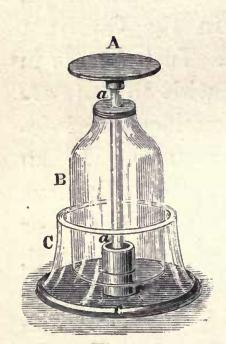
In the vessel C is placed some strong sulphuric acid c, which fills a wide shallow moat round the boss in the middle. The air within the bell glass B, in contact with the pillar a, is thus dried, and before any damp air can enter this part of the instrument, it must pass down between C and B and glide over the surface of the sulphuric acid, so that it is thoroughly dried before it reaches the glass pillar. Such an insulating stand is very valuable when delicate experiments have to be performed. For rougher purposes insulating stands may be made with pillars of glass varnished with shellac or of sealing-wax or ebonite.
容器 C 中盛有一些浓硫酸 c,它在中央圆台周围形成一个宽而浅的环槽。钟罩 B 内与柱 a 接触的空气由此被干燥;任何潮湿空气在进入仪器的这一部分之前,都必须从 C 与 B 之间向下通过,并掠过硫酸的表面,从而在到达玻璃柱之前已被充分干燥。在进行精密实验时,这种绝缘座非常宝贵。对于较粗陋的用途,可以用涂有虫胶清漆的玻璃柱、或火漆柱、硬橡胶柱来制作绝缘座。
16. For carrying about an electrified conductor, it is very convenient to fasten it to the end of an ebonite rod. Ebonite, however, is very easily electrified. The slightest touch with the hand, or friction of any kind, is sufficient to render its surface so electrical, that no conclusion can be drawn as to the electrification of the conductor at the end of the rod.
16. 要搬动一个带电导体,把它固定在一根硬橡胶棒的一端十分方便。然而,硬橡胶极易带电。手的最轻微触碰,或任何形式的摩擦,都足以使它的表面带上如此之多的电,以致无法就棒端导体的带电得出任何结论。
The rod therefore must never be touched but must be carried by means of a handle of metal, or of wood covered with tinfoil, and before making any experiment the whole surface of the ebonite must be freed from electrification by passing it rapidly through a flame.
因此,绝不能触碰这根棒,而必须借助金属手柄、或包有锡箔的木柄来拿它;并且在做任何实验之前,必须使硬橡胶的整个表面通过迅速掠过火焰而清除掉带电。
The sockets by which the conductors are fastened to the ebonite rods, should not project outwards from the conductors, for the electricity not only accumulates on the projecting parts, but creeps over the surface of the ebonite, and remains there when the electricity of the conductor is discharged. The sockets should therefore be entirely within the outer surface of the conductors as in Fig. 4.
把导体固定到硬橡胶棒上的插口,不应从导体向外突出,因为电荷不仅会积聚在突出的部分上,而且会沿硬橡胶表面蔓延,并在导体放电后仍残留在那里。因此,插口应完全处于导体的外表面之内,如图 4 所示。
It is convenient to have a brass ball, (Fig. 4), one inch in diameter, a cylindrical metal vessel (Fig. 5) about three inches in diameter and five or six inches deep, a pair of disks of tin plate (Figs. 6, 7), two inches in diameter, and a thin wire about a foot long (Fig. 8) to make connection between electrified bodies. These should all be mounted on ebonite rods (penholders), one eighth of an inch diameter, with handles of metal or of wood covered with tinfoil.
最好备有一个直径一英寸的黄铜球(图 4)、一个直径约三英寸、深五六英寸的圆柱形金属容器(图 5)、一对直径两英寸的锡板圆盘(图 6、7),以及一根长约一英尺、用于连接带电体的细导线(图 8)。这些都应装在直径八分之一英寸的硬橡胶棒(笔杆)上,并带有金属手柄或包锡箔的木柄。
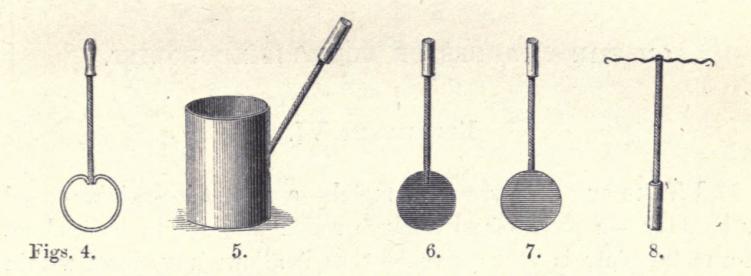
第二章 · 带电体的电荷Chapter II — On the Charges of Electrified Bodies
实验六 · 法拉第冰桶实验Experiment VI — The Ice-Pail
17. Take any deep vessel of metal,—a pewter ice-pail was used by Faraday,—a piece of wire gauze rolled into a cylinder and set on a metal plate is very convenient, as it allows any object within it to be seen. Set this vessel on an insulating stand, and place an electroscope near it. Connect one electrode of the electroscope permanently with the earth or the walls of the room, and the other with the insulated vessel, either permanently by a wire reaching from the one to the other, or occasionally by means of a wire carried on an ebonite rod and made to touch the vessel and the electrode at the same time. We shall generally suppose the vessel in permanent connection with the electroscope. The simplest way when a gold leaf electroscope is used is to set the vessel on the top of it.
17. 取一个深的金属容器——法拉第用的是白镴冰桶——把一片金属丝网卷成圆筒并放在金属板上十分方便,因为它可以让其中的任何物体被看见。把这个容器放在绝缘座上,并在它旁边放一个验电器。把验电器的一个电极永久地与大地或房间的墙壁相连,另一个电极与这个绝缘容器相连——或者用一根从一端连到另一端的导线永久相连,或者偶尔用一根装在硬橡胶棒上的导线同时触碰容器和电极。我们一般假定容器与验电器永久相连。使用金箔验电器时,最简单的办法是把容器放在验电器顶上。
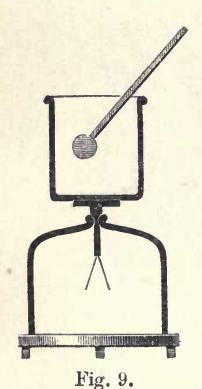
Take a metal ball at the end of an ebonite rod, electrify it by means of the electrophorus, and carrying it by the rod as a handle let it down into the metal vessel without touching the sides.
取一个装在硬橡胶棒末端的金属球,用起电盘使它带电,然后拿着棒作为手柄,把它放入金属容器中,不要碰到容器壁。
As the electrified ball approaches the vessel the indications of the electroscope continually increase, but when the ball is fairly within the vessel, that is when its depth below the opening of the vessel becomes considerable compared with the diameter of the opening, the indications of the electroscope no longer increase, but remain unchanged in whatever way the ball is moved about within the vessel.
当带电球接近容器时,验电器的指示不断增大;但当球完全进入容器内,即它低于容器开口的深度与开口直径相比已经相当可观时,验电器的指示就不再增大,而是无论球在容器内如何移动都保持不变。
This statement, which is approximately true for any deep vessel, is rigorously true for a closed vessel. This may be shewn by closing the mouth of the vessel with a metal lid worked by means of a silk thread. If the electrified ball be drawn up and let down in the vessel by means of a silk thread passing through a hole in the lid, the external electrification of the vessel as indicated by the electrometer will remain unchanged, while the ball changes its position within the vessel. The electrification of the gold leaves when tested is found to be of the same kind as that of the ball.
这个陈述对任何深容器都近似成立,对封闭容器则严格成立。这可以通过用一块金属盖(用丝线操纵)盖住容器口来证明。如果带电球用一根穿过盖上小孔的丝线在容器中拉起、放下,那么当球在容器内改变位置时,静电计所指示的容器外部带电将保持不变。检验发现,金箔的带电与球的带电属于同一种类。
Now touch the outside of the vessel with the finger, so as to put it in electric communication with the floor and walls of the room. The external electrification of the vessel will be discharged, and the gold leaves of the electroscope will collapse. If the ball be now moved about within the vessel, the electroscope will shew no signs of electrification; but if the ball be taken out of the vessel without touching the sides, the gold leaves will again diverge as much as they did during the first part of the experiment. Their electrification however will be found to be of the opposite kind from that of the ball.
现在用手指触碰容器的外面,使它和房间的地板与墙壁实现电连通。容器的外部带电将被放电,验电器的金箔将合拢。如果现在让球在容器内移动,验电器将不显示任何带电迹象;但如果把球取出容器而不碰到容器壁,金箔又会像实验第一部分那样张开。不过会发现,它们的带电与球的带电属于相反的种类。
实验七 · 比较两个球的电荷Experiment VII — Comparison of Charges
18. Since whatever be the position of the electrified bodies within the vessel its external electrification is the same, it must depend on the total electrification of the bodies within it, and not on the distribution of that electrification. Hence, if two balls, when alternately let down into the vessel, produce the same divergence of the gold leaves, their charges must be equal. This may be further tested by discharging the outside of the vessel when the first ball is in it, and then removing it and letting the second ball down into the vessel. If the charges are equal, the electroscope will still indicate no electrification.
18. 由于无论带电体在容器内处于什么位置,容器的外部带电都相同,所以它必然取决于容器内物体的总带电,而不是该带电的分布。因此,如果两个球交替放入容器时产生相同的金箔张开程度,它们的电荷必定相等。还可以进一步检验:当第一个球在容器内时把容器外面放电,然后取出它,再把第二个球放入容器。如果电荷相等,验电器仍将不显示任何带电。
If we wish to ascertain whether the charges of two bodies, oppositely electrified, are numerically equal, we may do so by discharging the vessel and then letting down both bodies into it. If the charges are equal and opposite, the electroscope will not be affected.
如果我们想确定两个带相反电的物体的电荷在数值上是否相等,可以把容器放电,然后把两个物体都放入其中。如果电荷大小相等、符号相反,验电器将不受影响。
实验八Experiment VIII
19. When an electrified body is hung up within a closed metallic vessel, the total electrification of the inner surface of the vessel is equal and opposite to that of the body. After hanging the body within the vessel, discharge the external electrification of the vessel, and hang up the whole within a larger vessel connected with the electroscope. The electroscope will indicate no electrification, and will remain unaffected even if the electrified body be taken out of the smaller vessel and moved about within the larger vessel. If, however, either the electrified body or the smaller vessel be removed from the large vessel, the electroscope will indicate positive or negative electrification.
19. 当一个带电体悬挂在一个封闭金属容器内时,容器内表面的总带电与物体的带电大小相等、符号相反。把物体悬挂在容器内之后,将容器的外部带电放电,然后把整个装置悬挂在一个与验电器相连的更大容器内。验电器将不显示任何带电;即使把带电体从较小的容器中取出并在较大容器内移动,验电器也保持不受影响。然而,如果带电体或较小的容器被移出大容器,验电器就会显示正电或负电。
When an electrified body is placed within a vessel free of charge, the external electrification is equal to that of the body. This follows from the fact already proved that the internal electrification is equal and opposite to that of the body, and from the circumstance that the total charge of the vessel is zero.
当一个带电体放在一个不带电的容器内时,外部带电等于物体的带电。这从已经证明的事实——内部带电与物体的带电大小相等、符号相反——以及容器总电荷为零这一情况得出。
But it may also be proved experimentally by placing, first the electrified body itself, and then the electrified body surrounded by an uncharged vessel, within the larger vessel and observing that the indications of the electroscope are the same in both cases.
但这也可以通过实验证明:先把带电体本身、再把被一个不带电容器包围的带电体放入较大的容器中,观察两种情况下验电器的指示是相同的。
实验九Experiment IX
20. When an electrified body is placed within a closed vessel and then put into electrical connection with the vessel, the body is completely discharged. In performing any of the former experiments bring the electrified body into contact with the inside of the vessel, and then take it out and test its charge by placing it within another vessel connected with the electroscope. It will be found quite free of charge. This is the case however highly the body may have been originally electrified, and however highly the vessel itself, the inside of which it is made to touch, may be electrified.
20. 当一个带电体放在一个封闭容器内,然后与容器实现电连接时,该物体被完全放电。在进行上述任一实验时,使带电体与容器内壁接触,然后取出它,把它放进另一个与验电器相连的容器中来检验其电荷。会发现它完全没有电荷。无论物体最初带电多强,也无论它所触碰内壁的容器本身带电多强,情况都是如此。
If the vessel, during the experiment, is kept connected with the electroscope, no alteration of the external electrification can be detected at the moment at which the electrified body is made to touch the inside of the vessel. This affords another proof that the electrification of the interior surface is equal and opposite to that of the electrified body within it. It also shews that when there is no electrified body within the surface every part of that surface is free from charge.
如果在实验过程中使容器始终与验电器相连,那么在带电体触碰容器内壁的那一瞬间,检测不到外部带电的任何变化。这为「内表面的带电与其内带电体的带电大小相等、符号相反」提供了另一个证明。它还表明,当面内没有带电体时,该面的每一部分都没有电荷。
实验十Experiment X
21. To charge a vessel with any number of times the charge of a given electrified body. Place a smaller vessel within the given vessel so as to be insulated from it. Place the electrified body within the inner vessel, taking care not to discharge it. The exterior charges of the inner and outer vessels will now be equal to that of the body, and their interior charges will be numerically equal but of the opposite kind. Now make electric connection between the two vessels. The exterior charge of the inner vessel and the interior charge of the outer vessel will neutralise each other, and the outer vessel will now have a charge equal to that of the body, and the inner vessel an equal and opposite charge.
21. 使一个容器带上给定带电体电荷的任意倍数。在给定容器内放入一个较小的容器,使它与之绝缘。把带电体放入内容器中,注意不要使它放电。内外容器的外部电荷现在将等于物体的电荷,而它们的内表面电荷数值相等、符号相反。现在使两个容器实现电连接。内容器的外部电荷与外容器的内部电荷将相互中和,外容器现在带有等于物体电荷的电荷,而内容器带有大小相等、符号相反的电荷。
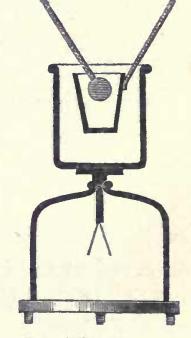
Now remove the electrified body; take out the inner vessel and discharge it; then replace it; place the electrified body within it; and make contact between the vessels. The outer vessel has now received a double charge, and by repeating this process any number of charges, each equal to that of the electrified body, may be communicated to the outer vessel.
现在移去带电体;取出内容器并把它放电;然后放回;把带电体放入其中;使两个容器接触。外容器现在已经获得了双倍电荷,通过重复这一过程,可以把任意多个、每个都等于带电体电荷的电荷传递给外容器。
To charge the outer vessel with electrification opposite to that of the electrified body is still easier. We have only to place the electrified body within the smaller vessel, to put this vessel for a moment in connection with the walls of the room so as to discharge the exterior electrification, then to remove the electrified body and carry the vessel into the inside of the larger vessel and bring it into contact with it so as to give the larger vessel its negative charge, and then to remove the smaller vessel, and to repeat this process the required number of times.
使外容器带上与带电体相反的带电更容易。我们只需把带电体放入较小的容器,把该容器与房间墙壁连接片刻以放掉外部带电,然后移去带电体,把该容器带入较大容器内部并与之接触,从而把它的负电荷给予较大容器,然后移去较小容器,并按所需次数重复这一过程。
We have thus a method of comparing the electric charges of different bodies without discharging them, of producing charges equal to that of a given electrified body, and either of the same or of opposite signs, and of adding any number of such charges together.
这样我们就有了一个方法:在不使不同物体放电的情况下比较它们的电荷;产生与给定带电体电荷相等、且符号相同或相反的电荷;以及把任意多个这样的电荷相加。
电现象的五条定律The Five Laws of Electrical Phenomena
22. In this way we may illustrate and test the truth of the following laws of electrical phenomena.
22. 这样我们就可以说明并检验以下电现象定律的真实性。
I. The total electrification or charge of a body or system of bodies remains always the same, except in so far as it receives electrification from, or gives electrification to other bodies. In all electrical experiments the electrification of bodies is found to change, but it is always found that this change arises from defective insulation, and that as the means of insulation are improved, the loss of electrification becomes less. We may therefore assert that the electrification of a body cut off from electrical communication with all other bodies by a perfectly insulating medium would remain absolutely constant.
一、 一个物体或物体体系的总带电或电荷始终保持不变,除非它从其他物体获得带电,或把带电给予其他物体。在所有电学实验中,物体的带电都被发现会改变,但总是发现这种改变是由绝缘不良引起的,而且随着绝缘手段的改进,带电的损失会变小。因此我们可以断言,一个被完全绝缘的介质与所有其他物体隔断电连通的物体,其带电将绝对保持恒定。
II. When one body electrifies another by conduction the total electrification of the two bodies remains the same, that is, the one loses as much positive or gains as much negative electrification as the other gains of positive or loses of negative electrification. For if the electric connection is made when both bodies are enclosed in a metal vessel, no change of the total electrification is observed at the instant of contact.
二、 当一个物体通过传导使另一个物体带电时,两个物体的总带电保持不变,也就是说,一个物体失去的正电(或获得的负电),等于另一个物体获得的正电(或失去的负电)。因为如果两个物体都封闭在一个金属容器内时建立电连接,那么在接触的瞬间观察不到总带电的任何变化。
III. When electrification is produced by friction or by any other known method, equal quantities of positive and of negative electricity are produced. For if the process of electrification is conducted within the closed vessel, however intense the electrification of the parts of the system may be, the electrification of the whole, as indicated by the electroscope connected with the vessel, remains zero.
三、 当带电由摩擦或任何其他已知方法产生时,产生的是等量的正电和负电。因为如果带电过程在封闭容器内进行,无论体系各部分的带电多么强,由与容器相连的验电器所指示的整体的带电始终保持为零。
IV. If an electrified body or system of bodies be placed within a closed conducting surface (which may consist of the floor, walls, and ceiling of the room in which the experiment is made), the interior electrification of this surface is equal and opposite to the electrification of the body or system of bodies.
四、 如果一个带电体或物体体系被放置在一个封闭的导体内表面内(该表面可以由进行实验的房间的地板、墙壁和天花板构成),则该表面的内部带电与物体或物体体系的带电大小相等、符号相反。
V. If no electrified body is placed within the hollow conducting surface, the electrification of this surface is zero. This is true, not only of the electrification of the surface as a whole, but of every part of this surface. For if a conductor be placed within the surface and in contact with it, the surface of this conductor becomes electrically continuous with the interior surface of the enclosing vessel, and it is found that if the conductor is removed and tested, its electrification is always zero, shewing that the electrification of every part of an interior surface within which there is no electrified body is zero.
五、 如果空心导体内表面内没有放置带电体,则该表面的带电为零。这不仅对表面整体的带电成立,而且对该表面的每一部分都成立。因为如果把一个导体放入该表面内并与之接触,该导体的表面就与包围容器的内表面在电上连续起来,并且发现:如果取出该导体并检验,它的带电总是零,这表明内部没有带电体的内表面的每一部分的带电都是零。
By means of Thomson's Quadrant Electrometer it is easy to measure the electrification of a body when it is a million times less than when charged to an amount convenient for experiment. Hence the experimental evidence for the above statements shews that they cannot be erroneous to the extent of one-millionth of the principal electrifications concerned.
借助汤姆孙象限静电计,很容易测量一个物体的带电,即使它比方便实验的电荷量小一百万倍。因此,上述陈述的实验证据表明,它们不可能在相关主要带电的百万分之一的程度上出错。
第三章 · 电功与能量Chapter III — On Electrical Work and Energy
功与能量Work and Energy
23. Work in general is the act of producing a change of configuration in a material system in opposition to a force which resists this change.
23. 功,一般说来,是反抗阻碍这种变化的一个力、在物质体系中产生构形(configuration)变化的行为。
Energy is the capacity of doing work.
能量是做功的能力。
When the nature of a material system is such that if after the system has undergone any series of changes it is brought back in any manner to its original state, the whole work done by external agents on the system is equal to the whole work done by the system in overcoming external forces, the system is called a Conservative system.
当一个物质体系的性质是这样的——如果体系经历任意一系列变化之后,又以任何方式回到其原始状态,那么外部施力者对该体系所做的总功,等于该体系在克服外力时所做的总功——这个体系就称为保守体系(Conservative system)。
The progress of physical science has led to the investigation of different forms of energy, and to the establishment of the doctrine, that all material systems may be regarded as conservative systems provided that all the different forms of energy are taken into account. This doctrine, of course, considered as a deduction from experiment, can assert no more than that no instance of a non-conservative system has hitherto been discovered, but as a scientific or science-producing doctrine it is always acquiring additional credibility from the constantly increasing number of deductions which have been drawn from it, which are found in all cases to be verified. In fact, this doctrine is the one generalised statement which is found to be consistent with fact, not in one physical science only, but in all. When once apprehended it furnishes to the physical enquirer a principle on which he may hang every known law relating to physical actions, and by which he may be put in the way to discover the relations of such actions in new branches of science. For such reasons the doctrine is commonly called the Principle of the Conservation of Energy.
物理科学的进步导致了对不同形式能量的研究,以及这样一个学说(doctrine)的确立:只要把各种不同形式的能量都考虑在内,所有物质体系都可以被视为保守体系。当然,这个学说作为从实验得出的推论,最多只能断言:迄今为止还没有发现非保守体系的实例;但作为一个科学的、或产生科学的学说,它却不断从它所推出的、且在所有情况下都被验证为真的日益增多的推论中获得额外的可信度。事实上,这个学说是唯一一个被发现在所有物理科学中(而不仅是一门中)都与事实相符的概括性陈述。一旦领会了它,它就给物理学研究者提供了一个原则,使他可以把所有已知的与物理作用有关的定律都挂在这个原则上,并使他能够借以在新科学分支中发现这类作用之间的关系。由于这些原因,这个学说通常被称为能量守恒原理(Principle of the Conservation of Energy)。
能量守恒的一般陈述General Statement of the Conservation of Energy
24. The total energy of any system of bodies is a quantity which can neither be increased nor diminished by any mutual action of those bodies, though it may be transformed into any of the forms of which energy is susceptible.
24. 任何物体体系的总能量,是一个既不能由这些物体的任何相互作用而增大、也不能由此而减小的量,尽管它可以转化为能量所能呈现的任何形式。
If, by the action of some external agent, the configuration of the system is changed, then, if the forces of the system are such as to resist this change of configuration, the external agent is said to do work on the system. In this case the energy of the system is increased. If, on the contrary, the forces of the system tend to produce the change of configuration, so that the external agent has only to allow it to take place, the system is said to do work on the external agent, and in this case the energy of the system is diminished. Thus when a fish has swallowed the angler's hook and swims off, the angler following him for fear his line should break, the fish is doing work against the angler, but when the fish becomes tired and the angler draws him to shore, the angler is doing work against the fish.
如果由于某个外部施力者的作用,体系的构形发生了改变,那么,如果体系的力是反抗这种构形改变的,就说外部施力者对体系做了功。在这种情况下,体系的能量增大。反之,如果体系的力趋向于产生这种构形改变,以致外部施力者只需听任它发生,就说体系对外部施力者做了功,在这种情况下体系的能量减小。因此,当一条鱼吞下了垂钓者的鱼钩并游开时,垂钓者因担心钓线断裂而跟着它,鱼就是在对垂钓者做功;但当鱼疲惫、垂钓者把它拉上岸时,垂钓者就是在对鱼做功。
Work is always measured by the product of the change of configuration into the force which resists that change. Thus, when a man lifts a heavy body, the change of configuration is measured by the increase of distance between the body and the earth, and the force which resists it is the weight of the body. The product of these measures the work done by the man. If the man, instead of lifting the heavy body vertically upwards, rolls it up an inclined plane to the same height above the ground, the work done against gravity is precisely the same; for though the heavy body is moved a greater distance, it is only the vertical component of that distance which coincides in direction with the force of gravity acting on the body.
功总是用构形的改变与反抗该改变的力的乘积来量度。因此,当一个人举起一个重物时,构形的改变用物体与地面之间距离的增大量度,而反抗它的力是物体的重量。这两者的乘积量度了这个人所做的功。如果这个人不是竖直向上举起重物,而是把它沿斜面滚到地面上同样的高度,那么反抗重力所做的功完全相同;因为尽管重物移动了更大的距离,但只有该距离的竖直分量才与作用在物体上的重力的方向一致。
25. If a body having a positive charge of electricity is carried by a man from a place of low to a place of high potential, the motion is opposed by the electric force, and the man does work on the electric system, thereby increasing its energy. The amount of work is measured by the product of the number of units of electricity into the increase of potential in moving from the one place to the other.
25. 如果一个带正电荷的物体被人从低电势处搬到高电势处,运动受到电力的反抗,人对电体系做了功,从而增大了它的能量。功的量用「电的单位的数目」与「从一处移动到另一处时电势的增量」的乘积来量度。
We thus obtain the dynamical definition of electric potential. The electric potential at a given point of the field is measured by the amount of work which must be done by an external agent in carrying one unit of positive electricity from a place where the potential is zero to the given point.
这样我们就得到了电势的动力学定义。场中给定点处的电势,用「外部施力者把一单位正电从电势为零处搬到该给定点所必须做的功的量」来量度。
This definition is consistent with the imperfect definition given at Art. 6, for the work done in carrying a unit of electricity from one place to another will be positive or negative according as the displacement is from lower to higher or from higher to lower potential. In the latter case the motion, if not prevented, will take place, without any interference from without, in obedience to the electric forces of the system. Hence the flow of electricity along conductors is always from places of high to places of low potential.
这个定义与第 6 条给出的不完备定义是一致的,因为把一单位电从一处搬到另一处所做的功,将依位移是从低电势到高电势、还是从高电势到低电势而为正或为负。在后一种情形中,如果不加阻止,运动就会在体系电力的作用下、无需任何外来干涉而发生。因此,电沿导体的流动总是从高电势处流向低电势处。
26. We have already defined the electromotive force from one place to another along a given path as the work done by the electric forces of the system on a unit of electricity carried along that path. It is therefore measured by the excess of the potential at the beginning over that at the end of the path.
26. 我们已经把「沿给定路径从一处到另一处的电动势」定义为「体系的电力对沿该路径搬运的一单位电所做的功」。因此,它用路径起点电势减去终点电势的差值来量度。
The electromotive force at a point is the force with which the electrified system would act on a small body electrified with a unit of positive electricity, and placed at that point.
一点处的电动势,是带电体系对一个放在该点处、带一单位正电的小物体所作用的力。
If the electrified body is moved in such a way as to remain on the same equipotential surface, no work is done by the electric forces or against them. Hence the direction of the electric force acting on the small body is such that any displacement of the body along any line drawn on the equipotential surface is at right angles to the force. The direction of the electromotive force, therefore, is at right angles to the equipotential surface.
如果带电体的移动方式使它始终留在同一等势面上,那么电力既不做功、也不被反抗做功。因此,作用于小物体的电力的方向是这样的:物体沿等势面上所画的任何直线的任何位移,都与力成直角。所以,电动势的方向与等势面成直角。
The magnitude of this force, multiplied by the distance between two neighbouring equipotential surfaces, gives the work done in passing from the one equipotential surface to the other, that is to say, the difference of their potentials.
这个力的大小,乘以两个相邻等势面之间的距离,给出从一个等势面到另一个等势面所做的功,也就是它们的电势之差。
Hence the magnitude of the electric force may be found by dividing the difference of the potentials of two neighbouring equipotential surfaces by the distance between them, the distance being, of course, very small, and measured perpendicularly to either surface. The direction of the force is that of the normal to the equipotential surface through the given point, and is reckoned in the direction in which the potential diminishes.
因此,电力的大小可以用「两个相邻等势面的电势差」除以「它们之间的距离」来求得——这个距离当然非常小,并且垂直于任一表面来量度。力的方向是通过给定点的等势面法线的方向,并且沿电势减小的方向计算。
电功的示功图Indicator Diagram of Electric Work
27. The indicator diagram, employed by Watt for measuring the work done by a steam engine,* may be made use of in investigating the work done during the charging of a conductor with electricity.
27. 瓦特用来测量蒸汽机所做功的示功图(indicator diagram)*,可以用来研究给导体充电过程中所做的功。
* Maxwell's 'Theory of Heat,' 4th ed., p. 102.
* 麦克斯韦《热理论》第 4 版,第 102 页。
Let the charge of the conductor at any instant be represented by a horizontal line OC, drawn from the point O, which is called the origin of the diagram, and let the potential of the conductor at the same instant be represented by a vertical line CA, drawn from the extremity of the first line, then the position of the extremity of the second line will indicate the electric state of the conductor, both with respect to its charge, and also with respect to its potential.
设导体在任一时刻的电荷用从点 O(称为图示的原点)画出的水平线 OC 表示,并设同一时刻导体的电势用从第一条线的端点画出的竖直线 CA 表示,那么第二条线端点的位置将指示导体的电状态——既包括其电荷,也包括其电势。
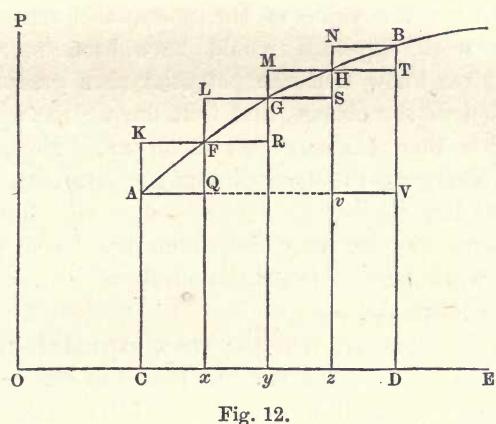
If during any electrical operation this point moves along the line AFGHB, we know not only that the charge has been increased from the value OC to the value OD, and that the potential has been increased from CA to DB, but that the charge and the potential at any instant, corresponding, say, to the point F of the curve, are represented respectively by Ox and xF.
如果在任何电操作过程中,这个点沿曲线 AFGHB 移动,那么我们不仅知道电荷已从值 OC 增大到值 OD、电势已从 CA 增大到 DB,而且还知道任何时刻(比如对应于曲线上点 F 的时刻)的电荷和电势分别由 Ox 和 xF 表示。
28. Theorem. The work expended by an external agent in bringing the increment of charge from the walls of the room to the conductor is represented by the area enclosed by the base line CD, the two vertical lines CA and DB, and the curve AFGHB.
28. 定理。外部施力者把电荷增量从房间墙壁搬到导体所耗费的功,由基线 CD、两条竖直线 CA 和 DB、以及曲线 AFGHB 所围成的面积表示。
For let CD, the increment of the charge, be divided into any number of equal parts at the points x, y, z. The value of the potential just before the application of the charge Cx is represented by AC. Hence if the potential were to remain constant during the application of the charge Cx, the work expended in charging the conductor would be represented by the product of this potential and the charge, or by the area ACxQ.
因为设 CD(电荷增量)在点 x、y、z 处被分成任意多个相等的部分。刚施加电荷 Cx 之前的电势值由 AC 表示。因此,如果在施加电荷 Cx 期间电势保持不变,那么给导体充电所耗费的功将由这个电势与电荷的乘积、即面积 ACxQ 表示。
As soon as the charge Cx has been applied the potential is xF. If this had been the value of the potential during the whole process, the work expended would have been represented by KCxF. But we know that the potential rises gradually during the application of the charge, and that during the whole process it is never less than CA or greater than xF. Hence the work expended in charging the conductor is not less than ACxQ, nor greater than KCxF.
电荷 Cx 一被施加,电势就是 xF。如果这是整个过程期间电势的值,那么所耗费的功将由 KCxF 表示。但我们知道,电势在施加电荷期间逐渐升高,并且在整个过程中它从不小于 CA,也不大于 xF。因此,给导体充电所耗费的功不小于 ACxQ,也不大于 KCxF。
In the same way we may determine the lower and higher limits of the work done during the application of any other portion of the entire charge.
用同样的方式,我们可以确定施加整个电荷的任何其他部分期间所做功的下限和上限。
We conclude, therefore, that the work expended in increasing the charge from OC to OD is not less than the area of the figure CAQFRGSHTD, nor greater than CKFLGMHNBD. The difference between these two values is the sum of the parallelograms KQ, LR, MS, NT, the breadths of which are equal, and their united height is BV. Their united area is therefore equal to that of the parallelogram NvVB.
因此我们断定,把电荷从 OC 增大到 OD 所耗费的功,不小于图形 CAQFRGSHTD 的面积,也不大于 CKFLGMHNBD 的面积。这两个值之差是平行四边形 KQ、LR、MS、NT 之和,它们的宽度相等,其总高度为 BV。因此它们的总面积等于平行四边形 NvVB 的面积。
By increasing without limit the number of equal parts into which the charge is divided, the breadth of the parallelograms will be diminished without limit. In the limit, therefore, the difference of the two values of the work vanishes, and either value becomes ultimately equal to the area CAFGHBD, bounded by the curve, the extreme ordinates, and the base line.
通过无限制地增大把电荷分成的相等部分的数目,平行四边形的宽度将无限制地减小。因此,在极限中,功的两个值之差消失,而任一个值最终都等于由曲线、两端纵坐标和基线所围成的面积 CAFGHBD。
This method of proof is applicable to any case in which the potential is always increasing or always diminishing as the charge increases. When this is not the case, the process of charging may be divided into a number of parts, in each of which the potential is either always increasing or always diminishing, and the proof applied separately to each of these parts.
这种证明方法适用于电势随电荷增大而总是升高或总是降低的任何情形。当不是这样时,可以把充电过程分成若干部分,使每一部分中电势总是升高或总是降低,然后对每一部分分别应用这种证明。
电效应的叠加Superposition of Electric Effects
29. It appears from Experiment VII that several electrified bodies placed in a hollow vessel produce each its own effect on the electrification of the vessel, in whatever positions they are placed.
29. 从实验七可以看出,放在一个空心容器中的几个带电体,无论放在什么位置,各自对容器的带电都产生其自身的效果。
From this it follows that one electric phenomenon at least, that called electrification by induction, is such that the effect of the whole electrification is the sum of the effects due to the different parts of the electrification. The different electrical phenomena, however, are so intimately connected with each other that we are led to infer that all other electrical phenomena may be regarded as composed of parts, each part being due to a corresponding part of the electrification.
由此得出,至少有一种电现象,即所谓感应起电(electrification by induction),是这样的:整个带电的效果是带电各部分所产生的效果之和。然而,各种电现象彼此联系得如此紧密,以致我们被引导去推断:所有其他电现象也都可以视为由若干部分组成的,每一部分都归因于带电的一个相应部分。
Thus if a body A, electrified in a definite manner, would produce a given potential, P, at a given point of the field, and if a body, B, also electrified in a definite manner, would produce a potential, Q, at the same point of the field, then when both bodies, still electrified as before, are introduced simultaneously into their former places in the field, the potential at the given point will be P+Q. This statement may be verified by direct experiment, but its most satisfactory verification is founded on a comparison of its consequences with actual phenomena.
因此,如果以确定方式带电的物体 A 会在场中给定点处产生给定电势 P,而以确定方式带电的物体 B 会在场中同一点处产生电势 Q,那么当两个物体(仍像之前那样带电)同时被引入它们在场中的原来位置时,给定点处的电势将是 P+Q。这个陈述可以用直接实验来验证,但它最令人满意的验证,建立在把它的推论与实际现象相比较的基础上。
As a particular case, let the electrification of every part of the system be multiplied n fold. The potential at every point of the system will also be multiplied by n.
作为一个特殊情况,设体系每一部分的带电都乘以 n 倍。体系每一点的电势也将乘以 n。
30. Let us now suppose that the electrical system consists of a number of conductors (which we shall call A₁, A₂, &c.) insulated from each other, and capable of being charged with electricity. Let the charges of these conductors be denoted by E₁, E₂, &c., and their potentials by P₁, P₂, &c.
30. 现在让我们假定,电体系由若干彼此绝缘、并能带上电荷的导体(我们称之为 A₁、A₂ 等)组成。设这些导体的电荷记为 E₁、E₂ 等,其电势记为 P₁、P₂ 等。
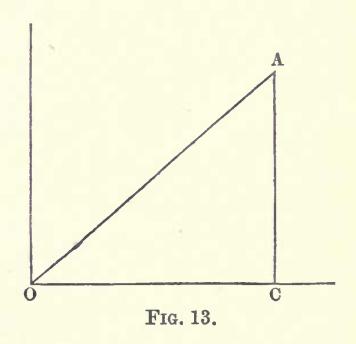
If at first the conductors are all without charge, and at potential zero, and if at a certain instant each conductor begins to be charged with electricity, so that the charge increases uniformly with the time, and if this process is continued till the charges simultaneously become E₁ for the first conductor, E₂ for the second, and so on, then since the increment of the charge of any conductor is the same for every equal interval of time during the process, the increment of the potential of each conductor will also be the same for every equal increment of time, so that the line which represents, on the indicator diagram, the succession of states of a given conductor with respect to charge and potential will be described with a velocity, the horizontal and vertical components of which remain constant during the process. This line on the diagram is therefore a straight line, drawn from the origin, which represents the initial state of the system when devoid of charge and at potential zero, to the point A₁ which indicates the final state of the conductor when its charge is E and its potential P₁, and will represent the process of charging the conductor A₁. The work expended in charging this conductor is represented by the area OCA, or half the product of the final charge E and the final potential P.
如果起初所有导体都没有电荷、处于零电势,并且在某一时刻每个导体开始带上电荷,使电荷随时间均匀增大,并且这个过程一直持续到电荷同时变为第一个导体的 E₁、第二个导体的 E₂,等等,那么由于过程中任一导体在每一相等时间间隔内的电荷增量都相同,每个导体在每一相等时间增量内的电势增量也将相同,所以在示功图上表示给定导体关于电荷与电势的连续状态的线,将以速度被描绘出来,该速度的水平分量和竖直分量在整个过程中保持不变。因此,图上的这条线是一条直线,从表示体系初始状态(无电荷、零电势)的原点,画到指示导体最终状态(电荷为 E、电势为 P₁)的点 A₁,它将表示给导体 A₁ 充电的过程。给这个导体充电所耗费的功由面积 OCA 表示,即最终电荷 E 与最终电势 P 乘积的一半。
带电体体系的能量Energy of a System of Electrified Bodies
31. When the relative positions of the conductors are fixed, the work done in charging them is entirely transformed into electrical energy. If they are charged in the manner just described, the work expended in charging any one of them is ½EP, where E represents its final charge and P its final potential. Hence the work expended in charging the whole system may be written
31. 当导体的相对位置固定时,给它们充电所做的功完全转化为电能。如果按刚才描述的方式给它们充电,给其中任一导体充电所耗费的功是 ½EP,其中 E 表示其最终电荷,P 表示其最终电势。因此,给整个体系充电所耗费的功可以写成
$$\tfrac{1}{2}E_1P_1 + \tfrac{1}{2}E_2P_2 + \&c.,$$
$$\tfrac{1}{2}E_1P_1 + \tfrac{1}{2}E_2P_2 + \ldots$$
there being as many products as there are conductors in the system. It is convenient to write the sum of such a series of terms in the form ½Σ(EP), where the symbol Σ (sigma) denotes that all the products of the form EP are to be summed together, there being one such product for each of the conductors of which the system consists.
体系中有多少个导体,就有多少个这样的乘积。把这样一系列项的和写成 ½Σ(EP) 的形式是方便的,其中符号 Σ(西格玛)表示把所有 EP 形式的乘积都加起来,体系由多少个导体组成,就有多少个这样的乘积。
Since an electrified system is subject to the law of Conservation of Energy, the work expended in charging it is entirely stored up in the system in the form of electrical energy. The value of this energy is therefore equal to that of the work which produced it, or ½Σ(EP). But the electrical energy of the system depends altogether on its actual state, and not on its previous history. Hence
由于带电体系服从能量守恒定律,给它充电所耗费的功完全以电能的形式储存于体系中。因此,这个能量的值等于产生它的功的值,即 ½Σ(EP)。但体系的电能完全取决于它的实际状态,而不是它此前的历史。因此
Theorem I. The electrical energy of a system of conductors, in whatever way they may have been charged, is half the sum of the products of the charge into the potential of each conductor.
定理一。 一个导体体系的电能,无论它们是以什么方式带电的,都等于每个导体的电荷与其电势乘积之和的一半。
We shall denote the electric energy of the system by the symbol Q, where $Q = \tfrac{1}{2} \Sigma(EP)$. (1)
我们将用符号 Q 表示体系的电能,其中 $Q = \tfrac{1}{2} \Sigma(EP)$。(1)
改变体系电荷所做的功Work done in altering the charges
32. We shall next suppose that the conductors of the system, instead of being originally without charge and at potential zero, are originally charged with quantities E₁, E₂, &c. of electricity, and are at potentials P₁, P₂, &c. respectively. When in this state let the charges of the conductors be changed, each at a uniform rate, the rate being, in general, different for each conductor, and let this process go on uniformly, till the charges have become E₁′, E₂′, &c., and the potentials P₁′, P₂′, &c. respectively.
32. 我们接下来假定,体系的导体起初并不是无电荷、零电势,而是最初带有电量 E₁、E₂ 等,并分别处于电势 P₁、P₂ 等。在此状态下,让各导体的电荷以均匀速率改变——一般说来各导体的速率不同——并让这个过程均匀地进行下去,直到电荷变为 E₁′、E₂′ 等,电势分别变为 P₁′、P₂′ 等。
By the principle of the superposition of electrical effects the increment of the potential will vary as the increment of the charge, and the potential of each conductor will increase or diminish at a uniform rate from P to P′, while its charge varies at a uniform rate from E to E′. Hence the line AA′, which represents the varying state of the conductor during the process, is the straight line which joins A, the point which indicates its original state, with A′, which represents its final state. The work spent in producing this increment of charge in the conductor is represented by the area ACC′A′, or ½CC′(CA+C′A′), or (E′−E)½(P+P′), or, in words, it is the product of the increase of charge and the half sum of the potentials at the beginning and end of the operation, and this will be true for every conductor of the system.
根据电效应叠加原理,电势的增量将随电荷的增量而变化,并且每个导体的电势将以均匀速率从 P 增大或减小到 P′,而其电荷以均匀速率从 E 变到 E′。因此,表示过程中导体变化状态的线 AA′,是连接 A(指示其原始状态的点)与 A′(表示其最终状态的点)的直线。给导体产生这个电荷增量所耗费的功,由面积 ACC′A′ 表示,即 ½CC′(CA+C′A′),或 (E′−E)½(P+P′),换句话说,它是电荷增量与操作开始和结束时电势的半和之积,这对体系的每一个导体都成立。
As, during this process, the electric energy of the system changes from Q, its original, to Q′, its final value, we may write
由于在这个过程中,体系的电能从其原始值 Q 变到其最终值 Q′,我们可以写成
$$Q' = Q + \tfrac{1}{2} \Sigma \{ (E' - E) (P' + P) \}, \dots (2)$$
$$Q' = Q + \tfrac{1}{2} \Sigma \{ (E' - E) (P' + P) \}, \dots (2)$$
hence,
因此,
Theorem II. The increment of the energy of the system is half the sum of the products of the increment of charge of each conductor into the sum of its potentials at the beginning and the end of the process.
定理二。 体系能量的增量,是每个导体的电荷增量与该导体在过程开始和结束时的电势之和的乘积之和的一半。
33. If all the charges but one are maintained constant (by the insulation of the conductors) the equation (2) is reduced to
33. 如果除一个电荷外其余所有电荷都保持不变(通过导体的绝缘),方程 (2) 就化为
$$Q' - Q = (E' - E) \tfrac{1}{2} (P' + P),$$
$$Q' - Q = (E' - E) \tfrac{1}{2} (P' + P),$$
$$\frac{Q' - Q}{E' - E} = \tfrac{1}{2} (P' + P). \qquad (3)$$
$$\frac{Q' - Q}{E' - E} = \tfrac{1}{2} (P' + P). \qquad (3)$$
If the increment of the charge is taken always smaller and smaller till it ultimately vanishes, P′ becomes equal to P and the equation may be interpreted thus:— The rate of increase of the electrical energy due to the increase of the charge of one of the conductors at a rate unity is numerically equal to the potential of that conductor.
如果电荷的增量取得越来越小、直至最终消失,P′ 就变得等于 P,方程可以这样解释:——由于某个导体的电荷以单位速率增大而导致的电能的增长率,在数值上等于该导体的电势。
In the notation of the differential calculus this result is expressed by the equation
用微积分记号,这个结果由方程表示为
$$\frac{dQ_e}{dE} = P, \dots (4)$$
$$\frac{dQ_e}{dE} = P, \dots (4)$$
in which it is to be remembered that all the charges but one are maintained constant.
其中要记住,除一个电荷外其余所有电荷都保持不变。
34. Returning to equation (2), we have already shewn that
34. 回到方程 (2),我们已经证明
$$Q = \tfrac{1}{2} \Sigma(EP) \quad \text{and} \quad Q' = \tfrac{1}{2} \Sigma(E'P'); \qquad (5)$$
$$Q = \tfrac{1}{2} \Sigma(EP) \quad \text{且} \quad Q' = \tfrac{1}{2} \Sigma(E'P'); \qquad (5)$$
we may therefore write equation (2)
因此我们可以把方程 (2) 写成
$$\tfrac{1}{2} \Sigma (E'P') = \tfrac{1}{2} \Sigma (EP) + \tfrac{1}{2} \Sigma (E'P' - EP + E'P - EP'). \dots (6)$$
$$\tfrac{1}{2} \Sigma (E'P') = \tfrac{1}{2} \Sigma (EP) + \tfrac{1}{2} \Sigma (E'P' - EP + E'P - EP'). \dots (6)$$
Cutting out from the equation the terms which destroy each other, we obtain
从方程中消去相互抵消的项,我们得到
$$\Sigma(EP') = \Sigma(E'P), \dots (7)$$
$$\Sigma(EP') = \Sigma(E'P), \dots (7)$$
or in words,
换句话说,
Theorem III. In a fixed system of conductors the sum of the products of the original charge and the final potential of each conductor is equal to the sum of the products of the final charge and the original potential.
定理三。 在一个固定的导体体系中,每个导体的原始电荷与其最终电势的乘积之和,等于其最终电荷与原始电势的乘积之和。
This theorem corresponds, in the elementary treatment of electrostatics, to Green's Theorem in the analytical theory. By properly choosing the original and the final state of the system we may deduce a number of results which we shall find useful in our afterwork.
在静电学的初等处理中,这个定理对应于解析理论中的格林定理(Green's Theorem)。通过适当地选择体系的原始状态和最终状态,我们可以推出若干在后文中会很有用的结果。
35. In the first place we may write, as before,
35. 首先我们可以像之前那样写出
$$\tfrac{1}{2} \Sigma \{ (E'-E) (P'+P) \} = \tfrac{1}{2} \Sigma (E'P'-EP+E'P-EP'); \dots (8)$$
$$\tfrac{1}{2} \Sigma \{ (E'-E) (P'+P) \} = \tfrac{1}{2} \Sigma (E'P'-EP+E'P-EP'); \dots (8)$$
adding and subtracting the equal quantities of equation (7),
加上并减去方程 (7) 的相等量,
$$O = \Sigma (EP' - E'P), \dots (9)$$
$$O = \Sigma (EP' - E'P), \dots (9)$$
and the right-hand side becomes
而右边变为
$$\tfrac{1}{2} \Sigma (E'P' - EP - E'P + EP'), \dots (10)$$
$$\tfrac{1}{2} \Sigma (E'P' - EP - E'P + EP'), \dots (10)$$
or
或
$$\tfrac{1}{2}\Sigma\{(E'-E)(P'+P)\}=Q'-Q=\tfrac{1}{2}\Sigma\{(E'+E)(P'-P)\}, (11)$$
$$\tfrac{1}{2}\Sigma\{(E'-E)(P'+P)\}=Q'-Q=\tfrac{1}{2}\Sigma\{(E'+E)(P'-P)\}, (11)$$
or in words,
换句话说,
Theorem IV. The increment of the energy of a fixed system of conductors is equal to half the sum of the products of the increment of the potential of each conductor into the sum of the original and final charges of that conductor.
定理四。 一个固定导体体系的能量增量,等于每个导体的电势增量与该导体原始电荷和最终电荷之和的乘积之和的一半。
36. If all the conductors but one are maintained at constant potentials (which may be done by connecting them with voltaic batteries of constant electromotive force), equation (11) is reduced to
36. 如果除一个导体外其余所有导体都保持恒定电势(这可以通过把它们与恒定电动势的伏打电池组相连来实现),方程 (11) 就化为
$$Q'-Q = \tfrac{1}{2}(E'+E)(P'-P), \dots (12)$$
$$Q'-Q = \tfrac{1}{2}(E'+E)(P'-P), \dots (12)$$
or
或
$$\frac{Q'-Q}{P'-P} = \tfrac{1}{2}(E'+E). \dots (13)$$
$$\frac{Q'-Q}{P'-P} = \tfrac{1}{2}(E'+E). \dots (13)$$
If the increment of the potential is taken successively smaller and smaller, till it ultimately vanishes, E′ becomes at last equal to E and the equation may be interpreted thus:— The rate of increase of the electrical energy due to the increase of potential of one of the conductors at a rate unity is numerically equal to the charge of that conductor.
如果电势的增量取得越来越小、直至最终消失,E′ 最终变得等于 E,方程可以这样解释:——由于某个导体的电势以单位速率增大而导致的电能的增长率,在数值上等于该导体的电荷。
In the notation of the differential calculus this result is expressed by the equation
用微积分记号,这个结果由方程表示为
$$\frac{dQ_p}{dP} = E, \qquad (14)$$
$$\frac{dQ_p}{dP} = E, \qquad (14)$$
in which it is to be remembered that all the potentials but one are maintained constant.
其中要记住,除一个电势外其余所有电势都保持不变。
倒易定理(定理五~七)Theorems V–VII
37. We have next to point out some of the results which may be deduced from Theorem III. If any conductor, as A_t, is insulated and without charge both in the initial and the final state, then E_t = 0 and E_t′ = 0, and therefore
37. 我们接下来要指出可以从定理三推出的一些结果。如果某个导体(比如 A_t)在初始状态和最终状态中都是绝缘且无电荷的,那么 E_t = 0 且 E_t′ = 0,因此
$$E_t P_t = 0 \quad \text{and} \quad E'_t P_t = 0, \qquad (15)$$
$$E_t P_t = 0 \quad \text{且} \quad E'_t P_t = 0, \qquad (15)$$
so that the terms depending on A_t disappear from both members of equation (7). Again, if another conductor, say A_u, be connected with the earth both in the initial and in the final state, P_u = 0 and P_{u′} = 0, so that
这样,依赖于 A_t 的项就从方程 (7) 的两端消失了。再者,如果另一个导体(比如 A_u)在初始状态和最终状态中都与大地相连,P_u = 0 且 P_{u′} = 0,所以
$$E_u P_u' = 0 \quad \text{and} \quad E_u' P_u = 0;$$
$$E_u P_u' = 0 \quad \text{且} \quad E_u' P_u = 0;$$
so that, in this case also, the terms depending on A_u disappear from both sides of equation (7). If, therefore, all the conductors with the exception of two, say A_r and A_s, are either insulated and without charge, or else connected with the earth, equation (7) is reduced to the form
所以在这种情况下,依赖于 A_u 的项也从方程 (7) 的两边消失了。因此,如果除两个导体(比如 A_r 和 A_s)外,其余所有导体要么绝缘且无电荷,要么与大地相连,方程 (7) 就化为
$$E_r P_r' + E_s P_s' = E_r' P_r + E_s' P_s. \qquad (16)$$
$$E_r P_r' + E_s P_s' = E_r' P_r + E_s' P_s. \qquad (16)$$
Let us first suppose that in the initial state all the conductors except A_r are without charge, and that in the final state all the conductors except A_s are without charge. The equation then becomes
让我们首先假定,在初始状态中除 A_r 外所有导体都无电荷,而在最终状态中除 A_s 外所有导体都无电荷。方程于是变为
$$E_r P_r' = E_s' P_s, \dots (17)$$
$$E_r P_r' = E_s' P_s, \dots (17)$$
$$\frac{P_s}{E_r} = \frac{P_r'}{E_r'},$$
$$\frac{P_s}{E_r} = \frac{P_r'}{E_r'},$$
or in words,
换句话说,
Theorem V. In a system of fixed insulated conductors, the potential (P_s) produced in A_s by a charge E communicated to A_r is equal to the potential (P_r′) produced in A_r by an equal charge E communicated to A_s.
定理五。 在一个固定的绝缘导体体系中,把电荷 E 传给 A_r 而在 A_s 中产生的电势 (P_s),等于把相等的电荷 E 传给 A_s 而在 A_r 中产生的电势 (P_r′)。
This is the first instance we have met with of the reciprocal relation of two bodies. There are many such reciprocal relations. They occur in every branch of science, and they often enable us to deduce the solution of new electrical problems from those of simpler problems with which we are already familiar. Thus, if we know the potential which an electrified sphere produces at a point in its neighbourhood, we can deduce the effect which a small electrified body, placed at that point, would have in raising the potential of the sphere.
这是我们第一次遇到两个物体的倒易关系(reciprocal relation)。这样的倒易关系有很多。它们出现在科学的每一个分支中,并且常常使我们能够从我们已经熟悉的较简单问题的解中,推出新的电学问题的解。因此,如果我们知道一个带电球在其邻近一点处产生的电势,我们就能推出放在该点处的一个小带电体会对升高球的电势产生什么效果。
38. Let us next suppose that the original potential of A_s is P_s and that all the other conductors are kept at potential zero by being connected with the walls of the room, and let the final potential of A_r be P_r, that of all the others being zero, then in equation (7) all the terms involving zero potentials will vanish, and we shall have in this case also
38. 让我们接下来假定 A_s 的原始电势是 P_s,而所有其他导体因与房间墙壁相连而保持零电势,并设 A_r 的最终电势是 P_r,所有其他导体的电势为零,那么在方程 (7) 中所有含零电势的项都将消失,在这种情况下我们同样有
$$E_r P_r' = E_s' P_s. \quad \dots \tag{18}$$
$$E_r P_r' = E_s' P_s. \quad \dots \tag{18}$$
If, therefore, P_r′ = P_s, E_r = E_s′,
因此,如果 P_r′ = P_s,则 E_r = E_s′,
Theorem VI. In a system of fixed conductors, connected, all but one, with the walls of the room, the charge (E_r) induced on A_r when A_s is raised to the potential P_s is equal to the charge (E_s′) induced on A_s when A_r is raised to an equal potential (P_r′).
定理六。 在一个除一个导体外其余都与房间墙壁相连的固定导体体系中,当 A_s 升到电势 P_s 时在 A_r 上感生的电荷 (E_r),等于当 A_r 升到相等电势 (P_r′) 时在 A_s 上感生的电荷 (E_s′)。
39. As a third case, let us suppose all the conductors insulated and without charge, and that a charge is communicated to A_r which raises its potential to P_r, and that of A_s to P_s. Next, let A_r be connected with the earth, and let a charge E_r′ on A_r induce the charge E_s′ on A_s. In equation (16) we have E_r = 0 and P_s′ = 0, so that the left-hand member vanishes and the equation becomes
39. 作为第三种情况,让我们假定所有导体都绝缘且无电荷,并把一个电荷传给 A_r,使其电势升到 P_r、A_s 的电势升到 P_s。接下来,让 A_r 与大地相连,并让 A_r 上的电荷 E_r′ 在 A_s 上感生出电荷 E_s′。在方程 (16) 中我们有 E_r = 0 且 P_s′ = 0,所以左端消失,方程变为
$$O = E_r' P_r + E_s' P_s, \qquad (20)$$
$$O = E_r' P_r + E_s' P_s, \qquad (20)$$
or
或
$$\frac{P_s}{P_r} = -\frac{E_r'}{E_s'}.$$
$$\frac{P_s}{P_r} = -\frac{E_r'}{E_s'}.$$
Hence, if
因此,如果
$$P_s = n P_r, \qquad E_r' = -n E_s', \qquad (21)$$
$$P_s = n P_r, \qquad E_r' = -n E_s', \qquad (21)$$
or in words,
换句话说,
Theorem VII. If in a system of fixed conductors insulated and originally without charge a charge be communicated to A_r which raises its potential to P_r, unity, and that of A_s to n, then if in the same system of conductors a charge unity be communicated to A_s and A_r be connected with the earth the charge induced on A_r will be −n.
定理七。 在一个固定、绝缘、且最初无电荷的导体体系中,如果把一个电荷传给 A_r,使其电势升到 P_r(取作 1),并使 A_s 的电势升到 n,那么如果在同一导体体系中把单位电荷传给 A_s、并使 A_r 与大地相连,则在 A_r 上感生的电荷将是 −n。
If, instead of supposing the other conductors A_t &c. to be all insulated and without charge, we had supposed some or all of them to be connected with the earth, the theorem would still be true, only the value of n would be different according to the arrangement we adopt.
如果不是假定其他导体 A_t 等都绝缘且无电荷,而是假定其中一些或全部与大地相连,定理仍将成立,只是 n 的值将依我们所采用的安排而不同。
This is one of Green's theorems. As an example of its application, let us suppose that we have ascertained the distribution of electric charge induced on the various parts of the surface of a conductor by a small electrified body in a given position with unit charge. Then by means of this theorem we can solve the following problem. The potential at every point of a surface coinciding in position with that of the conductor being given, determine the potential at a point corresponding to the position of the small electrified body.
这是格林定理之一。作为其应用的一个例子,让我们假定我们已经确定了:一个处于给定位置、带单位电荷的小带电体,在一个导体表面的各个部分上感生的电荷分布。那么借助这个定理,我们可以解决以下问题。已知一个与导体位置重合的面在每一点的电势,确定对应于小带电体位置的点的电势。
Hence, if the potential is known at all points of any closed surface, it may be determined for any point within that surface if there be no electrified body within it, and for any point outside if there be no electrified body outside.
因此,如果任何闭合面在所有点的电势都已知,那么如果面内没有带电体,就可以确定面内任何点的电势;如果面外没有带电体,就可以确定面外任何点的电势。
位移所做的机械功Mechanical Work during Displacement
40. Let A₁, A₂ &c. be the conductors, E₁, E₂ &c. their charges, which, as the conductors are insulated, remain constant. Let P₁, P₂ &c. be their potentials before and P₁′, P₂′ &c. their potentials after the displacement. The electrical energy of the system before the displacement is $Q = \tfrac{1}{2} \Sigma (EP)$. ... (22)
40. 设 A₁、A₂ 等为导体,E₁、E₂ 等为它们的电荷——由于导体是绝缘的,这些电荷保持不变。设 P₁、P₂ 等为它们位移前的电势,P₁′、P₂′ 等为位移后的电势。位移前体系的电能是 $Q = \tfrac{1}{2} \Sigma (EP)$。... (22)
During the displacement the electric forces which act in the same direction as the displacement perform an amount of work equal to W, and the energy remaining in the system is
在位移期间,与位移同方向作用的电力做了等于 W 的功,体系中剩余的能量是
$$Q' = \tfrac{1}{2} \Sigma (EP'). \qquad (23)$$
$$Q' = \tfrac{1}{2} \Sigma (EP'). \qquad (23)$$
The original energy, Q, is thus transformed into the work W and the final energy Q′, so that the equation of energy is
原始能量 Q 由此转化为功 W 和最终能量 Q′,所以能量方程是
$$Q = W + Q', \dots (24)$$
$$Q = W + Q', \dots (24)$$
or
或
$$W = \tfrac{1}{2} \Sigma [E(P-P')]. \qquad (25)$$
$$W = \tfrac{1}{2} \Sigma [E(P-P')]. \qquad (25)$$
This expression gives the work done during any displacement, small or large, of an insulated system. To find the force, we must make the displacement so small that the configuration of the system is not sensibly altered thereby. The ultimate value of the quotient found by dividing the work by the displacement is the value of the force resolved in the direction of the displacement.
这个表达式给出绝缘体系在任何位移(无论大小)期间所做的功。为求力,我们必须使位移小到体系的构形不因此发生可察觉的改变。用功除以位移所得商的极限值,就是力沿位移方向分解的值。
41. Let us begin by supposing each conductor of the system insulated, and that a small displacement is given to the system, by which the potential is changed from P to P₁. The work done during this displacement is, as we have shewn,
41. 让我们首先假定体系的每个导体都绝缘,并给体系一个小的位移,使电势从 P 变为 P₁。这个位移期间所做的功,正如我们已经证明的,是
$$W = \tfrac{1}{2} \Sigma [E(P - P_1)]. \qquad (26)$$
$$W = \tfrac{1}{2} \Sigma [E(P - P_1)]. \qquad (26)$$
Next, let the conductors remain fixed while the charges of the conductors are altered from E to E₁, so as to bring back the value of the potential from P₁ to P. Then we know by equation (7) that
接下来,让导体保持不动,而把导体的电荷从 E 变为 E₁,以便把电势的值从 P₁ 带回 P。那么由方程 (7) 我们知道
$$\Sigma (EP - E_1 P_1) = 0. \qquad (27)$$
$$\Sigma (EP - E_1 P_1) = 0. \qquad (27)$$
Hence, substituting for Σ(EP) in (26),
因此,代入 (26) 中的 Σ(EP),
$$W = \tfrac{1}{2} \Sigma [(E_1 - E)P_1]. \qquad (28)$$
$$W = \tfrac{1}{2} \Sigma [(E_1 - E)P_1]. \qquad (28)$$
Performing these two operations alternately for any number of times, and distinguishing each pair of operations by a suffix, we find the whole work
把这两个操作交替地重复任意多次,并用下标区分每一对操作,我们发现总功是
$$W = W_1 + W_2 + \&c. \quad (29)$$
$$W = W_1 + W_2 + \ldots \quad (29)$$
$$= \tfrac{1}{2} \Sigma \left[ (E_1 - E) P_1 \right] + \tfrac{1}{2} \Sigma \left[ (E_2 - E_1) P_2 \right] + \&c. \quad \dots (30)$$
$$= \tfrac{1}{2} \Sigma \left[ (E_1 - E) P_1 \right] + \tfrac{1}{2} \Sigma \left[ (E_2 - E_1) P_2 \right] + \ldots \quad \dots (30)$$
By making each of the partial displacements small enough, the values of P₁, P₂ &c. may be made to approach without limit to P, the constant value of the potential, and the expression becomes
通过把每个部分位移取得足够小,P₁、P₂ 等的值可以无限制地接近电势的恒定值 P,表达式变为
$$W = \tfrac{1}{2} \Sigma [(E_1 - E)P] + \tfrac{1}{2} \Sigma [(E_2 - E_1)P] + \&c. + \tfrac{1}{2} \Sigma [(E' - E_{n-1})P], (31)$$
$$W = \tfrac{1}{2} \Sigma [(E_1 - E)P] + \tfrac{1}{2} \Sigma [(E_2 - E_1)P] + \ldots + \tfrac{1}{2} \Sigma [(E' - E_{n-1})P], (31)$$
where E′ is the value of E after the last operation. The final result is therefore
其中 E′ 是最后一次操作后 E 的值。因此最终结果是
$$W = \tfrac{1}{2} \Sigma [(E' - E)P], \dots (32)$$
$$W = \tfrac{1}{2} \Sigma [(E' - E)P], \dots (32)$$
which is an expression giving the work done during a displacement of any magnitude of a system of conductors, the potential of each of which is maintained constant during the displacement.
这是一个给出导体体系在任意大小的位移期间所做功的表达式,其中每个导体的电势在位移期间保持不变。
We may write this result
我们可以把这个结果写成
$$W = \tfrac{1}{2} \Sigma(E'P) - \tfrac{1}{2} \Sigma(EP), \qquad (33)$$
$$W = \tfrac{1}{2} \Sigma(E'P) - \tfrac{1}{2} \Sigma(EP), \qquad (33)$$
$$W = Q' - Q; \qquad (34)$$
$$W = Q' - Q; \qquad (34)$$
or the work done by the electric forces is equal to the increase of the electric energy of the system during the displacement when the potential of each conductor is maintained constant. When the charge of each conductor was maintained constant, the work done was equal to the decrease of the energy of the system.
即当每个导体的电势保持不变时,电力所做的功等于体系在位移期间电能的增量。当每个导体的电荷保持不变时,所做的功等于体系能量的减少量。
Hence, when the potential of each conductor is maintained constant during a displacement in which a quantity of work, W, is done, the voltaic batteries which are employed to keep the potentials constant must do an amount of work equal to 2W. Of this energy supplied to the system, half is spent in increasing the energy of the system, and the other half appears as mechanical work.
因此,当每个导体的电势在一个做了功 W 的位移期间保持不变时,用来保持电势不变的伏打电池组必须做等于 2W 的功。在供给体系的这份能量中,一半用于增大体系的能量,另一半表现为机械功。
第四章 · 电场Chapter IV — The Electric Field
电场The Electric Field
42. We have seen that, when an electrified body is enclosed in a conducting vessel, the total electrification of the interior surface of the surrounding vessel is invariably equal in numerical value but opposite in kind to that of the body. This is true, however large this vessel may be. It may be a room of any size having its floor, walls and ceiling of conducting matter. Its boundaries may be removed further, and may consist of the surface of the earth, of the branches of trees, of clouds, perhaps of the extreme limits of the atmosphere or of the universe. In every case, wherever we find an electrified insulated body, we are sure to find at the boundaries of the insulating medium, wherever they may be, an equal amount of electrification of the opposite kind.
42. 我们已经看到,当一个带电体被封闭在一个导体容器内时,周围容器内表面的总带电,在数值上始终等于该物体的带电,而在种类上与其相反。无论这个容器多大,这都是成立的。它可以是一个任意大小的房间,其地板、墙壁和天花板由导电物质构成。它的边界还可以移得更远,可以由地球表面、树枝、云、也许是大气的极限或宇宙的极限构成。在每一种情况下,无论我们在哪里发现一个带电的绝缘体,我们都必定会在绝缘介质的边界(无论它们在哪里)处发现等量的、种类相反的带电。
This correspondence of properties between the two limits of the insulating medium leads us to examine the state of this medium itself, in order to discover the reason why the electrification at its inner and outer boundaries should be thus related. In thus directing our attention to the state of the insulating medium, rather than confining it to the inner conductor and the outer surface, we are following the path which led Faraday to many of his electrical discoveries.
绝缘介质两个极限之间性质的这种对应关系,引导我们去考察这个介质本身的状态,以便发现其内外边界处的带电为何应如此相关联的原因。通过这样把注意力引向绝缘介质的状态、而不是把它局限于内部导体和外表面,我们正沿着把法拉第引向他的许多电学发现的道路前进。
43. To render our conceptions more definite, we shall begin by supposing a conducting body electrified positively and insulated within a hollow conducting vessel. The space between the body and the vessel is filled with air or some other insulating medium. We call it an insulating medium when we regard it simply as retaining the charge on the surface of the electrified body. When we consider it as taking an important part in the manifestation of electric phenomena we shall use Faraday's expression, and call it a dielectric medium. Finally, when we contemplate the region occupied by the medium as being a part of space in which electric phenomena may be observed, we shall call this region the Electric Field. By using this last expression we are not obliged to figure to ourselves the mode in which the dielectric medium takes part in the phenomena. If we afterwards wish to form a theory of the action of the medium, we may find the term dielectric useful.
43. 为了使我们的概念更加明确,我们首先假定一个带正电的导体被绝缘在一个空心导体容器内。物体与容器之间的空间充满了空气或某种其他绝缘介质。当我们仅仅把它视为把电荷保持在带电体表面上的物质时,我们称之为绝缘介质(insulating medium)。当我们把它视为在电现象的表现中起重要作用时,我们将使用法拉第的说法,称之为介电介质(dielectric medium)。最后,当我们把介质所占据的区域视为可以观察电现象的空间的一部分时,我们把这个区域称为电场(Electric Field)。通过使用最后这个说法,我们不必在头脑中设想介电介质参与现象的方式。如果此后我们想建立介质作用的理论,我们会发现「介电」这个词是有用的。
实验十一~十二 · 电场的探查Exploration of the Electric Field
44. (a) Exploration by means of a small electrified body. Electrify a small round body, a gilt pith ball, for example, and carry it by means of a white silk thread into any part of the field. If the ball is suspended in such a way that the tension of the string exactly balances the weight of the ball, then when the ball is placed in the electric field it will move under the action of a new force developed by the action of the electrified ball on the electric condition of the field. This new force tends to move the ball in a certain direction, which is called the direction of the electromotive force.
44. (a)用一个小带电体探查。使一个小圆体(例如镀金髓球)带电,并用一根白色丝线把它带到场中的任何部位。如果这样悬挂球:线的张力恰好与球的重量平衡,那么当球被放入电场时,它将在由带电球对场的电状态的作用所产生的一个新力的作用下运动。这个新力趋向于沿某个确定的方向移动球,这个方向称为电动势的方向。
If the charge of the ball is varied, the force is sensibly proportional to the charge, provided this charge is not sufficient to produce a sensible disturbance of the state of electrification of the system. If the charge is positive, the force which acts on the ball is, on the whole, from the positively electrified body, and towards the negatively electrified walls of the room. If the charge is negative, the force acts in the opposite direction.
如果球的电荷改变,力与电荷成可察觉的正比,只要这个电荷不足以对体系的带电状态产生可察觉的扰动。如果电荷为正,作用在球上的力总的来说是从带正电的物体出发、朝向房间带负电的墙壁。如果电荷为负,力沿相反方向作用。
Since, therefore, the force which acts on the ball depends partly on the charge of the ball and partly on its position and on the electrification of the system, it is convenient to regard this force as the product of two factors, one being the charge of the ball, and the other the electromotive force at that point of the field which is occupied by the centre of the ball. This electromotive force at the point is definite in magnitude and direction. A positively charged body placed there tends to move in the positive direction of the line representing the force. A negatively charged body tends to move in the opposite direction.
因此,由于作用在球上的力部分取决于球的电荷、部分取决于它的位置和体系的带电,把这种力视为两个因子的乘积是方便的,一个是球的电荷,另一个是球心所占据的场中那一点的电动势。该点处的电动势在大小和方向上都是确定的。放在那里的带正电物体趋向于沿表示该力的线的正方向运动。带负电物体趋向于沿相反方向运动。
45. (b) Exploration by means of two disks. But the electromotive force not only tends to move electrified bodies, it also tends to transfer electrification from one part of a body to another. Take two small equal thin metal disks, fastened to handles of shellac or ebonite; discharge them and place them face to face in the electric field, with their planes perpendicular to the direction of the electromotive force. Bring them into contact, then separate them and remove them, and test first one and then the other by introducing them into the hollow vessel of Experiment VII. It will be found that each is charged, and that if the electromotive force acts in the direction AB, the disk on the side of A will be charged negatively, and that on the side of B positively.
45. (b)用两个圆盘探查。但电动势不仅趋向于移动带电体,它还趋向于把带电从一个物体的一部分转移到另一部分。取两个小的、相等的薄金属圆盘,固定在虫胶或硬橡胶手柄上;把它们放电,并把它们面对面地放在电场中,使它们的平面垂直于电动势的方向。使它们接触,然后分开并移开,再把它们逐一放入实验七的空心容器中来检验。会发现每个都带电,而且如果电动势沿方向 AB 作用,A 侧的圆盘将带负电,B 侧的圆盘将带正电。
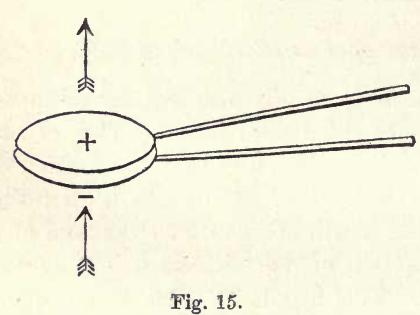
the numerical values of these charges being equal. This shews that there has been an actual transference of electricity from the one disk to the other, the direction of this transference being that of the electromotive force. This experiment with two disks affords a much more convenient method of measuring the electromotive force at a point than the experiment with the charged pith ball. The measurement of small forces is always a difficult operation, and becomes almost impossible when the weight of the body acted on forms a disturbing force and has to be got rid of by the adjustment of counterpoises. The measurement of the charges of the disks, on the other hand, is much more simple.
这些电荷的数值相等。这表明有电荷从一圆盘实际转移到了另一圆盘,这个转移的方向就是电动势的方向。这个用两个圆盘的实验,提供了一种比用带电髓球的实验方便得多的测量一点处电动势的方法。小力的测量总是一项困难的操作,当被作用物体的重量构成干扰力、并不得不通过调整配重来消除时,几乎变得不可能。另一方面,圆盘电荷的测量要简单得多。
The two disks, when in contact, may be regarded as forming a single disk, and the fact that when separated they are found to have received equal and opposite charges, shews that while the disks were in contact there was a distribution of electrification between them, the electrification of each disk being opposite to that of the body next to it, whether the insulated body, which is charged positively, or the inner surface of the surrounding vessel, which is charged negatively.
两个圆盘接触时可以视为形成一个单一的圆盘;它们分开时被发现获得相等且相反的电荷这一事实表明,圆盘接触期间它们之间存在着带电的分布,每个圆盘的带电都与它旁边的物体相反——无论是带正电的绝缘体,还是带负电的周围容器内表面。
电张力Electric Tension
46. The two disks, after being brought into contact, tend to separate from each other, and to approach the oppositely electrified surfaces to which they are opposed. The force with which they tend to separate is proportional to the area of the disks, and it increases as the electromotive force increases, not, however, in the simple ratio of that force, but in the ratio of the square of the electromotive force.
46. 两个圆盘在被带到一起接触之后,趋向于彼此分开,并趋向于接近它们所对向的带相反电的表面。它们趋向于分开的力与圆盘的面积成正比,并且它随电动势增大而增大,但不是与那个力成简单正比,而是与电动势的平方成正比。
The electrification of each disk is proportional to the electromotive force, and the mechanical force on the disk is proportional to its electrification and the electromotive force conjointly, that is, to the square of the electromotive force.
每个圆盘的带电与电动势成正比,而圆盘上的机械力与其带电和电动势两者联合成正比,即与电动势的平方成正比。
This force may be accounted for if we suppose that at every point of the dielectric at which electromotive force exists there is a tension, like the tension of a stretched rope, acting in the direction of the electromotive force, this tension being proportional to the square of the electromotive force at the point. This tension acts only on the outer side of each disk, and not on the side which is turned towards the other disk, for in the space between the disks there is no electromotive force, and consequently no tension.
如果我们假定,在介电体中存在电动势的每一点处,都有一个像张紧的绳子的张力那样的张力,沿电动势方向作用,这个张力与该点处电动势的平方成正比,那么就可以解释这个力。这个张力只作用在每个圆盘的外侧,而不作用在朝向另一圆盘的一侧,因为在圆盘之间没有电动势,因而没有张力。
The expression Electric Tension has been used by some writers in different senses. In this treatise we shall always use it in the sense explained above,—the tension of so many pounds' or grains' weight on the square foot exerted by the air or other dielectric medium in the direction of the electromotive force.
「电张力」(Electric Tension)这一说法曾被某些作者以不同的含义使用。在本论著中,我们将始终按上述含义使用它——即空气或其他介电介质沿电动势方向在每平方英尺上施加的若干磅或格令重量的张力。
实验十三 · 库仑验电板Coulomb's Proof Plane
47. If one of these disks be placed with one of its flat surfaces in contact with the surface of an electrified conductor and then removed, it will be found to be charged. If the disk is very thin, and if the electrified surface is so nearly flat that the whole surface of the disk lies very close to it, the charge of the disk will be nearly equal to that of the portion of the electrified surface which it covered. If the disk is thick, or does not lie very close to the electrified surface, its charge, when removed, will be somewhat greater.
47. 如果把这些圆盘中的一个以其一个平表面与带电导体的表面接触、然后移开,会发现它带上了电荷。如果圆盘非常薄,并且带电表面近乎平坦,使圆盘的整个表面都非常贴近它,那么圆盘的电荷将几乎等于它所覆盖的带电表面那部分的电荷。如果圆盘厚,或不非常贴近带电表面,那么它移开时的电荷会略大一些。
This method of ascertaining the density of electrification of a surface was introduced by Coulomb, and the disk when used for this purpose is called Coulomb's Proof Plane. The charge of the disk is by Experiment XII proportional to the electromotive force at the electrified surface. Hence the electromotive force close to a conducting surface is proportional to the density of the electrification at that part of the surface.
这种确定表面带电密度的方法是由库仑引入的,用于此目的的圆盘称为库仑验电板(Coulomb's Proof Plane)。由实验十二,圆盘的电荷与带电表面处的电动势成正比。因此,紧靠导体表面的电动势与该部分表面的带电密度成正比。
Since the surface of the conductor is an equipotential surface, the electromotive force is perpendicular to it. The fact that the electromotive force at a point close to the surface of a conductor is perpendicular to the surface and proportional to the density of the electrification at that point was first established experimentally by Coulomb, and it is generally referred to as Coulomb's Law.
由于导体的表面是等势面,电动势垂直于它。紧靠导体表面的点处的电动势垂直于表面、并与该点带电密度成正比这一事实,最初是由库仑通过实验确立的,通常被称为库仑定律(Coulomb's Law)。
To prove that when the proof plane coincides with the surface of the conductor the charge of the proof plane when removed from the electrified conductor is equal to the charge on the part of the surface which it covers, we may make the following experiment. A sphere whose radius is 5 units is placed on an insulating stand. A segment of a thin spherical shell is fastened to an insulating handle. The radius of the spherical surface of the shell is 5, the diameter of the circular edge of the segment is 8, and the height of the segment is 2. When applied to the sphere it covers one-fifth part of its surface. A second sphere, whose radius is also 5, is placed on an insulating handle.
为证明当验电板与导体表面重合时、验电板从带电导体上移开后的电荷等于它所覆盖部分表面的电荷,我们可以做如下实验。一个半径为 5 单位的球放在绝缘座上。一片薄球壳的球冠固定在绝缘手柄上。壳的球面半径是 5,球冠圆形边缘的直径是 8,球冠的高度是 2。当把它放到球上时,它覆盖球表面的五分之一。第二个球(半径也是 5)放在绝缘手柄上。
The first sphere is electrified, the segment is then placed in contact with it and removed. The second sphere is then made to touch the first sphere, removed and discharged, and then made to touch the first sphere again. The segment is then placed within a conducting vessel, which is discharged to earth, and then insulated and the segment removed. One of the spheres is then made to touch the outside of the vessel, and is found to be perfectly discharged.
第一个球带电,然后把球冠放到与它接触再移开。然后让第二个球接触第一个球,移开并放电,再让第二个球接触第一个球。然后把球冠放进一个对地放电、然后绝缘的导体容器内,并移开球冠。然后让其中一个球接触容器外面,会发现它被完全放电。
Let e be the electrification of the first sphere, and let the charge removed by the segment be ne, then the charge remaining on the sphere is (1−n)e. The charge of the first sphere is then divided with the second sphere, and becomes ½(1−n)e. The second sphere is then discharged, and the charge is again divided, so that the charge on either sphere is ¼(1−n)e. The charge on the insulated vessel is equal and opposite to that on the segment, and it is therefore −ne, and this is perfectly neutralized by the charge on one of the spheres; hence ¼(1−n)e+(−ne)=0, from which we find n = 1/5, or the electricity removed by the segment covering one-fifth of the surface of the sphere is one-fifth of the whole charge of the sphere.
设 e 为第一个球的带电,设球冠移走的电荷为 ne,那么球上剩余的电荷是 (1−n)e。第一个球的电荷然后与第二个球平分,变为 ½(1−n)e。第二个球然后放电,电荷再次平分,使任一球上的电荷为 ¼(1−n)e。绝缘容器上的电荷与球冠上的电荷大小相等、符号相反,因此它是 −ne,而这被其中一个球上的电荷完全中和;因此 ¼(1−n)e+(−ne)=0,由此我们求得 n = 1/5,即覆盖球面五分之一的球冠移走的电荷是球全部电荷的五分之一。
实验十四~十六Experiments XIV–XVI
48. Direction of Electromotive Force at a Point. A convenient way of determining the direction of the electromotive force is to suspend a small elongated conductor with its middle point at the given point of the field. The two ends of the short conductor will become oppositely electrified, and will then be drawn in opposite directions by the electromotive force, so that the axis of the conductor will place itself in the direction of the force at that point. A short piece of fine cotton or linen thread, through the middle of which a fine silk fibre is passed, answers very well. The silk fibre, held by both ends, serves to carry the piece of thread into any desired position, and the thread then takes up the direction of the electric force at that place.
48. 一点处电动势的方向。确定电动势方向的一个方便办法,是悬挂一个小而细长的导体,使其中点在场中的给定点处。短导体的两端将带上相反的电荷,然后被电动势沿相反方向拉动,使导体的轴把它自己摆到该点处力的方向上。一小段细棉线或亚麻线,中间穿过一根细丝纤维,十分合用。用两端拉住的丝纤维把这小段线带到任何所需的位置,线然后就会取该处电力的方向。
49. Potential at any Point of the Field. Suspend two small uncharged metal balls in the field by silk threads, and then connect them by means of a fine metal wire fastened to the end of an ebonite rod. Remove the wire and the spheres separately, and then examine the charges of the spheres.
49. 场中任一点的电势。用丝线在场中悬挂两个小的不带电金属球,然后用一根固定在硬橡胶棒末端的细金属线把它们连接起来。分别移去金属线和球,然后检验球的电荷。
It will be found that the two spheres, if they have become electrified, have received equal and opposite charges. If the potentials at the points of the field occupied by the centres of the spheres are different, positive electrification will be transferred from the place of high to the place of low potential, and the sphere at the place of high potential will thus become charged negatively, and that at the place of low potential will become charged positively. These charges may be shewn to be proportional to the difference of potentials at the two places.
会发现两个球(如果它们已经带电)获得了相等且相反的电荷。如果球心所占据的场中两点处的电势不同,正电荷将从高电势处转移到低电势处,因此高电势处的球将带负电,低电势处的球将带正电。可以证明这些电荷与两处电势之差成正比。
We have thus a method of determining points of the field at which the potential is the same. Place one of the spheres at a fixed point, and move the other about till, on connecting the spheres with a wire as before, no charge is found on either sphere. The potentials of the field at the points occupied by the centres of the spheres must now be the same. In this way a number of points may be found, the potential at each of which is equal to that at a given point.
这样我们就有了确定场中电势相同的点的方法。把一个球放在固定点,移动另一个球,直到像之前那样用金属线连接两球时,两个球上都没有电荷。球心所占据的场中两点处的电势现在必定相同。用这种方法可以找到许多点,每个点的电势都等于给定点的电势。
All these points lie on a certain surface, which is called an equipotential surface. On one side of this surface the potential is higher, on the other it is lower, than at the surface itself. We have seen that electricity has no tendency to flow from one part of such a surface to another. An electrified body, if constrained so as to be capable of moving only from one point of the surface to another, would be in equilibrium, and the force acting on such a body is therefore everywhere perpendicular to the equipotential surface.
所有这些点都位于某个表面上,这个表面称为等势面(equipotential surface)。这个表面的一侧电势高于表面本身,另一侧低于表面本身。我们已经看到,电没有从这种表面的一部分流向另一部分的趋势。一个带电体,如果被约束得只能从表面上的一点移到另一点,就会处于平衡,因此作用在这种物体上的力处处垂直于等势面。
50. We may use one sphere only, and after placing it with its centre at any given point of the field we may touch it for a moment with a wire connected to the earth. We may then remove the sphere and determine its charge. The charge of the sphere is proportional to the potential at the given point, a positive charge, however, corresponding to a negative potential.
50. 我们可以只用一球,把它的中心放在场中任一给定点之后,用一根与大地相连的金属线触碰它片刻。然后可以移开球并确定它的电荷。球的电荷与给定点处的电势成正比,不过正电荷对应于负电势。
等势面Equipotential Surfaces
51. In this way the potential at any number of points in the field may be ascertained, and equipotential surfaces may be supposed drawn corresponding to values of the potential represented by the numbers 1, 2, 3, &c.
51. 用这种方法可以确定场中任意多个点的电势,并可以设想画出等势面,对应于由数字 1、2、3 等表示的电势值。
These surfaces will form a series, each, in general, lying within the preceding surface and having the succeeding surface within it. No two distinct surfaces can intersect each other, though a particular equipotential surface may consist of two or more sheets, intersecting each other at certain lines or points.
这些表面将形成一个系列,一般说来,每个表面都位于前一个表面之内,并把后一个表面包含在它之内。任意两个不同的表面不能相交,尽管一个特定的等势面可以由两个或更多的叶组成,它们在一定的线或点处相交。
The surface of any conductor in electric equilibrium is an equipotential surface. For if the potential at one point of the conductor is different from that at another point, electricity will flow from the place of higher potential to the place of lower potential till the potentials are rendered equal.
任何处于电平衡的导体的表面都是等势面。因为如果导体一点的电势与另一点的电势不同,电就会从高电势处流向低电势处,直到电势相等。
52. To make an experimental determination of the equipotential surfaces belonging to an electrified system we may use a small exploring sphere permanently connected by a fine wire with one electrode of the electroscope, the other electrode being connected with the earth. Place the centre of the sphere at a given point, and connect the electrodes together for an instant. The indication of the electroscope will thus be reduced to zero. If the sphere is now moved in such a manner that the indication of the electrometer remains zero during the motion, the path of the centre of the exploring sphere will lie on an equipotential surface. For if it moves to a place of higher potential, electricity will flow from the sphere to the electroscope, and if it moves to a place of lower potential, electricity will flow from the electroscope to the sphere.
52. 要用实验确定一个带电体系所属的等势面,我们可以用一个小的探查球,它用一根细金属线永久地与验电器的一个电极相连,另一个电极与大地相连。把球心放在给定点,并把两个电极连接片刻。验电器的指示将因此降到零。如果现在移动球时,验电器的指示在运动期间保持为零,那么探查球中心的路径将位于一个等势面上。因为如果它移到较高电势处,电就从球流向验电器,如果它移到较低电势处,电就从验电器流向球。
If the bodies belonging to the electrified system are not perfectly insulated, their potentials and the potentials of the points of the field will tend to approach zero. The path in which the centre of the exploring sphere moves is such that its potential at any point has a given value at the time when the centre of the sphere passes it. The different points of the path are not therefore on a surface which has the same potential at any one instant, for the potential is diminishing everywhere, and the path must therefore pass from surfaces of lower to surfaces of higher potential so as to make up for this loss.
如果属于带电体系的物体不是完全绝缘的,它们的电势和场中各点的电势将趋向于接近零。探查球中心所运动的路径是这样的:当球心经过它时,该路径上任一点的电势在那一时刻具有给定值。因此,路径的不同点并不在任一时刻都具有相同电势的表面上,因为电势处处在减小,所以路径必须从较低电势的面经过到较高电势的面,以弥补这种损失。
53. The following method, founded on Theorem V, Art. 37, is therefore in many cases more convenient, as it is much easier to secure good insulation for the exploring sphere on an insulating handle than for a large electrified conductor of irregular form. Let it be required to determine the equipotential surfaces due to the electrification of the conductor C placed on an insulating stand. Connect the conductor with one electrode of the electroscope, the other being connected with the earth. Electrify the exploring sphere, and, carrying it by the insulating handle, bring its centre to a given point. Connect the electrodes for an instant, and then move the sphere in such a path that the indication of the electroscope remains zero. This path will lie on an equipotential surface.
53. 以下方法以第 37 条定理五为基础,因此在许多情况下更方便,因为为绝缘手柄上的探查球保证良好绝缘,比为形状不规则的大带电导体保证良好绝缘容易得多。设需要确定放在绝缘座上的导体 C 的带电所产生的等势面。把导体与验电器的一个电极相连,另一个电极与大地相连。使探查球带电,拿着绝缘手柄,把它的中心带到给定点。把电极连接片刻,然后沿使验电器指示保持为零的路径移动球。这条路径将位于等势面上。
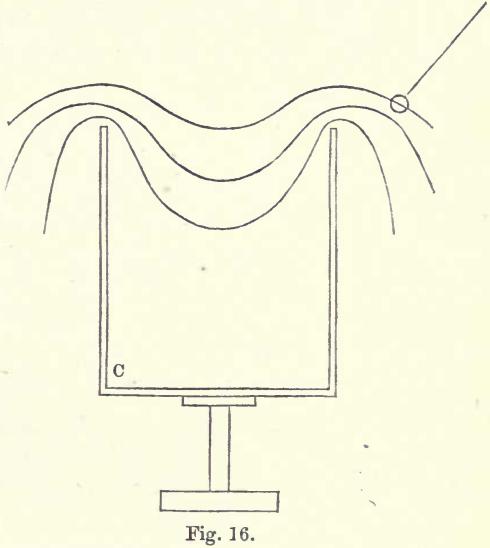
For by Theorem V, the part of the potential of the conductor C due to the presence of the charged exploring sphere with its centre at a given point is equal to the potential at the given point due to a charge on the conductor C equal to that of the exploring sphere.
因为由定理五,由于中心在给定点处的带电探查球的存在而产生的导体 C 的电势的一部分,等于由于导体 C 上等于探查球电荷的电荷而在给定点处产生的电势。
By this method the potential of the conductor remains zero, or very nearly zero, during the whole time of the experiment, so that there is very little tendency to change of the charge of this body. The exploring sphere, on the other hand, is at a high potential, but as it is not connected by a wire with any other body, its insulation may be made very good.
用这种方法,导体的电势在整个实验期间保持为零、或几乎为零,因此这个物体电荷改变的趋势非常小。另一方面,探查球处于高电势,但由于它没有用金属线与任何其他物体相连,它的绝缘可以做得非常好。
电力线Lines of Electric Force
54. If the direction of the electric force at various points of the field be determined, and if a line be drawn so that its direction at every point of its course coincides with the direction of the electric force at that point, such a line is called a Line of Force. By drawing a number of such lines, the direction of the force at different parts of the field may be indicated.
54. 如果确定了场中不同点处电力的方向,并且画一条线,使它在其路径的每一点处的方向都与该点处电力的方向一致,这样的线称为电力线(Line of Force)。通过画若干条这样的线,可以指示场中不同部分力的方向。
The lines of force and equipotential surfaces may be drawn, not in the electric field itself, where the mechanical operation of drawing them might produce disturbance, but in a model or plan of the electric field. Drawings of this kind are given in Plates I to VI at the end of the volume.
电力线和等势面可以画在电场的模型或平面图上,而不是画在电场本身中(在那里画它们的机械操作可能产生扰动)。这类图在卷末的图版 I 到 VI 中给出。
Since the electric force is everywhere perpendicular to the equipotential surfaces, the lines of force cut these surfaces everywhere at right angles. The lines of force which meet the surface of a conductor are therefore at right angles to it. When they issue from the surface the electrification is positive, and when they enter the surface of the conductor the electrification is negative.
由于电力处处垂直于等势面,电力线处处与这些表面成直角相交。因此,与导体表面相遇的电力线垂直于它。当它们从表面发出时,带电为正;当它们进入导体表面时,带电为负。
A line of force in every part of its course passes from places of higher to places of lower potential.
电力线在其路径的每一部分都从高电势处通向低电势处。
The extremities of the same line of force are called corresponding points. The beginning of the line is a point on a positively electrified surface, and the end of the line is a corresponding point on a negatively electrified surface.
同一条电力线的两端称为对应点(corresponding points)。线的起点是带正电表面上的点,线的终点是带负电表面上的对应点。
The potential of the first of these surfaces must be higher than that of the second.
前一个表面的电势必定高于后一个表面。
第五章 · 法拉第的感应线定律Chapter V — Faraday's Law of Lines of Induction
感应线与感应管Lines and Tubes of Induction
55. FARADAY in his electrical researches employs the lines of force to indicate, not only the direction of the electric force at each point of the field, but also the quantity of electrification on any given portion of the electrified surface.
55. 法拉第在他的电学研究中使用电力线,不仅指示场中每一点电力的方向,而且指示带电表面任一给定部分的带电量。
If we consider a portion of an electrified surface as cut off from the rest by the bounding line which surrounds it, and if from every point of this bounding line we draw a line of force, producing it till it meets the surface of some other body in a point which is said to correspond to the point of the body from which the line was drawn, these lines will form a tubular surface, and will cut off a certain portion from the surface of the other body corresponding to the portion of the surface of the first body, and the total electrifications of the two corresponding portions are equal in numerical magnitude but opposite in kind.
如果我们考虑带电表面的一部分,它被围绕它的边界线从其余部分切下;并且如果从这条边界线的每一点画一条电力线,把它延长,直到它与某个其他物体的表面相交于一个被称为与该线所从画出的点「对应」的点,那么这些线将形成一个管状面,并从另一物体的表面切下与第一个物体表面部分相对应的一定部分,两个相对应部分的总带电在数值上相等、在种类上相反。
56. A particular instance of Faraday's law is that which we have already proved by experiment, namely, that the electrification of the inner surface of a closed conducting vessel is equal and opposite to that of an electrified body placed within it. Here we have a relation between the whole electrification of the inner surface and that of the opposed surface of the interior body. Faraday's law asserts that, by drawing lines of force from the one surface to the other, points corresponding to each other in the two surfaces may be found; that corresponding lines are such that any point of one has its corresponding point in the other; and that the electrifications of the two portions of the opposed surfaces bounded by such corresponding lines are equal and opposite.
56. 法拉第定律的一个特例是我们已经用实验证明的:一个封闭导体容器内表面的带电,与放在其中的带电体的带电大小相等、符号相反。这里我们有了内表面整体带电与内部物体相对表面带电之间的关系。法拉第定律断言:通过从一个表面向另一个表面画电力线,可以找到两个表面中彼此对应的点;对应线是这样的——一个表面的任何点都在另一表面中有其对应点;由这种对应线所界定的两个相对表面部分的带电大小相等、符号相反。
57. We have called these lines 'lines of force' because we began by defining them as lines whose direction at every point coincides with that of the electric force. Every line of force begins at a positively electrified surface and ends at a negatively electrified surface, and the points of these surfaces at which it begins and ends are called corresponding points.
57. 我们把这些线称为「电力线」,因为我们一开始就把它们定义为方向在每一点都与电力方向一致的线。每条电力线都始于带正电的表面、终于带负电的表面,而它起始和终止的表面上的点称为对应点(corresponding points)。
A system of lines of force forming a tubular surface closed at the one end by a portion of the positively electrified surface and at the other by the corresponding portion of the negative surface, is called by Faraday a Tube of Induction, because electric induction, according to Faraday, is that condition of the dielectric by which the electrifications of the opposed surfaces are placed in that physical relation to one another, which we express by saying that their electrifications are equal and opposite.
一个电力线体系形成一个管状面,一端由带正电表面的一部分封闭、另一端由负电表面的相应部分封闭,法拉第称之为感应管(Tube of Induction),因为根据法拉第,电感应是介电体的一种状态,它使相对表面的带电彼此处于我们所说的「大小相等、符号相反」的物理关系中。
元胞与能量Cells and Energy
58. (1) The electrification of the portion of the positively electrified surface from which the tube of induction proceeds is equal in numerical value but opposite in sign to the negative electrification of the portion of the surface at which the tube of induction terminates. By dividing the positive surface into portions, the electrification of each of which is unity, and drawing tubes corresponding to each portion, we obtain a system of unit tubes, which will be very convenient in describing electric phenomena. For in this case the electrification of any surface is measured by the number of tubes which abut on it. If they proceed from the surface, this number is to be taken as representing the positive electrification; if the tubes terminate at the surface, the electrification is negative.
58. (1)感应管所从出发的带正电表面部分的带电,在数值上等于、在符号上相反于感应管所终止的表面部分的负电。通过把正电表面分成每一部分的带电都为 1 的部分,并画出对应于每一部分的管,我们就得到了一个单位管(unit tubes)体系,它在描述电现象时会非常方便。因为在这种情况下,任何表面的带电都由邻接在它上面的管的数目来量度。如果它们从表面发出,这个数目就取作表示正电;如果管终止于表面,则带电为负。
It is in this sense that Faraday so often speaks of the number of lines of force which fall on a given area. If we suppose an imaginary surface drawn in the electric field, then the quantity of electrostatic induction through this surface is measured by the number of tubes of induction which pass through it, and is reckoned positive or negative accordingly as the tubes pass through it in the positive or negative direction.
法拉第常常正是在这个意义上谈论落在给定面积上的电力线的数目。如果我们设想在电场中画一个虚设面,那么通过这个面的静电感应量,由穿过它的感应管的数目来量度,并且依管沿正方向还是负方向穿过它而为正或为负。
Note. By an imaginary surface is meant a surface which has no physical existence, but which may be imagined to exist in space without interfering with the physical properties of the substance which occupies that space. Thus we may imagine a vertical plane dividing a man's head longitudinally into two equal parts, and by means of this imaginary surface we may render our ideas of the form of his head more precise, though any attempt to convert this imaginary surface into a physical one would be criminal.
注。 所谓虚设面,是指一个没有物理存在、但可以设想它存在于空间中、且不干扰占据该空间的物质的物理性质的表面。因此,我们可以设想一个竖直平面把一个人的头沿纵向分成相等的两半,借助这个虚设面,我们对他的头形的概念可以更精确,尽管任何把这个虚设面变成物理面的企图都将是犯罪行为。
59. In every part of the course of a line of electrostatic induction it is passing from places of higher to places of lower potential, and in a direction at right angles to the equipotential surfaces which it cuts. We have seen that the electric field is divided by the equipotential surfaces into a series of shells, like the coats of an onion, the thickness of each shell at any point being inversely as the electric force at that point.
59. 静电感应线在其路径的每一部分都从高电势处通向低电势处,并且沿垂直于它所切割的等势面的方向。我们已经看到,电场被等势面分成一系列壳层,像洋葱的皮一样,每个壳层在任一点处的厚度与该点处的电力成反比。
We have now divided the electric field into a system of unit tubes of induction, the section of each tube at any point varying inversely as the intensity of the electric induction at that point. Each of these tubes is cut by the equipotential surfaces into a number of segments which we may call unit cells.
我们现在已经把电场分成一个单位感应管体系,每个管在任一点处的截面与该点处电感应强度成反比。这些管中的每一个都被等势面切割成若干段,我们可以称之为单位元胞(unit cells)。
60. If we take the simplest case—that of a single positively electrified body placed within a closed conducting vessel, all the tubes of induction begin at the positively electrified body and end at the negatively electrified surface of the inner vessel. The number of these tubes, since they are unit-tubes, is equal to the number of electrical units in the charge of the electrified body. Each of them cuts all the equipotential surfaces which enclose the electrified body and are enclosed by the vessel. Each tube, therefore, is divided into a number of cells representing the difference of the potential of the electrified body from that of the vessel. If e is the charge of the body and p its potential, E and P being the charge and potential of the vessel, the whole number of cells is
60. 如果我们取最简单的情形——一个放在封闭导体容器内的单一带正电物体,所有感应管都始于带正电物体、终于内容器的带负电表面。这些管的数目,由于它们是单位管,等于带电体电荷中电单位的数目。它们中的每一个都切割所有包围带电体、且被容器包围的等势面。因此,每个管都被分成若干元胞,表示带电体与容器电势之差。如果 e 是物体的电荷、p 是它的电势,E 和 P 是容器的电荷和电势,那么元胞的总数是
$$e(p-P),$$
$$e(p-P),$$
or, since E = −e, we may write this expression
或者,由于 E = −e,我们可以把这个表达式写成
$$ep + EP.$$
$$ep + EP.$$
Now this is double of the expression which we formerly obtained for the electrical energy of the system (see Art. 31). Hence in this simple case the number of cells is double the number of units of energy in the system.
而这是我们先前为体系电能所得的表达式(见第 31 条)的两倍。因此,在这个简单情形中,元胞的数目是体系中能量单位数目的两倍。
If there are several electrified bodies, A, B, C, &c., the tubes of induction proceeding from one of them, A, may abut either on the inner surface of the surrounding vessel or on one of the other electrified bodies. Let E₁, E₂, E₃ be the charges of A, B, C and P₁, P₂, P₃ their potentials, the charge and potential of the vessel being E₀ and P₀. Let EAB, EAC, EAO denote the number of tubes of induction which pass from A to the conductors B and C and the vessel O, respectively. Then the whole number of cells will be
如果有几个带电体 A、B、C 等,从其中一个(A)出发的感应管,可以邻接在周围容器的内表面上,也可以邻接在其他带电体之一上。设 E₁、E₂、E₃ 为 A、B、C 的电荷,P₁、P₂、P₃ 为它们的电势,容器的电荷和电势为 E₀ 和 P₀。设 EAB、EAC、EAO 分别表示从 A 通向导体 B、C 和容器 O 的感应管数目。那么元胞的总数将是
$$E_{AB}(P_{1}-P_{2})+E_{AC}(P_{1}-P_{3})+E_{AO}(P_{1}-P_{0})+E_{BC}(P_{2}-P_{3})+E_{BO}(P_{2}-P_{0})+E_{CO}(P_{3}-P_{0}).$$
$$E_{AB}(P_{1}-P_{2})+E_{AC}(P_{1}-P_{3})+E_{AO}(P_{1}-P_{0})+E_{BC}(P_{2}-P_{3})+E_{BO}(P_{2}-P_{0})+E_{CO}(P_{3}-P_{0}).$$
By arranging the terms according to the potentials involved in them, and remembering that since EAB denotes the number of tubes which pass from A to B, EBA must denote the number which pass from B to A and therefore EBA = −EAB, the expression may be written
通过按所涉及的电势排列各项,并记住由于 EAB 表示从 A 通向 B 的管的数目,EBA 必须表示从 B 通向 A 的数目,因此 EBA = −EAB,表达式可以写成
$$P_{0}E_{0}+P_{1}E_{1}+P_{2}E_{2}+P_{3}E_{3},$$
$$P_{0}E_{0}+P_{1}E_{1}+P_{2}E_{2}+P_{3}E_{3},$$
and this is double the energy of the system. Hence, whether there is one electrified body or several, the number of cells is twice the number of units of electrical energy in the system.
而这是体系能量的两倍。因此,无论有一个还是几个带电体,元胞的数目都是体系中电能单位数目的两倍。
电位移Electric Displacement
61. This remarkable correspondence between the number of cells into which the tubes of induction are cut by the equipotential surfaces, and the electrical energy of the system, leads us to enquire whether the electrical energy may not have its true seat in the dielectric medium which is thus cut up into cells, each cell being a portion of the medium in which half a unit of energy is stored up. We have only to suppose that the electromotive force, when it acts on a dielectric, puts it into a certain state of constraint, from which it is always endeavouring to relieve itself. To make our conception of what takes place more precise, let us consider a single cell belonging to a tube of induction proceeding from a positively electrified body, the cell being bounded by two consecutive equipotential surfaces surrounding the body. We know that there is an electromotive force acting outwards from the electrified body. This force, if it acted on a conducting medium, would produce a current of electricity which would last as long as the force continued to act. The medium however is a non-conducting or dielectric medium, and the effect of the electromotive force is to produce what we may call electric displacement, that is to say, the electricity is forced outwards in the direction of the electromotive force, but its condition when so displaced is such that, as soon as the electromotive force is removed, the electricity resumes the position which it had before displacement.
61. 感应管被等势面切割成的元胞数目与体系电能之间的这种显著对应关系,引导我们去探究:电能是否可能真正位于被这样切成元胞的介电介质中,每个元胞都是储存着半个单位能量的介质的一部分。我们只需假定,电动势作用于介电体时,使它进入某种约束状态,而它总是力图从这种状态解脱出来。为了使我们对所发生事情的概念更精确,让我们考虑一个属于从带正电物体出发的感应管的单一元胞,这个元胞由包围物体的两个相邻等势面界定。我们知道有一个从带电体向外作用的电动势。这个力如果作用在导电介质上,就会产生一个电流,它持续的时间与该力持续作用的时间一样长。然而,介质是不导电的介电介质,电动势的效果是产生我们所谓的电位移(electric displacement),也就是说,电沿电动势方向被向外驱赶,但它在这样位移时的状态是这样的:电动势一被移去,电就恢复它位移前的位置。
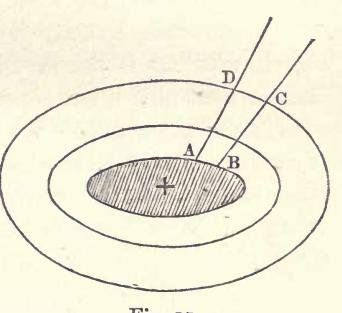
The amount of electric displacement is measured by the quantity of electricity which crosses an imaginary fixed surface drawn parallel to the equipotential surfaces. We know absolutely nothing with respect to the distance through which any particular portion of electricity is displaced from its original position. The only thing we know is the quantity which crosses a given surface. The greater the amount of electricity which we suppose to exist, say, in a cubic inch, the smaller the distance through which we must suppose it displaced in order that a given quantity of electricity may be displaced across a square inch of area fixed in the medium. It is probable that the actual motion of displacement is exceedingly small, in which case we must suppose the quantity of electricity in a cubic inch of the medium to be exceedingly great. If this is really the case the actual velocity of electricity in a telegraph wire may be very small, less, say, than the hundredth of an inch in an hour, though the signals which it transmits may be propagated with great velocity.
电位移的量由穿过一个平行于等势面所画的虚设固定面的电量来量度。关于某一特定部分电从其原始位置位移了多远,我们一无所知。我们唯一知道的是穿过给定面的量。我们设想存在于(比如说)一立方英寸中的电量越大,为使给定电量位移穿过介质中固定的一平方英寸面积所必须设想的位移距离就越小。很可能位移的实际运动极小,在这种情况下,我们必须设想一立方英寸介质中的电量极大。如果情况确实如此,那么电在电报线中的实际速度就可能非常小,比如每小时不足百分之一英寸,尽管它所传递的信号可能以很大的速度传播。
62. The displacement across any section of a unit tube of induction is one unit of electricity and the direction of the displacement is that of the electromotive force, namely, from places of higher to places of lower potential.
62. 单位感应管任一截面上的位移是一单位电,位移的方向就是电动势的方向,即从高电势处到低电势处。
Besides the electric displacement within the cell we have to consider the state of the two ends of the cell which are formed by the equipotential surfaces. We must suppose that in every cell the end formed by the surface of higher potential is coated with one unit of positive electricity, the opposite end, that formed by the surface of lower potential, being coated with one unit of negative electricity. In the interior of the medium where the positive end of one cell is in contact with the negative end of the next, these two electrifications exactly neutralise each other, but where the dielectric medium is bounded by a conductor, the electrification is no longer neutralised, but constitutes the observed electrification at the surface of the conductor.
除了元胞内的电位移,我们还必须考虑由等势面形成的元胞两端的状况。我们必须设想,在每个元胞中,由较高电势面形成的一端涂覆着一单位正电,而相反的一端(由较低电势面形成的一端)涂覆着一单位负电。在介质内部,一个元胞的正端与下一个元胞的负端相接触,这两个带电恰好相互中和;但在介电介质以导体为界的地方,带电不再被中和,而是构成导体表面上观察到的带电。
According to this view of electrification, we must regard electrification as a property of the dielectric medium rather than of the conductor which is bounded by it.
根据这种对带电的看法,我们必须把带电视为介电介质的性质,而不是以它为界的导体的性质。
63. If we further admit that in every part of a dielectric medium through which electric induction is taking place there is a tension, like that of a rope, in the direction of the lines of force, and a pressure in all directions at right angles to the lines of force, we may account for all the mechanical actions which take place between electrified bodies. The tension, referred to unit of surface, is proportional to the square of the electromotive force at the point. The pressure has the same numerical value, but is, of course, opposite in sign.
63. 如果我们进一步承认,在发生电感应的介电介质的每一部分中,都存在一个像绳子的张力那样、沿电力线方向的张力,以及一个沿垂直于电力线的所有方向的压力,那么我们就能解释带电体之间发生的所有机械作用。就单位表面而言,张力与该点处电动势的平方成正比。压力具有相同的数值,但符号当然相反。
In my larger treatise on electricity a proof is given of the fact that a system of stress such as is here described is consistent with the equilibrium of a fluid dielectric medium, and that this state of stress in the medium is mechanically equivalent to the attraction or repulsion which electrified bodies manifest. I have not, however, attempted, by any hypothesis as to the internal constitution of the dielectric medium, to explain in what way the electric displacement causes or is associated with this state of stress.
在我的大著《电磁论》中,给出了这样一个事实的证明:这里所描述的这种应力体系与流体介电介质的平衡是一致的,并且介质中的这种应力状态在力学上等价于带电体所表现出的吸引或排斥。然而,我并没有试图通过任何关于介电介质内部构造的假设,来解释电位移以何种方式引起或关联于这种应力状态。
物理类比On the use of Physical Analogies
64. In many cases the relations of the phenomena in two different physical questions have a certain similarity which enables us, when we have solved one of these questions, to make use of our solution in answering the other. The similarity which constitutes the analogy is not between the phenomena themselves, but between the relations of these phenomena.
64. 在许多情况下,两个不同物理问题中的现象之间的关系具有一定的相似性,这种相似性使我们一旦解决了其中一个问题,就能利用我们的解来回答另一个问题。构成这种类比的相似性不在于现象本身之间,而在于这些现象的关系之间。
To begin with a case of extreme simplicity;—a person slow at arithmetic having to find the price of 52 yards of cotton at 7 pence a yard, if he happened to remember that there are 52 weeks and a day in a year of 365 days, might at once give the answer, 364 pence, without performing the calculation. Here there is no resemblance whatever between the quantities themselves—the weeks and the yards of cotton,—the sole resemblance is between the arithmetical relations of these quantities to others in the same question.
先从一个极简单的例子开始——一个算术迟钝的人要求出 52 码棉布、每码 7 便士的价格,如果他碰巧记得一年 365 天里有 52 个星期零一天,就可能不进行计算而立即给出答案 364 便士。这里各量本身——星期与棉布的码数——之间毫无相似之处,唯一的相似之处是这些量与同一问题中其他量之间的算术关系。
The analogy between electrostatic phenomena and those of the uniform conduction of heat in solid bodies was first pointed out by Sir W. Thomson in a paper 'On the Uniform Motion of Heat in Homogeneous Solid Bodies, and its connection with the Mathematical Theory of Electricity,' published in the Cambridge Mathematical Journal, Feb. 1842. The analogy is of the following nature:—
静电现象与固体中热均匀传导现象之间的类比,最早是由 W. 汤姆孙爵士在《论均匀固体中热的匀速运动及其与电学数学理论的联系》一文中指出的,发表于《剑桥数学杂志》1842 年 2 月号。这种类比具有如下性质:——
Electrostatics.
The electric field.
A dielectric medium.
The electric potential at different points of the field.
The electromotive force which tends to move positively electrified bodies from places of higher to places of lower potential.
A conducting body.
The positively electrified surface of a conductor.
The negatively electrified surface of a conductor.
A positively electrified body.
A negatively electrified body.
An equipotential surface.
A line or tube of induction.
静电学。
电场。
介电介质。
场中不同点处的电势。
趋向于使带正电物体从高电势处移动到低电势处的电动势。
导电体。
导体的带正电表面。
导体的带负电表面。
带正电物体。
带负电物体。
等势面。
感应线或感应管。
Heat.
An unequally heated body.
A body which conducts heat.
The temperature at different points in the body.
The flow of heat by conduction from places of higher to places of lower temperature.
A perfect conductor of heat.
A surface through which heat flows into the body.
A surface through which heat escapes from the body.
A source of heat.
A sink of heat, that is, a place at which heat disappears from the body.
An isothermal surface.
A line or tube of flow of heat.
热学。
一个受热不均匀的物体。
一个导热的物体。
物体中不同点处的温度。
热通过传导从高温处流向低温处。
热的完全导体。
热流入物体的表面。
热从物体逸出的表面。
热源。
热汇,即热从物体消失的地方。
等温面。
热流线或热流管。
By a judicious use of this analogy and other analogies of the same nature the progress of physical science has been greatly assisted. In order to avoid the dangers of crude hypotheses we must study the true nature of analogies of this kind. We must not conclude from the partial similarity of some of the relations of the phenomena of heat and electricity that there is any real physical similarity between the causes of these phenomena. The similarity is a similarity between relations, not a similarity between the things related.
通过明智地利用这个类比以及其他同类类比,物理科学的进步得到了极大的助益。为避免粗糙假设的危险,我们必须研究这类类比的真正性质。我们绝不能从热现象与电现象的某些关系的部分相似性,就断定这些现象的原因之间存在任何真正的物理相似性。这种相似性是关系之间的相似性,而不是被关联的事物之间的相似性。
This similarity is so complete as far as it goes that any result we may have obtained either about electricity or about the conduction of heat may be at once translated out of the language of the one science into that of the other without fear of error; and in pursuing our investigations in either subject we are at liberty to make use of the ideas belonging to the other, if by so doing we are enabled to see more clearly the connection between one step and another of the reasoning.
这种相似性在其所及范围内是如此完全,以致我们在电或热传导方面所得的任何结果,都可以立即从一门科学的语言翻译成另一门科学的语言而不必担心出错;并且在任一学科中进行研究时,我们都可以自由地使用属于另一学科的观念,只要这样做能使我们更清楚地看到推理中一步与另一步之间的联系。
We must bear in mind that at the time when Sir W. Thomson pointed out the analogy between electrostatic and thermal phenomena men of science were as firmly convinced that electric attraction was a direct action between distant bodies as that the conduction of heat was the continuous flow of a material fluid through a solid body. The dissimilarity, therefore, between the things themselves appeared far greater to the men of that time than to the readers of this book, who, unless they have been previously instructed, have not yet learned either that heat is a fluid or that electricity acts at a distance.
我们必须记住,在 W. 汤姆孙爵士指出静电现象与热现象之间类比的时候,科学界人士坚信电吸引是远距离物体之间的直接作用,其坚信程度不亚于他们相信热传导是物质流体在固体中的连续流动。因此,事物本身之间的不相似性,在当时的人们看来,远比本书读者看来要大得多——本书读者除非事先受过教导,否则还没有被灌输「热是一种流体」或「电是超距作用」的观念。
65. But we must now consider the limits of the analogy—the points beyond which we must not push it. In the first place, it is only a particular class of cases of the conduction of heat that have analogous cases in electrostatics. In general, when heat is flowing through a body it causes the temperature of some parts of the body to rise and that of others to fall, and the flow of heat, which depends on the relation of these temperatures, is therefore variable. If the supply of heat is maintained uniform, the temperatures of the different parts of the body tend to adjust themselves to a state in which they remain constant. The quantity of heat which enters any given portion of the body is then exactly equal to that which leaves it during the same time. Under these circumstances the flow of heat is said to be steady.
65. 但我们现在必须考虑这个类比的界限——我们不能越过的点。首先,只有热传导的一类特殊情形在静电学中有类似情形。一般说来,当热流经物体时,它使物体某些部分的温度升高、另一些部分降低,而依赖于这些温度关系的热流因此是可变的。如果热的供给保持均匀,物体不同部分的温度就趋向于自行调节到一个保持不变的状态。进入物体任一给定部分的热量,于是在同一时间内恰好等于离开它的热量。在这些情况下,热流被称为稳定(steady)的。
Now the analogy with electric phenomena applies to the steady flow of heat only. The more general case, that of variable flow of heat, has nothing in electrostatics analogous to it. Even the restricted case of steady flow of heat differs in a most important element from the electrostatic analogue. The steady flow of heat must be kept up by the continual supply of heat at a constant rate and the continual withdrawal of heat at an equal rate. This involves a continual expenditure of energy to maintain the flow of heat in a constant state, so that though the state of the body remains constant and independent of time, the element of time enters into the calculation of the amount of heat required.
现在,与电现象的类比只适用于稳定的热流。更一般的情形,即可变热流,在静电学中没有任何与之类似的东西。即使是稳定热流这一受限情形,也在一个最重要的方面不同于静电学的类似情形。稳定热流必须靠以恒定速率不断供给热、并以相等速率不断抽走热来维持。这涉及为把热流维持在恒定状态而不断消耗能量,所以尽管物体的状态保持恒定、与时间无关,时间这个元素却进入了所需热量大小的计算。
The element of time does not enter into the corresponding case in electrostatics. So far as we know, a set of electrified bodies placed in a perfectly insulating medium might remain electrified for ever without a supply of anything from external sources. There is nothing in this case to which we can apply the term 'flow,' which we apply to the case of the transmission of heat with the same propriety that we apply it to the case of a current of electricity, of water, or of time itself.
时间这个元素并不进入静电学中的相应情形。就我们所知,一组放在完全绝缘介质中的带电体,可以无需任何外部来源的供给而永远保持带电。在这种情况下,没有什么东西能让我们应用「流」这个词——我们把「流」用于热传递的情形,其恰当程度与用于电流、水流、甚至时间本身的情形相同。
66. Another limitation to the analogy is that the temperature of a body cannot be altered without altering its physical state. The density, conductivity, electric properties, &c. all vary when the temperature rises. The electrical potential, however, which is the analogue of temperature is a mere scientific concept. We have no reason to regard it as denoting a physical state. If a number of bodies are placed within a hollow metallic vessel which completely surrounds them, we may charge the outer surface of the vessel and discharge it as we please without producing any physical effect whatever on the bodies within. But we know that the electric potential of the enclosed bodies rises and falls with that of the vessel. This may be proved by passing a conductor connected to the earth through a hole in the vessel. The relation of the enclosed bodies to this conductor will be altered by charging and discharging the vessel. But if the conductor be removed, the simultaneous rise and fall of the potentials of the bodies in the vessel is not attended with any physical effect whatever.
66. 这个类比的另一个局限是,物体的温度不改变其物理状态就不能被改变。密度、导电性、电学性质等都会随温度升高而变化。然而,作为温度类比物的电势,只是一个纯粹的科学概念。我们没有理由把它视为表示某种物理状态。如果把若干物体放在一个完全包围它们的空心金属容器内,我们可以随心所欲地给容器外表面充电、放电,而对内部物体不产生任何物理效应。但我们知道,内部物体的电势随容器一起升降。这可以通过让一根与大地相连的导体穿过容器上的孔来证明。内部物体与该导体的关系会因容器的充放电而改变。但如果移去导体,容器内物体电势的同时升降并不伴随任何物理效应。
67. Faraday* proved this by constructing a hollow cube, twelve feet in the side, covered with good conducting materials, insulated from the ground and highly electrified by a powerful machine. 'I went into this cube,' he says, 'and lived in it, but though I used lighted candles, electrometers, and all other tests of electrical states, I could not find the least influence upon them, or indication of anything particular given by them, though all the time the outside of the cube was powerfully charged and large sparks and brushes were starting off from every part of its outer surface.'
67. 法拉第*通过建造一个边长十二英尺的空心立方体证明了这一点,立方体覆以良好导电材料、与地绝缘、并用一台强力起电机高度带电。「我走进这个立方体,」他说,「并住在里面,但尽管我使用了点燃的蜡烛、静电计以及其他所有检验电状态的手段,我都找不到对它们的丝毫影响,也找不到它们给出的任何特殊迹象,尽管在这整个时间里,立方体的外部都被强力充电,大火花和电刷正从它外表面的每一部分迸发出来。」
It appears, therefore, that the most sudden changes of potential produce no physical effects on matter, live or dead, provided these changes take place simultaneously on all the bodies in the field. If Faraday, instead of raising his cube to a high electric potential, had raised it to a high temperature, the result, as we know, would have been very different.
因此,看来电势的最突然变化也不会对物质(无论有无生命)产生任何物理效应,只要这些变化同时发生在场中的所有物体上。如果法拉第不是把他的立方体升到高电势,而是升到高温,那么结果(如我们所知)将会非常不同。
68. It appears, therefore, that the analogy between the conduction of heat and electrostatic phenomena has its limits, beyond which we must not attempt to push it. At the time when it was pointed out by Thomson, men of science were already acquainted with the great work of Fourier on the conduction of heat in solid bodies, and their minds were more familiar with the ideas there developed than with those belonging to current electricity, or to the theory of the displacements of a medium.
68. 因此,看来热传导与静电现象之间的类比有其界限,我们不应试图越过。在汤姆孙指出这个类比的时候,科学界人士已经熟悉傅里叶关于固体中热传导的伟大著作,他们的头脑对其中发展的观念比对属于电流、或介质位移理论的观念更熟悉。
It is true that Ohm had, in 1827, applied the results obtained by Fourier for heat to the theory of the distribution of electric currents in conductors, but it was long before the practical value of Ohm's work was understood, and till men became familiar with the idea of electric currents in solid conductors, any illustration of electrostatic phenomena drawn from such currents would have served rather to obscure than to enlighten their minds.
诚然,欧姆早在 1827 年就把傅里叶为热所得的结果应用到了导体中电流分布的理论上,但欧姆工作的实际价值过了很久才被理解;并且在人们熟悉固体导体中电流的观念之前,从这种电流中引出的静电现象的任何例证,都只会使他们的头脑更加迷惑,而不是得到启发。
69. When an electric current flows through a solid conductor, the direction of the current at any point is from places of higher to places of lower potential, and its intensity is proportional to the rate at which the potential decreases from point to point of a line drawn in the direction of the current.
69. 当电流流经固体导体时,任一点处电流的方向是从高电势处到低电势处,其强度与沿电流方向所画的线上电势逐点降低的速率成正比。
We may suppose equipotential surfaces drawn in the conducting medium. The lines of flow of the current are everywhere at right angles to the equipotential surfaces, and the rate of flow is proportional to the number of equipotential surfaces which would be cut by a line of unit length drawn in the direction of the current. It appears, therefore, that this case of a conducting medium through which an electric current is passing has certain points of analogy with that of a dielectric medium bounded by electrified bodies.
我们可以设想在导电介质中画出等势面。电流的流线处处与等势面成直角,流速与沿电流方向所画的单位长度线所切割的等势面数目成正比。因此,看来电流通过的导电介质这一情形,与以带电体为界的介电介质情形有某些类似之处。
In both the medium is divided into layers by a series of equipotential surfaces. In both there is a system of lines which are everywhere perpendicular to these surfaces. In the one case these lines are called current lines or lines of flow; in the other they are called lines of electric force or electric induction. An assemblage of such lines drawn from every point of a given line is called a surface of flow. Since the lines of which this surface is formed are everywhere in the direction of the electric current, no part of the current passes through the surface of flow. Such a surface therefore may be regarded as impervious to the current without in any way altering the state of things.
在这两种情形中,介质都被一系列等势面分成层。在这两种情形中,都有一个处处垂直于这些面的线体系。在一种情形中,这些线称为电流线或流线;在另一种情形中,它们称为电力线或电感应线。从给定线的每一点画出的一组这样的线,称为流面(surface of flow)。由于形成这个面的线处处沿电流方向,电流没有任何部分穿过流面。因此,这个面可以被视为对电流不渗透,而无需以任何方式改变事物的状态。
If the line from which the assemblage of lines of flow is drawn is one which returns into itself, which we shall call a closed curve, or, more briefly, a ring, the surface of flow will have the form of a tube and is called a tube of flow. Any two sections of the same tube of flow correspond to each other in the sense defined in Art. 54, and the quantities of electricity which in the same time flow across these two sections are equal. Here then we have the analogue of Faraday's law, that the quantities of electricity upon corresponding areas of opposed conducting surfaces are equal and opposite.
如果从中画出这组流线的线是一条回到自身的线——我们将称之为闭合曲线(closed curve),或更简短地称为环(ring)——那么流面将具有管的形状,称为流管(tube of flow)。同一流管的任意两个截面在第 54 条定义的意义上彼此对应,并且在同一时间内流过这两个截面的电量相等。这样我们就有了法拉第定律的类比物:相对导体表面的对应面积上的电量大小相等、符号相反。
70. But we may arrive at a more perfect mental representation of induction by comparing it, not with the instantaneous state of a current, but with the small displacements of a medium of invariable density. Returning to the case of an electric current through a solid conductor, let us suppose that the current, after flowing for a very short time, ceases. If we consider a surface drawn within the solid, then if this surface intersects the tubes of flow, a certain quantity of electricity will have passed from one side of the surface to the other during the time when the current was flowing. This passage of electricity through the surface is called electric displacement, and the displacement through a given surface is the quantity of electricity which passes through it. In the case of a continuous current the displacement increases continuously as long as the current is kept up, but if the current lasts for a finite time, the displacement reaches its final value and then remains constant. The lines, surfaces, and tubes of flow of the transient current are also lines, surfaces, and tubes of displacement. The displacements across any two sections of the same tube of displacement are equal. At the beginning of each unit tube of displacement there is a unit of positive electricity, and at the end of the tube there is a unit of negative electricity.
70. 但我们可以通过把感应与「密度不变的介质的小位移」相比较、而不是与电流的瞬时状态相比较,来得到对感应的更完善的心智表象。回到电流流经固体导体的情形,让我们假定电流在流动了很短时间后停止。如果我们考虑在固体内画的一个面,那么如果这个面与流管相交,在电流流动期间,一定量的电就会从面的一侧通过到另一侧。电穿过这个面的通过称为电位移(electric displacement),而穿过给定面的位移就是穿过它的电量。在连续电流的情形中,只要电流持续,位移就不断增加;但如果电流持续有限时间,位移就达到其最终值、然后保持不变。瞬态电流的线、面和管,也是位移线、位移面和位移管。同一位移管的任意两个截面上的位移相等。在每个单位位移管的起始处有一个单位正电,在管的末端有一个单位负电。
At every point of the medium there is a state of stress consisting of a tension in the direction of the line of displacement through the point and a pressure in all directions at right angles to this line. The numerical value of the tension is equal to that of the pressure, namely, the square of the intensity of the electric force divided by 4π.
在介质的每一点处,都存在一种应力状态,它由沿穿过该点的位移线方向的张力、以及沿垂直于该线的所有方向的压力组成。张力的数值等于压力的数值,即电力强度的平方除以 4π。
感应管的性质Properties of a Tube of Induction
71. By the consideration of the properties of the tubes of induction and the equipotential surfaces we may easily prove several important general theorems in the theory of electricity, the demonstration of which by the older methods is long and difficult. The properties of a tube of induction have already been stated, but for the sake of what follows we may state them again:—
71. 通过考察感应管和等势面的性质,我们可以容易地证明电学理论中的几个重要的一般定理,而这些定理用较老的方法证明既冗长又困难。感应管的性质前面已经陈述过,但为了下文起见,我们不妨再陈述一次:——
(1) If a tube of induction is cut by an imaginary surface, the quantity of electricity displaced across a section of the tube is the same at whatever part of the tube the section be made.
(1)如果一个感应管被一个虚设面切割,那么在管的任何部位作截面,穿过该截面的电位移量都是相同的。
(2) In every part of the course of a line of electrostatic force it cuts the equipotential surfaces at right angles, and is proceeding from a place of higher to a place of lower potential.
(2)在静电力线的每一部分路径中,它都与等势面成直角相交,并且从高电势处通向低电势处。
Note. This statement is true only when the distribution of electric force can be completely represented by means of a set of equipotential surfaces. This is always the case when the electricity is in equilibrium, but when there are electric currents, though in some parts of the field it may be possible to draw a set of equipotential surfaces, there are other parts of the field where the distribution of electric force cannot be represented by means of such surfaces. For an electric current is always of the nature of a circuit which returns into itself, and such a circuit cannot in every part of its course be proceeding from places of higher to places of lower potential.
注。 只有当电力的分布能完全用一组等势面来表示时,这个陈述才成立。当电处于平衡时,这总是成立的;但当存在电流时,尽管场中某些部分可能画得出一组等势面,场中另一些部分电力的分布却无法用这种面来表示。因为电流总是具有回到自身的回路的性质,而这样的回路不可能在其每一部分路径中都从高电势处通向低电势处。
72. It may be observed that in (1) we have used the words 'tube of induction,' and in (2) the words 'line of electrostatic force.' In a fluid dielectric, such as air, the line of electrostatic force is always in the same direction as the tube of induction, and it may seem pedantic to maintain a distinction between them. There are other cases, however, in which it is very important to remember that a tube of induction is defined with respect to the phenomenon which we have called electric displacement, while a line of force is defined with respect to the electric force. In fluids the electric displacement is always in the direction of the electric force, but there are solid bodies in which this is not the case*, and in which, therefore, the tubes of induction do not coincide in direction with the lines of force.
72. 可以注意到,在(1)中我们用了「感应管」一词,在(2)中用了「静电力线」一词。在像空气这样的流体介电体中,静电力线总是与感应管同方向,坚持在它们之间保持区别似乎显得学究气。然而,在其他情形中,非常重要的是要记住:感应管是相对于我们称为电位移的现象来定义的,而力线是相对于电力来定义的。在流体中,电位移总是沿电力方向;但在某些固体中并非如此*,因此在其中感应管不与力线同方向。
* See the experiments of Boltzmann on crystals of sulphur. Vienna Sitzungsb. 9 Jan. 1873.
* 参见玻尔兹曼关于硫晶体的实验。《维也纳科学院会报》1873 年 1 月 9 日。
73. It follows from (1) that every tube of induction begins at a place where there is a certain quantity of positive electricity and ends at a place where there is an equal quantity of negative electricity, and that, conversely, from any place where there is positive electricity a tube may be drawn, and that wherever there is negative electricity a tube must terminate.
73. 由(1)得出,每个感应管都始于存在一定量正电的地方、终于存在等量负电的地方;并且反过来,从任何有正电的地方都可以画出一个管,而无论哪里有负电,都必定有一个管在那里终止。
74. It follows from (2) that the potential at the beginning of a tube is higher than at the end of it. Hence, no tube can return into itself, for in that case the same point would have two different potentials, which is impossible.
74. 由(2)得出,管起始处的电势高于终止处。因此,没有哪个管能回到自身,因为那样的话同一点就会有两个不同的电势,这是不可能的。
75. From this we may prove that if the potential at every point of a closed surface is the same, and if there is no electrified body within that surface, the potential at any point within the region enclosed within the closed surface is the same as that at the surface. For if there were any difference of potential between one point and another within this region, there would be lines of force from the places of higher towards the places of lower potential. These lines, as we have seen, cannot return into themselves. Hence they must have their extremities either within the region or without it. Neither extremity of a line of force can be within the region, for there must be positive electrification at the beginning and negative electrification at the end of a line of force, but by our hypothesis there is no electrification within the region. On the other hand, a line of force within the region cannot have its extremities without the region, for in that case it must enter the region at one point of the surface and leave it at another, and therefore by (2) the potential must be higher at the point of entry than at the point of issue, which is contrary to our hypothesis that the potential is the same at every point of the surface.
75. 由此我们可以证明,如果一个闭合面每一点的电势都相同,并且该面内没有带电体,那么闭合面所围区域内任一点的电势都与面上的电势相同。因为如果该区域内一点与另一点之间存在任何电势差,就会有从高电势处通向低电势处的力线。这些线,如我们所见,不能回到自身。因此它们的两端要么都在区域内,要么都在区域外。力线的任何一端都不可能在该区域内,因为力线的起始处必须有正电、末端必须有负电,但根据我们的假设,该区域内没有带电。另一方面,区域内的力线也不可能两端都在区域外,因为那样的话它就必须在表面的一点进入区域、在另一点离开区域,因此由(2),进入点的电势必须高于离开点,这与「表面每一点的电势都相同」的假设相矛盾。
Hence no line of force can exist within the region, and therefore the potential at any point within the region is the same as that at the surface itself.
因此,该区域内不可能存在力线,所以区域内任一点的电势都与表面本身的电势相同。
76. It follows from this theorem, that if the closed surface is the internal surface of a hollow conducting vessel, and if no electrified body is within the surface, there is no electrification on the internal surface. For if there were, lines of force would proceed from the electrified parts of the surface into the region within, and we have already proved that there are no lines of force in that region. We have already proved this by experiment (Art. 20), but we now see that it is a necessary consequence of the properties of lines of force.
76. 由这个定理得出,如果闭合面是一个空心导体容器的内表面,并且该面内没有带电体,那么内表面上就没有带电。因为如果有的话,力线就会从表面的带电部分进入内部区域,而我们已证明该区域内没有力线。我们已用实验证明了这一点(第 20 条),但现在我们看到,它是力线性质的一个必然推论。
电体系的叠加Superposition of Electric Systems
77. We have already (Art. 29) given some examples of the superposition of electric effects, but we must now state the principle of superposition more definitely. If the same system is electrified in three different ways, then if the potential at any point in the third case is the sum of the potentials in the first and second cases, the electrification of any part of the system in the third case will be the sum of the electrifications of the same part in the first and second cases. By reversing the sign of the electrifications and potentials in one of these cases, we may enunciate the principle with respect to the case in which the potential and the electrification are at every point the excess of what they are in the first case over what they are in the second.
77. 我们已在第 29 条给出了一些电效应叠加的例子,但我们现在必须更明确地陈述叠加原理。如果同一体系以三种不同方式带电,那么如果第三种情形中任一点的电势是第一、第二两种情形中电势之和,则第三种情形中体系任何部分的带电,就是第一、第二两种情形中同一部分带电之和。通过颠倒其中一种情形中带电和电势的符号,我们就可以把这个原理陈述为:电势和带电在每一点处都是第一种情形超过第二种情形之量。
78. We may now establish a theorem which is of the greatest importance in the theory of electricity. If the electric field under consideration consist of a finite portion of a dielectric medium, and if at every point of the boundary of this region the potential is given, and if the distribution of electrification within the region be also given, then the potential at any point within the region can have one and only one value consistent with these conditions.
78. 我们现在可以确立一个在电学理论中最重要的定理。如果所考虑的电场由介电介质的一个有限部分组成,并且该区域边界每一点的电势都给定、区域内的带电分布也给定,那么区域内任一点的电势只能有与这些条件相一致的一个且仅一个值。
One value at least of the potential must be possible, because the conditions of the theorem are physically possible. Again, if at any point two values of the potential were possible, then by taking the excess of the first value over the second for every point of the system, a third case might be formed in which the potential is everywhere the excess of the first case above the second. At the boundary of the region the potential in the third case is everywhere zero. Within the region the electrification is everywhere zero. Hence, by (Art. 75), at every point within the region the potential in the third case is zero.
电势至少有一个值必定是可能的,因为定理的条件在物理上是可能的。再者,如果在某一点电势可能有两个值,那么通过取体系每一点第一值超过第二值的量,就可以构成第三种情形,其中电势处处是第一种情形超过第二种情形的量。在区域边界处,第三种情形中的电势处处为零。在区域内,带电处处为零。因此,由第 75 条,区域内每一点处第三种情形的电势都是零。
There is, therefore, no difference between the distribution of potential in the first case and in the second, or, in other words, the potential at any point within the region can have only one value. If in any case we can find a distribution of potential which satisfies the given conditions, then by this theorem we are assured that this distribution is the only possible solution of the problem. Hence the importance of this theorem in the theory of electricity.
因此,第一种情形与第二种情形的电势分布之间没有差别,换句话说,区域内任一点的电势只能有一个值。如果在任何情形中我们能找到一个满足给定条件的电势分布,那么由这个定理我们可以确信,这个分布是问题的唯一可能解。这就是这个定理在电学理论中重要性的由来。
79. For instance, let A be an electrified body and let B be one of the equipotential surfaces surrounding the body. Let the potential of the surface B be equal to P. Now let a conducting body be constructed and placed so that its external surface coincides with the closed surface B, and let it be so electrified that its potential is P. Then the conditions of the region outside B are the same as when it was acted on by the body A only. For the potential over the whole bounding surface of the region is P, the same as before, and whatever electrified bodies exist outside of B remain unchanged. Hence the potential at every point outside of B may, consistently with the conditions, be the same as before. By our theorem, therefore, the potential at every point outside B must be the same, when, instead of the body A, we have a conducting surface B, raised to the potential P.
79. 例如,设 A 为一个带电体,设 B 为包围该物体的等势面之一。设面 B 的电势等于 P。现在构造一个导体,并放置得使它的外表面与闭合面 B 重合,并使它带电到电势为 P。那么 B 之外区域的条件,就与它只受物体 A 作用时相同。因为区域整个边界面上的电势都是 P,与之前相同,而且存在于 B 之外的任何带电体都保持不变。因此,B 之外每一点的电势可以(与条件相一致地)与之前相同。所以,由我们的定理,当用一个升到电势 P 的导体面 B 代替物体 A 时,B 之外每一点的电势必定相同。
80. The charge of every part of the surface of a conductor is of the same sign as its potential, unless there is another body in the field whose potential is of the same sign but numerically greater. Let us suppose the potential of the body to be positive; then, if on any part of its surface there is negative electricity, lines of force must terminate on this part of the surface, and these lines of force must begin at some electrified surface whose potential is higher than that of the body. Hence, if there is no other body whose potential is higher than that of the given body, no part of the surface of the given body can be charged with negative electricity.
80. 导体表面每一部分的电荷与其电势同号,除非场中另有一个物体,其电势同号但在数值上更大。让我们假定物体的电势为正;那么,如果它表面的任何部分有负电,力线就必须终止在表面的这一部分上,而这些力线必须始于某个电势高于该物体的带电表面。因此,如果没有其他电势高于给定物体的物体,那么给定物体表面的任何部分都不可能带负电。
If an uninsulated conductor is placed in the same field with a charged conductor, the charge on every part of the surface of the uninsulated conductor is of the opposite sign to the charge of the charged conductor. For since the potential of the uninsulated body is zero, there can be no line of force between it and the walls of the room, or infinite space where the potential is always zero. The line of force which has one end at any point of the surface of this body must therefore have its other end at some point of the charged body, and since the two extremities of a line of force are oppositely electrified, the electrification of the surface of the uninsulated body must be everywhere opposite to the charge of the charged body.
如果一个不绝缘的导体与一个带电导体放在同一场中,那么不绝缘导体表面每一部分的电荷都与带电导体的电荷反号。因为既然不绝缘物体的电势为零,它与房间墙壁(或电势始终为零的无限空间)之间就不可能有任何力线。因此,一端在该物体表面任一点的力线,其另一端必定在带电物体的某一点上,而由于力线的两端带相反的电,不绝缘物体表面的带电必定处处与带电物体的电荷相反。
The charged body in this experiment is called the Inductor, and the other body the induced body. When the induced body is uninsulated, the electricity spread over every part of its surface is, as we have just proved, of the opposite sign to that of the inductor. The total charge, EA, of the induced body, which we may call A, may be found by multiplying PB, the potential of the inductor B, by QAB, the mutual coefficient of induction between the bodies, which is always a negative quantity. This electrification induced on an uninsulated body is called by some writers on electricity the Induced Electrification of the First Species. Since the potential of A is already zero, it is manifest that if any part of its surface is touched by a fine wire communicating with the ground there will be no discharge.
这个实验中的带电体称为施感体(Inductor),另一物体称为被感体(induced body)。当被感体不绝缘时,如我们刚证明的,铺在其表面每一部分的电都与施感体反号。被感体(我们称之为 A)的总电荷 EA,可以通过把施感体 B 的电势 PB 乘以两物体之间的互感系数 QAB(它总是负量)来求得。这种在不绝缘物体上感生的带电,被某些电学作者称为第一类感生带电(Induced Electrification of the First Species)。由于 A 的电势已经为零,很明显,如果它的表面任何部分被一根与地相通的细线触碰,都不会有放电。
Next, let us suppose that the body, A, instead of being uninsulated is insulated, but originally without charge. Under the action of the inductor B part of its surface, on the side next to B, will become electrified oppositely to B; but since the algebraic sum of its electrification is zero, some other part of its surface must be electrified similarly to B. This electrification, of the same name as that of B, is called by writers on electricity the Induced Electrification of the Second Species. If a wire connected with the ground be now made to touch any part of the surface of A, electricity of the same name as that of B will be discharged, its amount being equal and opposite to the negative charge (of the first species) which remains on the body A, which is now reduced to potential zero.
接下来,让我们假定物体 A 不是不绝缘的、而是绝缘的,但最初无电荷。在施感体 B 的作用下,它的表面靠近 B 的一侧将带上与 B 相反的电;但由于它带电的代数和为零,它表面的其他某部分必定带上与 B 相同的电。这种与 B 同名的带电,被电学作者称为第二类感生带电(Induced Electrification of the Second Species)。如果现在让一根与地相连的线触碰 A 表面的任何部分,与 B 同名的电将被放掉,其量等于、且相反于仍留在物体 A 上(现在被降到零电势)的第一类负电荷。
第六章 · 起电的特殊情形Chapter VI — Particular Cases of Electrification
球形导体Spherical Conductor
81. A SPHERICAL conductor is electrified and insulated within the concentric spherical internal surface of a conducting vessel. On account of the perfect symmetry of this system in all directions, it is manifest that the distribution of electricity will be uniform over each of the opposed spherical surfaces, that the lines of force will be in the directions passing through the common centre of the spheres, and that the equipotential surfaces will be spheres having this point for their centre. If e is the quantity of electricity on the inner sphere and E that on the internal surface of the outer sphere, then by Experiment VIII
81. 一个球形导体被带电、并绝缘在一个导体容器的同心球形内表面之内。由于这个体系在所有方向上完全对称,很明显,电的分布在每个相对的球面上都是均匀的,力线沿通过两球共同中心的方向,而等势面是以这一点为中心的球面。如果 e 是内球上的电量,E 是外球内表面上的电量,那么由实验八
$$E = -e. \qquad (1)$$
$$E = -e. \qquad (1)$$
If r and R are the radii of the spheres, s and S their surfaces, and σ and Σ the surface-densities of the electricity on these surfaces, then by geometry,
如果 r 和 R 是两球的半径,s 和 S 是它们的表面,σ 和 Σ 是这些表面上电的面密度,那么由几何学,
$$s = 4\pi r^2, \qquad S = 4\pi R^2, \dots (2)$$
$$s = 4\pi r^2, \qquad S = 4\pi R^2, \dots (2)$$
where π denotes the ratio of the circumference of a circle to its diameter. The whole charge on either sphere is found by multiplying the surface into the surface-density, or
其中 π 表示圆周与其直径之比。任一球上的总电荷由表面乘以面密度求得,即
$$e = s \sigma, \qquad E = S \Sigma. \qquad (3)$$
$$e = s \sigma, \qquad E = S \Sigma. \qquad (3)$$
Hence,
因此,
$$\sigma = \frac{e}{4\pi r^2}, \qquad \Sigma = \frac{E}{4\pi R^2} = \frac{-e}{4\pi R^2}. \qquad (4)$$
$$\sigma = \frac{e}{4\pi r^2}, \qquad \Sigma = \frac{E}{4\pi R^2} = \frac{-e}{4\pi R^2}. \qquad (4)$$
It appears, therefore, that when the charge, e, of the inner sphere is given, the surface-density, Σ, on the internal surface of the vessel is inversely as the square of the distance of that surface from the centre of the electrified sphere.
因此,看来当内球的电荷 e 给定时,容器内表面上的面密度 Σ 与该表面到带电球中心的距离的平方成反比。
Hence by Coulomb's law (Experiment XIII, Art. 47) the electromotive force at the outer spherical surface is inversely as the square of the distance from the centre of the sphere. This is the law according to which the electric force varies at different distances from a sphere uniformly electrified. The amount of the force is independent of the radius of the inner electrified sphere, and depends only on the whole charge upon it. If we suppose the radius of the inner sphere to become very small till at last the sphere cannot be distinguished from a point, we may imagine the whole charge concentrated at this point, and we may then express our result by saying that the electric action of a uniformly electrified sphere at any point outside the sphere is the same as that of the whole charge of the sphere would be if concentrated at the centre of the sphere.
因此,由库仑定律(实验十三,第 47 条),外球面处的电动势与该面到带电球中心的距离的平方成反比。这就是电力在距均匀带电球不同距离处变化的定律。力的大小与内部带电球的半径无关,只取决于它上面的总电荷。如果我们设想内球的半径变得非常小、直到最后球无法与点区分,我们就可以设想整个电荷集中在这个点上,然后我们可以这样表述我们的结果:均匀带电球在球外任一点的电作用,与该球的整个电荷如果集中在球心处时的作用相同。
We must bear in mind, however, that it is physically impossible to charge the small sphere with more than a certain quantity of electricity on each unit of area of its surface. If the surface-density exceed this limit, electricity will fly off in the form of the brush discharge. Hence the idea of an electrified point is a mere mathematical fiction which can never be realised in nature. The imaginary charge concentrated at the centre of the sphere, which produces an effect outside the sphere equivalent to that of the actual distribution of electricity on the surface, is called the Electrical Image of that distribution. See Art. 100.
然而,我们必须记住,在物理上不可能给小球表面每单位面积充上超过一定量的电。如果面密度超过这个限度,电就会以电刷放电的形式飞散。因此,带电点的观念只是一个数学虚构,在自然界中永远无法实现。集中在球心处、在球外产生与表面上电的实际分布等效的效果的那个想象电荷,称为该分布的「电像」(Electrical Image)。见第 100 条。
电的测量与库仑定律Measurement of Electricity
82. We have already described methods of comparing the quantity of electrification on different bodies, but in each case we have only compared one quantity of electricity with another, without determining the absolute value of either. To determine the absolute value of an electric charge we must compare it with some definite quantity of electricity, which we assume as a unit. The unit of electricity adopted in electrostatics is that quantity of positive or vitreous electricity which, if concentrated in a point, and placed at the unit of distance from an equal charge, also concentrated in a point, would repel it with the unit of mechanical force. The dielectric medium between the two charged points is supposed to be air.
82. 我们已经描述了比较不同物体上带电量的方法,但在每种情况下,我们都只是把一个电量与另一个电量比较,而没有确定其中任何一个的绝对值。要确定电荷的绝对值,我们必须把它与某个我们取作单位的确定电量相比较。静电学中所采用的电单位,是这样一个正电(或玻璃电)量:如果它集中在一个点上,并放在距一个同样集中在点上的相等电荷单位距离处,它会以单位机械力排斥该电荷。两个带电点之间的介电介质假定为空气。
83. Let us now suppose two bodies, whose dimensions are small compared with the distance between them, to be charged with electricity. Let the charge of the first body be e units of electricity and that of the second e′ units, and let the distance between the bodies be r. Then, since the force varies inversely as the square of the distance, the force with which each unit of electricity in the first body repels each unit of electricity in the second body will be 1/r², and since the number of pairs of units, one in each body, is ee′, the whole repulsion between the bodies will be
83. 现在让我们设想两个尺寸比它们之间距离小的物体带上了电荷。设第一个物体的电荷是 e 个电单位、第二个是 e′ 个单位,并设两物体之间的距离是 r。那么,由于力与距离的平方成反比,第一个物体中每个电单位排斥第二个物体中每个电单位的力将是 1/r²,而由于每个物体各取一个单位所成的单位对的数目是 ee′,两物体之间的总排斥力将是
$$f = \frac{ee'}{r^2}.$$
$$f = \frac{ee'}{r^2}.$$
If the charge of the first or the second body is negative we must consider e or e′ negative. If the one charge is positive and the other negative, f will be negative, or the force between the bodies will be an attraction instead of a repulsion. If the charges are both positive or both negative, the force between the bodies will be a repulsion.
如果第一个或第二个物体的电荷是负的,我们必须把 e 或 e′ 视为负的。如果一个电荷为正、另一个为负,f 将为负,即两物体之间的力是吸引而不是排斥。如果两个电荷都为正或都为负,两物体之间的力将是排斥。
电力Electric Force
84. Definition.—The electric or electromotive force at a point is the force which would be experienced by a small body charged with the unit of positive electricity and placed at that point, the electrification of the system being supposed to remain undisturbed by the presence of this unit of electricity. We shall use the German letter E as the symbol of electric force.
84. 定义。——一点处的电力或电动势,是一个带一单位正电、放在该点处的小物体所会受到的力,假定体系的带电不因这个电单位的存在而受扰动。我们将用德文字母 E(𝔈)作为电力的符号。
85. Let us now return to the case of a sphere whose radius is r, the external surface of which is uniformly electrified, the surface density of the electrification being σ. As we have already proved, the whole charge of the sphere is
85. 现在让我们回到半径为 r、外表面均匀带电的球的情形,设带电的面密度为 σ。如我们已经证明的,球的总电荷是
$$e = 4 \pi r^2 \sigma.$$
$$e = 4 \pi r^2 \sigma.$$
At any point outside the sphere such that the distance from the centre of the sphere is r′ the electromotive force, 𝔈, is directed from the centre, and its value is
在球外任一点,设该点到球心的距离为 r′,电动势 𝔈 沿背离球心的方向,其值为
$$\mathfrak{E} = \frac{e}{r^{\prime 2}}.$$
$$\mathfrak{E} = \frac{e}{r^{\prime 2}}.$$
If the point is close to the surface of the sphere, r′ = r, and
如果该点紧靠球的表面,r′ = r,并且
$$\mathfrak{E} = \frac{e}{r^2} = 4\pi\sigma,$$
$$\mathfrak{E} = \frac{e}{r^2} = 4\pi\sigma,$$
or the electric force close to the surface of an electrified sphere is at right angles to the surface and is equal to the surface-density multiplied by 4π. We have already seen that in all cases the electric force close to the surface of a conductor is at right angles to that surface, and is proportional to the surface-density. We now, by means of this particular case, find that the constant ratio of the electric force to the surface-density is 4π for a uniformly electrified sphere, and therefore this is the ratio for a conductor of any form. The equation
也就是说,紧靠带电球表面的电力与表面成直角,并且等于面密度乘以 4π。我们已经看到,在所有情形中,紧靠导体表面的电力都与该表面成直角,并且与面密度成正比。现在我们借助这个特殊情形发现,对于均匀带电球,电力与面密度的恒定比值是 4π,因此这也是任何形状导体的比值。方程
$$\mathfrak{E} = 4\pi\sigma$$
$$\mathfrak{E} = 4\pi\sigma$$
is the complete expression of the law discovered by Coulomb and referred to in Arts. 47 and 81.
是库仑所发现、并在第 47 条和第 81 条提及的那条定律的完整表达式。
电势的值Value of the Potential
86. We must next consider the values of the potential at different distances from a small electrified body. Definition. The electric potential at any point is the work which must be expended in order to bring a body charged with unit of electricity from an infinite distance to that point. If ψ is the potential at A and ψ′ that at B, then the work which must be spent by the external agency in overcoming electrical force while carrying a unit of electricity from A to B is ψ′ − ψ. The quantity ψ′ − ψ would also represent the work which would be done by the electrical forces in assisting the transfer of the unit of electricity from B to A if the motion were reversed. If the force from B to A were constant and equal to 𝔈, then ψ′ − ψ = BA · 𝔈.
86. 我们接下来必须考虑距小带电体不同距离处电势的值。定义。 任一点的电势,是把一个带一单位电的物体从无限远处搬到该点所必须耗费的功。如果 ψ 是 A 处的电势、ψ′ 是 B 处的电势,那么外部施力者在把一单位电从 A 搬到 B 时克服电力所必须耗费的功是 ψ′ − ψ。量 ψ′ − ψ 也代表:如果运动反过来,电力在协助把单位电从 B 搬到 A 时所做的功。如果从 B 到 A 的力恒定且等于 𝔈,那么 ψ′ − ψ = BA · 𝔈。
In general, the electric force varies as the body moves from B to A, so that we cannot at once apply this method of finding the difference of potentials. But, by breaking up the path BA into a sufficient number of parts, we may make these parts so small that the electric force may be regarded as uniform during the passage of the body along any one of these parts. We may then ascertain the parts of the work done in each part of the path, and by adding them together, obtain the whole work done during the passage from B to A.
一般说来,电力随物体从 B 移到 A 而变化,所以我们不能立即用这种方法求电势差。但是,通过把路径 BA 分成足够多的部分,我们可以使这些部分小到电力在物体沿其中任一部分通过期间可被视为均匀。然后我们可以确定路径每一部分中所做功的部分,把它们加起来,就得到从 B 到 A 通过期间所做的总功。
Let us suppose a unit of electricity placed at O, and let the distances of the points A, B, C, … Z from O be a, b, c, … z. The electric force at A is 1/a², at B 1/b², and so on, all in the direction from O to A. To find the work which must be done in order to bring a unit of electricity from A to B we must multiply the distance AB by the average of the electromotive force at the various points between A and B. The least value of the force is 1/a², and the greatest value is 1/b². Hence the work required is greater than AB/a² and less than AB/b². By taking a series of such steps and passing to the limit, we find the difference of potentials between A and Z to be
让我们设想一单位电放在 O 处,并设点 A、B、C、… Z 到 O 的距离为 a、b、c、… z。A 处的电力是 1/a²,B 处是 1/b²,等等,都沿从 O 到 A 的方向。为求把单位电从 A 搬到 B 所必须做的功,我们必须用距离 AB 乘以 A、B 之间各点处电动势的平均值。力的最小值是 1/a²,最大值是 1/b²。因此所需功大于 AB/a²、小于 AB/b²。通过取这样一系列步骤并过渡到极限,我们求得 A 与 Z 之间的电势差为
$$Z - A = \frac{1}{z} - \frac{1}{a}.$$
$$Z - A = \frac{1}{z} - \frac{1}{a}.$$
We have thus found the difference between the potentials at A and Z. To determine the actual value of the potential, say at Z, we must refer to the definition of the potential, that it is the work expended in bringing unit of electricity from an infinite distance to the given point. We have therefore in the above expression to suppose the point A removed to an infinite distance from O, in which case the potential A is zero, and the reciprocal of the distance, or 1/a, is also zero. The equation is therefore reduced to the form Z = 1/z, or in words, the numerical value of the potential at a given point due to unit of electricity at a given distance is the reciprocal of the number expressing that distance.
这样我们就求得了 A 与 Z 处电势之差。为确定电势的实际值(比如在 Z 处),我们必须参照电势的定义:它是把单位电从无限远处搬到给定点所耗费的功。因此,在上述表达式中,我们必须设想点 A 移到距 O 无限远处,在这种情况下电势 A 为零,距离的倒数 1/a 也为零。因此方程化为 Z = 1/z,换句话说,单位电在给定距离处、在给定点产生的电势的数值,是表示该距离的那个数的倒数。
If the charge is e, then the potential at a distance z is e/z. The potential due to a number of charges placed at different distances from the given point is found by adding the potentials due to each separate charge, regard being had to the sign of each potential.
如果电荷是 e,那么距离 z 处的电势是 e/z。放在距给定点不同距离处的若干电荷所产生的电势,通过把每个单独电荷产生的电势相加来求得,并注意每个电势的符号。
87. Since, as we have seen, the electric force at any point outside a uniformly electrified spherical surface is the same as if the electric charge of the surface had been concentrated at its centre, the potential due to the electrified surface must be, for points outside it,
87. 由于(如我们所见的)均匀带电球面外任一点的电力,与该球面的电荷若集中在其中心时相同,所以带电球面在它之外的点产生的电势必定是
$$\psi = \frac{e}{r},$$
$$\psi = \frac{e}{r},$$
where e is the whole charge of the surface, and r is the distance of the given point from the centre. Let a be the radius of the spherical surface, then this expression for the potential is true as long as r is greater than a. At the surface, r is equal to a. The potential at the surface due to its own electrification is therefore ψa = e/a [since there can be no discontinuity in the value of the potential between the surface and a point just outside it].
其中 e 是球面的总电荷,r 是给定点到中心的距离。设 a 为球面的半径,那么只要 r 大于 a,电势的这个表达式就成立。在表面处,r 等于 a。因此,表面由于自身带电而产生的电势是 ψa = e/a [因为在表面与紧靠其外的点之间,电势的值不可能有间断]。
Within the surface there is no electromotive force, and the potential is therefore the same as at the surface for all points within the sphere. If the potential of the spherical surface is unity, then e = a, or the charge is numerically equal to the radius.
在球面内没有电动势,因此球内所有点的电势都与表面处相同。如果球面的电势为 1,那么 e = a,即电荷在数值上等于半径。
Now the electric capacity of a body in a given field is measured by the charge which raises its potential to unity. Hence the electric capacity of a conducting sphere placed in air at a considerable distance from any other conductor is numerically equal to the radius of the sphere.
现在,一个物体在给定场中的电容,由把它的电势升到 1 所需的电荷来量度。因此,一个放在空气中、距任何其他导体相当远的导体球的电容,在数值上等于该球的半径。
If by means of an electrometer we can measure the potential of the sphere, we can ascertain its charge by multiplying this potential by the radius of the sphere. This method of measuring a quantity of electricity was employed by Weber and Kohlrausch in their determination of the ratio of the unit employed in electromagnetic to that employed in electrostatic researches. Since there is no electric force within a uniformly electrified sphere the potential within the sphere is constant and equal to e/a.
如果我们能用静电计测量球的电势,就可以通过把这个电势乘以球的半径来确定它的电荷。这种测量电量的方法,曾被韦伯和科尔劳施用于确定电磁单位与静电单位之比。由于均匀带电球内没有电力,球内的电势是恒定的,等于 e/a。
同心球与莱顿瓶Concentric Spherical Surfaces
88. We are now able to complete the theory of the electrification of two concentric spherical surfaces. Let a spherical conductor of radius a be insulated within a hollow conducting vessel, the internal surface of which is a sphere of radius b concentric with the inner sphere. Let the charge on the inner sphere be e, then, as we have already seen, the charge on the interior surface of the vessel will be −e. At any point outside both spherical surfaces and distant r from the centre the electric potential due to the inner sphere will be e/r, and that due to the outer sphere will be −e/r. Since these two quantities are numerically equal, but of opposite sign, they destroy each other, and the potential at every point for which r is greater than b is zero.
88. 我们现在能够完成两个同心球面带电的理论。设一个半径为 a 的球形导体被绝缘在一个空心导体容器内,容器的内表面是一个与内球同心、半径为 b 的球面。设内球上的电荷为 e,那么(如我们已经看到的)容器内表面上的电荷将是 −e。在两个球面之外、距中心 r 的任一点处,内球产生的电势将是 e/r,外球产生的将是 −e/r。由于这两个量数值相等、符号相反,它们相互抵消,因此 r 大于 b 的每一点处的电势都是零。
Between the two spherical surfaces, at a point distant r from the centre, the potential due to the inner sphere is e/r, and that due to the outer sphere is −e/b. Hence the whole potential in this intermediate space is e(1/r − 1/b). At the surface of the inner sphere r = a so that the potential of the inner sphere is e(1/a − 1/b). The potential at all points within the inner sphere is uniform and equal to e(1/a − 1/b).
在两个球面之间、距中心 r 的一点处,内球产生的电势是 e/r,外球产生的是 −e/b。因此这个中间空间中的总电势是 e(1/r − 1/b)。在内球的表面处 r = a,所以内球的电势是 e(1/a − 1/b)。内球内所有点的电势都是均匀的,等于 e(1/a − 1/b)。
The capacity of the inner sphere is numerically equal to the value of e when the potential is made equal to unity. In this case
内球的电容,在数值上等于电势取为 1 时 e 的值。在这种情况下
$$e = \frac{1}{\frac{1}{a} - \frac{1}{b}} = \frac{ab}{b - a},$$
$$e = \frac{1}{\frac{1}{a} - \frac{1}{b}} = \frac{ab}{b - a},$$
or, the capacity of a sphere insulated within a concentric spherical surface is a fourth proportional to the distances (b − a) between the surfaces and the radii (a, b) of the surfaces. By diminishing the interval, b − a, between the surfaces, the capacity of the system may be made very great without making use of very large spheres.
或者说,一个绝缘在同心球面内的球的电容,是两表面之间距离 (b − a) 与两表面半径 (a, b) 的第四比例项。通过减小两表面之间的间隔 b − a,可以不用非常大的球而使体系的电容非常大。
This example may serve to illustrate the principle of the Leyden jar, which consists of two metallic surfaces separated by insulating material. The smaller the distance between the surfaces and the greater the area of the surfaces, the greater the capacity of the jar.
这个例子可以说明莱顿瓶(Leyden jar)的原理,莱顿瓶由被绝缘材料隔开的两个金属表面组成。两表面之间的距离越小、面积越大,瓶的电容就越大。
Hence, if an electrical machine which can charge a body up to a given potential is employed to charge a Leyden jar, one surface of which is connected with the earth, it will, if worked long enough, communicate a much greater charge to the jar than it would to a very large insulated body placed at a great distance from any other conductor. The capacity of the jar, however, depends on the nature of the dielectric which is between the two metallic surfaces as well as on its thickness and area. See Art. 131 et sqq.
因此,如果用一台能把物体充到给定电势的起电机给一个莱顿瓶充电(瓶的一个表面与地相连),只要工作足够长的时间,它传给瓶的电荷就会比传给一个放在距任何其他导体很远处的非常大的绝缘体的电荷大得多。然而,瓶的电容既取决于两个金属表面之间介电体的性质,也取决于它的厚度和面积。见第 131 条及以后。
两平行平面Two Parallel Planes
89. Another simple case of electrification is that in which the electrodes are two parallel plane surfaces at a distance c. We shall suppose the dimensions of these surfaces to be very great compared with the distance between them, and we shall consider the electrical action only in that part of the space between the planes whose distance from the edges of the plates is many times greater than c. Let A be the potential of the upper plane in the figure, and B that of the lower plane. Then the electric force at any point P between the planes, and not near the edge of either plane, is (A−B)/c, acting from A to B. The electric density on the upper plane is found by Coulomb's Law by dividing this quantity by 4π. If σ be the surface density,
89. 起电的另一个简单情形是,电极为两个相距 c 的平行平面。我们设想这些表面的尺寸与它们之间的距离相比非常大,并且只考虑两平面之间、距板边缘多倍于 c 的那部分空间中的电作用。设 A 是图中上平面的电势,B 是下平面的电势。那么两平面之间、不靠近任一平面边缘的任一点 P 处的电力是 (A−B)/c,沿从 A 到 B 的方向。上平面上的面密度由库仑定律把这个量除以 4π 求得。如果 σ 是面密度,
$$\sigma = \frac{A - B}{4\pi c}. \tag{1}$$
$$\sigma = \frac{A - B}{4\pi c}. \tag{1}$$
The surface density on the plane B is equal to this in magnitude but opposite in sign. Let us now consider the quantity of electricity on an area S, which we may suppose cut out from the upper plane by an imaginary closed curve. Multiplying S into σ, we find
平面 B 上的面密度与这个大小相等、符号相反。现在让我们考虑一个面积 S 上的电量,S 可以设想由一条虚设闭合曲线从上平面切出。把 S 乘以 σ,我们得到
$$e = \frac{A - B}{4\pi c} S. \tag{2}$$
$$e = \frac{A - B}{4\pi c} S. \tag{2}$$
The quantity of electricity on an equal area of the plane B taken exactly opposite to S will be −e. The energy of the electrification of these two portions of electricity is, by Art. 31,
平面 B 上正对 S 的相等面积上的电量将是 −e。这两部分电的带电能量,由第 31 条,是
$$Q = \tfrac{1}{2} \{ Ae + B(-e) \} = \tfrac{1}{2} (A - B) e. \tag{3}$$
$$Q = \tfrac{1}{2} \{ Ae + B(-e) \} = \tfrac{1}{2} (A - B) e. \tag{3}$$
Expressing this in terms of e it becomes
用 e 表示,它变为
$$Q = \frac{2\pi}{S}e^2c. \tag{4}$$
$$Q = \frac{2\pi}{S}e^2c. \tag{4}$$
If c, the distance between the surfaces, be made to increase to c′ the charges of the surfaces remaining the same, the energy will become Q′ = (2π/S)e²c′. The augmentation of the potential energy is Q′ − Q = (2π/S)e²(c′−c), and this is the work done by external agency in pulling the planes asunder against the electric attraction. If F is the electric attraction between the two areas S, then F(c′−c) = (2π/S)e²(c′−c), or
如果让表面之间的距离 c 增大到 c′、而表面电荷保持不变,能量将变为 Q′ = (2π/S)e²c′。势能的增加量是 Q′ − Q = (2π/S)e²(c′−c),这就是外部施力者把两平面拉开、克服电吸引所做的功。如果 F 是两个面积 S 之间的电吸引力,那么 F(c′−c) = (2π/S)e²(c′−c),即
$$F = \frac{2\pi}{S} e^2. \tag{8}$$
$$F = \frac{2\pi}{S} e^2. \tag{8}$$
90. This result gives us the best experimental method of measuring the quantity of electricity on the area S, for by this equation
90. 这个结果给了我们测量面积 S 上电量的最好实验方法,因为由这个方程
$$e = \sqrt{\frac{FS}{2\pi}}. \tag{9}$$
$$e = \sqrt{\frac{FS}{2\pi}}. \tag{9}$$
In this expression F is the force of attraction on the area S determined in dynamical measure from observation of its effects. S is the area of the surface and π is the ratio of the circumference of a circle to its diameter. The difference between the potentials, A and B, of the two planes is easily found in terms of e by means of equation (2), thus,
在这个表达式中,F 是面积 S 上的吸引力,由观察其效果以动力学量度确定。S 是表面的面积,π 是圆周与直径之比。两平面的电势差 A 和 B,借助方程 (2) 用 e 很容易求得,即
$$A - B = 4\pi c \frac{e}{S} = c \sqrt{\frac{8\pi F}{S}}. \tag{10}$$
$$A - B = 4\pi c \frac{e}{S} = c \sqrt{\frac{8\pi F}{S}}. \tag{10}$$
91. In Sir William Thomson's attracted disk electrometers a disk is so arranged that when in its proper position the surface of the disk forms part of a much larger plane surface extending for a considerable distance on all sides of the disk. The part of the surface outside the moveable disk is called the Guard Ring and the surface of the disk and guard ring together may be considered as the surface of a large disk, part of which, near its centre, is moveable. Opposite this disk is placed another disk having its surface parallel to the first disk and much larger than the moveable disk. The electrification of the moveable disk is then the same as that of a small portion of one of the large opposed planes taken at a considerable distance from the edge of the plane, and only very small corrections are needed to make the formulæ already given apply to the case of the moveable disk.
91. 在威廉·汤姆孙爵士的吸引盘静电计(attracted disk electrometers)中,一个圆盘被安排得:当它处于适当位置时,盘的表面构成一个在盘四周延伸相当距离的更大平面的一部分。可动盘之外的表面部分称为保护环(Guard Ring),盘和保护环的表面一起可以被视为一个大盘的表面,其中靠近中心的一部分是可动的。对着这个盘放置另一个盘,其表面与第一个盘平行、且比可动盘大得多。可动盘的带电于是与在距平面边缘相当远处所取的、大的相对平面之一的一小部分的带电相同,只需很小的修正即可使已给出的公式适用于可动盘的情形。
The distribution of electrification and of electric force near the edges of the large disks is by no means so simple. It is calculated in Art. 202 of my larger Treatise, and the lines of force and equipotential surfaces are shown in Plate V at the end of this book.
大圆盘边缘附近的带电和电力的分布远没有那么简单。它在我大著《电磁论》第 202 条中进行了计算,力线和等势面示于本书卷末的图版 V 中。
正问题与逆问题The Direct and Inverse Problems
92. The direct problem of electrostatics—the problem which the circumstances of every electrostatic experiment present to us—may be stated as follows. A system of insulated conductors is given in form and position, and the electric charge of each conductor is given, required the distribution of electricity on each conductor and the electric potential at any point of the field.
92. 静电学的正问题——每个静电实验的环境呈现给我们的问题——可以陈述如下。给定一个绝缘导体体系的形式和位置,并给定每个导体的电荷,求每个导体上电的分布以及场中任一点的电势。
The mathematical difficulties of the solution of this problem have been overcome hitherto only in a small number of cases, and it is only by a study of what we may call the inverse problem that the results we possess have been obtained.
迄今,这个问题的解在数学上的困难只在少数情形中被克服,我们拥有的结果只有通过研究所谓的逆问题才能得到。
In the inverse problem, a possible distribution of potential being given, it is required to find the forms, positions and charges of a system of conductors which shall be consistent with this distribution of potential. Any number of solutions of this latter problem may be obtained by taking, instead of the electrified bodies of the original distribution, any set of equipotential surfaces surrounding them, and supposing these surfaces to be the surfaces of conductors, the charge of each conductor being equal to the sum of the charges of all the bodies of the original distribution which it encloses.
在逆问题中,给定一个可能的电势分布,要求找出与这个电势分布相一致的导体体系的形式、位置和电荷。后一问题可以得到任意多个解:取原始分布的带电体的任意一组包围它们的等势面,并设想这些面是导体的表面,每个导体的电荷等于它包围的原始分布所有物体的电荷之和。
Every electrical problem of which we know the solution has been constructed by an inverse process of this kind. It is therefore of great importance to the electrician that he should know what results have been obtained in this way, since the only method by which he can expect to solve a new problem is by reducing it to one of the cases in which a similar problem has been constructed by the inverse process.
我们所知道其解的每个电学问题,都是用这种逆过程构造出来的。因此,对电学工作者来说,了解以这种方式得到了哪些结果非常重要,因为他能期望解决新问题的唯一方法,就是把它化归为某个已经用逆过程构造出类似问题的情形。
This historical knowledge of results can be turned to account in two ways. If we are required to devise an instrument for making electrical measurements with the greatest accuracy, we may select these forms for the electrified surfaces which correspond to cases of which we know the accurate solution. If, on the other hand, we are required to estimate what will be the electrification of bodies whose forms are given, we may begin with some case in which one of the equipotential surfaces takes a form somewhat resembling the given form, and then by a tentative method we may modify the problem till it more nearly corresponds to the given case.
这种对结果的历史知识可以从两方面加以利用。如果要求我们设计一个以最大精度进行电测量的仪器,我们可以选择那些对应于我们知道其精确解的情形的带电表面形式。另一方面,如果要求我们估计给定形式的物体的带电会是什么样,我们可以从某个等势面形式与给定形式有些相似的情形开始,然后用尝试法修改问题,直到它更接近给定的情形。
This latter method, I think, may be of some use, even in cases in which the exact solution has been obtained, for I find that an eye knowledge of the forms of the equipotential surfaces often leads to a right selection of a mathematical method of solution. I have therefore drawn several diagrams of systems of equipotential surfaces and lines of force, so that the student may make himself familiar with the forms of the lines.
我认为后一种方法即使在已获得精确解的情形中也可能有些用处,因为我发现,对等势面形式的目测知识,往往能引导正确地选择数学解法。因此,我画了若干等势面和力线体系的图,以便学生熟悉这些线的形式。
图版说明The Plates
93. In the first plate at the end of this volume we have the equipotential surfaces surrounding two points electrified with quantities of electricity of the same kind and in the ratio of 20 to 5. Here each point is surrounded by a system of equipotential surfaces which become more nearly spheres as they become smaller, but none of them are accurately spheres. If two of these surfaces, one surrounding each sphere, be taken to represent the surfaces of two conducting bodies, nearly but not quite spherical, and if these bodies be charged with the same kind of electricity, the charges being as 4 to 1, then the diagram will represent the equipotential surfaces, provided we expunge all those which are drawn inside the two bodies. It appears from the diagram that the action between the bodies will be the same as that between two points having the same charges, these points being not exactly in the middle of the axis of each body, but somewhat more remote than the middle point from the other body.
93. 在本书卷末的第一个图版中,我们有包围两个点的等势面,这两个点带同种电、电量之比为 20 比 5。这里每个点都被一个等势面体系包围,这些等势面越变小时越接近球面,但它们没有一个是精确的球面。如果取两个这样的面(各包围一个球)来表示两个近乎球、但不完全是球的导体表面,并且这两个物体带同种电、电荷之比为 4 比 1,那么这个图就表示等势面,只要我们把画在两个物体内部的所有面擦掉。由图可见,两物体之间的作用与两个具有相同电荷的点之间的作用相同,这些点不恰好在每个物体轴线的中间,而是比中间点离另一物体略远一些。
The same diagram enables us to see what will be the distribution of electricity on one of the oval figures, larger at one end than the other, which surround both centres. Such a body, if electrified with a charge 25 and free from external influence, will have the surface-density greatest at the small end, less at the large end, and least in a circle somewhat nearer the smaller than the larger end. There is one equipotential surface, indicated by a dotted line, which consists of two lobes meeting at the conical point P. That point is a point of equilibrium, and the surface-density on a body of the form of this surface would be zero at this point.
同一图还使我们能看出,在包围两个中心的、一端比另一端大的卵形图形之一上,电的分布会是什么样。这样的物体,如果带上 25 个单位的电荷且不受外部影响,其面密度在小端最大、在大端较小、在略靠近小端而不靠近大端的圆处最小。有一个等势面(用虚线表示)由两个在锥点 P 处相遇的叶组成。该点是一个平衡点,具有这个面形式的物体上的面密度在该点将为零。
The lines of force in this case form two distinct systems, divided from one another by a surface of the sixth degree, indicated by a dotted line, passing through the point of equilibrium, and somewhat resembling one sheet of the hyperboloid of two sheets. This diagram may also be taken to represent the lines of force and equipotential surfaces belonging to two spheres of gravitating matter whose masses are as 4 to 1.
这种情形中的力线形成两个不同的体系,彼此被一个六次曲面(用虚线表示)分开,该面通过平衡点,有些像双叶双曲面的一叶。这个图也可以用来表示两个引力物质球(质量之比为 4 比 1)所属的力线和等势面。
94. In the second Plate we have again two points whose charges are as 4 to 1, but the one positive and the other negative. In this case one of the equipotential surfaces, that, namely, corresponding to potential zero, is a sphere. It is marked in the diagram by the dotted circle Q. The importance of this spherical surface will be seen when we come to the theory of Electrical Images. We may see from this diagram that if two round bodies are charged with opposite kinds of electricity they will attract each other as much as two points having the same charges but placed somewhat nearer together than the middle points of the round bodies.
94. 在第二个图版中,我们又有两个电荷之比为 4 比 1 的点,但一个为正、另一个为负。在这种情形中,其中一个等势面(即对应于零电势的那个)是一个球面。它在图中用虚线圈 Q 标出。当我们讲到电像理论时,就会看到这个球面的重要性。从这个图我们可以看出,如果两个圆体带相反的电,它们将相互吸引,其程度与具有相同电荷、但放置得比圆体的中间点略近一些的两个点相同。
Here, again, one of the equipotential surfaces, indicated by a dotted line, has two lobes, an inner one surrounding the point whose charge is 5 and an outer one surrounding both bodies, the two lobes meeting in a conical point P which is a point of equilibrium. If the surface of a conductor is of the form of the outer lobe, a roundish body having, like an apple, a conical dimple at one end of its axis, then, if this conductor be electrified, we shall be able to determine the superficial density at any point. That at the bottom of the dimple will be zero.
这里,同样有一个等势面(用虚线表示)有两个叶,内叶包围电荷为 5 的点、外叶包围两个物体,两个叶在锥点 P 处相遇,P 是一个平衡点。如果一个导体的表面是外叶的形式——一个像苹果一样、在轴线一端有锥形凹窝的圆体——那么如果这个导体带电,我们就能确定任一点的面密度。凹窝底部的面密度将为零。
Surrounding this surface we have others having a rounded dimple which flattens and finally disappears in the equipotential surface passing through the point marked M. The lines of force in this diagram form two systems divided by a surface which passes through the point of equilibrium. If we consider points on the axis on the further side of the point B, we find that the resultant force diminishes to the double point P, where it vanishes. It then changes sign, and reaches a maximum at M, after which it continually diminishes. This maximum, however, is only a maximum relatively to other points on the axis, for if we draw a surface perpendicular to the axis, M is a point of minimum force relatively to neighbouring points on that surface.
包围这个表面,我们还有另一些表面,它们有一个圆凹窝,凹窝逐渐变平,最后在通过标为 M 的点的等势面中消失。这个图中的力线形成两个体系,被一个通过平衡点的面分开。如果我们考虑轴线上 B 点更远一侧的点,我们发现合力减小到双点 P,在那里消失。然后它改变符号,在 M 处达到极大值,之后不断减小。然而,这个极大值只是相对于轴线上的其他点而言的极大值,因为如果我们画一个垂直于轴线的面,M 是相对于该面上邻近点的极小力点。
95. Plate III represents the equipotential surfaces and lines of force due to an electrified point whose charge is 10 placed at A, and surrounded by a field of force, which, before the introduction of the electrified point, was uniform in direction and magnitude at every part. In this case, those lines of force which belong to A are contained within a surface of revolution which has an asymptotic cylinder, having its axis parallel to the undisturbed lines of force. The equipotential surfaces have each of them an asymptotic plane. One of them, indicated by a dotted line, has a conical point and a lobe surrounding the point A. Those below this surface have one sheet with a depression near the axis. Those above have a closed portion surrounding A and a separate sheet with a slight depression near the axis.
95. 图版 III 表示由一个放在 A 处、电荷为 10 的带电点产生的等势面和力线,这个点被一个力场包围,该力场在引入带电点之前在每一部分都是方向、大小均匀的。在这种情形中,属于 A 的那些力线被包含在一个旋转面内,该面有一个渐近圆柱,其轴平行于未受扰动的力线。等势面各自都有一个渐近平面。其中一个(用虚线表示)有一个锥点和一个包围点 A 的叶。这个面之下的那些面有一叶、靠近轴处有一个凹陷。它之上的那些面有一个包围 A 的封闭部分和一个靠近轴处略有凹陷的独立叶。
If we take one of the surfaces below A as the surface of a conductor, and another a long way below A as the surface of another conductor at a different potential, the system of lines and surfaces between the two conductors will indicate the distribution of electric force. If the lower conductor is very far from A its surface will be very nearly plane, so that we have here the solution of the distribution of electricity on two surfaces, both of them nearly plane and parallel to each other, except that the upper one has a protuberance near its middle point, which is more or less prominent according to the particular equipotential line we choose for the surface.
如果我们取 A 之下的一个面作为导体的表面,再取 A 之下很远处的另一个面作为处于不同电势的另一个导体的表面,那么两个导体之间的线和面体系将表示电力的分布。如果下面那个导体离 A 非常远,它的表面将非常接近平面,所以这里我们就有了两个表面(它们都近乎平面且彼此平行,只是上面那个在其中点附近有一个突起,突起依我们为表面所选的具体等势线而或多或少地显著)上电分布的解。
96. Plate IV represents the equipotential surfaces and lines of force due to three electrified points A, B and C, the charge of A being 15 units of positive electricity, that of B 12 units of negative electricity, and that of C 20 units of positive electricity. These points are placed in one straight line, so that AB = 9, BC = 16, AC = 25. In this case, the surface for which the potential is unity consists of two spheres whose centres are A and C and their radii 15 and 20. These spheres intersect in the circle which cuts the plane of the paper in D and D′, so that B is the centre of this circle and its radius is 12. This circle is an example of a line of equilibrium, for the resultant force vanishes at every point of this line.
96. 图版 IV 表示由三个带电点 A、B 和 C 产生的等势面和力线,A 的电荷是 15 单位正电,B 是 12 单位负电,C 是 20 单位正电。这些点放在一条直线上,使 AB = 9、BC = 16、AC = 25。在这种情形中,电势为 1 的面由两个球组成,球心为 A 和 C、半径为 15 和 20。这两个球相交于一个圆,该圆在纸平面上的截点是 D 和 D′,所以 B 是这个圆的圆心、其半径为 12。这个圆是平衡线(line of equilibrium)的一个例子,因为合力在这条线的每一点处都消失。
If we suppose the sphere whose centre is A to be a conductor with a charge of 3 units of positive electricity, and placed under the influence of 20 units of positive electricity at C, the state of the case will be represented by the diagram if we leave out all the lines within the sphere A. The part of this spherical surface within the small circle DD′ will be negatively electrified by the influence of C. All the rest of the sphere will be positively electrified, and the small circle DD′ itself will be a line of no electrification.
如果我们设想球心为 A 的球是一个带 3 单位正电的导体,并处于 C 处 20 单位正电的影响之下,那么只要省略球 A 内的所有线,这个图就表示这种情况。这个球面在小圆 DD′ 内的部分,将因 C 的影响而带负电。球的其余部分将带正电,而小圆 DD′ 本身将是一条无带电线。
We may also consider the diagram to represent the electrification of the sphere whose centre is C, charged with 8 units of positive electricity, and influenced by 15 units of positive electricity placed at A. The diagram may also be taken to represent the case of a conductor whose surface consists of the larger segments of the two spheres meeting in DD′, charged with 23 units of positive electricity.
我们也可以把这个图视为表示球心为 C、带 8 单位正电、并受放在 A 处 15 单位正电影响的球的带电。这个图也可以用来表示这样一个导体的情形:其表面由在 DD′ 处相遇的两个球的较大弓形部分组成,带 23 单位正电。
97. I am anxious that these diagrams should be studied as illustrations of the language of Faraday in speaking of 'lines of force,' the 'forces of an electrified body,' &c. In strict mathematical language the word Force is used to signify the supposed cause of the tendency which a material body is found to have towards alteration in its state of rest or motion. It is indifferent whether we speak of this observed tendency or of its immediate cause, since the cause is simply inferred from the effect, and has no other evidence to support it.
97. 我殷切希望这些图能作为法拉第谈论「力线」、「带电体的力」等语言的例证来研究。在严格的数学语言中,「力」一词用来表示一个物质物体被发现在其静止或运动状态上有改变趋势的所谓原因。我们说这个观察到的趋势、还是说它的直接原因,是无所谓的,因为原因只是从效果推断出来的,没有其他证据支持它。
Since, however, we are ourselves in the practice of directing the motion of our own bodies, and of moving other things in this way, we have acquired a copious store of remembered sensations relating to these actions, and therefore our ideas of force are connected in our minds with ideas of conscious power, of exertion, and of fatigue, and of overcoming or yielding to pressure. These ideas, which give a colouring and vividness to the purely abstract idea of force, do not in mathematically trained minds lead to any practical error.
然而,由于我们自己习惯于支配我们身体的运动、并以这种方式移动其他东西,我们已经获得了大量与这些动作相关的记忆感觉,因此我们关于力的观念,在头脑中与有意识的力量、用力、疲劳、以及克服或屈服于压力的观念联系在一起。这些给纯粹抽象的力的观念增添了色彩和生动性的观念,在受过数学训练的头脑中不会导致任何实际错误。
But in the vulgar language of the time when dynamical science was unknown, all the words relating to exertion, such as force, energy, power, &c., were confounded with each other, though some of the schoolmen endeavoured to introduce a greater precision into their language.
但在动力学科学尚不为人所知的时代的大众语言中,所有与用力有关的词,如力、能量、功率等,都彼此混淆,尽管一些经院学者努力在他们的语言中引入更大的精确性。
The cultivation and popularization of correct dynamical ideas since the time of Galileo and Newton has effected an immense change in the language and ideas of common life, but it is only within recent times, and in consequence of the increasing importance of machinery, that the ideas of force, energy, and power have become accurately distinguished from each other. Very few, however, even of scientific men, are careful to observe these distinctions; hence we often hear of the force of a cannon-ball when either its energy or its momentum is meant, and of the force of an electrified body when the quantity of its electrification is meant.
自伽利略和牛顿时代以来,正确动力学观念的培养和普及,给日常生活的语言和观念带来了巨大的变化,但只是在近代、由于机械日益重要,力、能量和功率的观念才被准确地区分开来。然而,即使是科学界人士,也很少有人注意观察这些区别;因此我们常听说炮弹的「力」,而实际上指的是它的能量或动量;也听说带电体的「力」,而实际上指的是它的带电量。
Now the quantity of electricity in a body is measured, according to Faraday's ideas, by the number of lines of force, or rather of induction, which proceed from it. These lines of force must all terminate somewhere, either on bodies in the neighbourhood, or on the walls and roof of the room, or on the earth, or on the heavenly bodies, and wherever they terminate there is a quantity of electricity exactly equal and opposite to that on the part of the body from which they proceeded. By examining the diagrams this will be seen to be the case. There is therefore no contradiction between Faraday's views and the mathematical result of the old theory, but, on the contrary, the idea of lines of force throws great light on these results, and seems to afford the means of rising by a continuous process from the somewhat rigid conceptions of the old theory to notions which may be capable of greater expansion, so as to provide room for the increase of our knowledge by further researches.
现在,根据法拉第的观念,一个物体中的电量由从它出发的力线(或更确切地说是感应线)的数目来量度。这些力线必定都在某处终止——或者在邻近的物体上,或者在房间的墙壁和屋顶上,或者在地球上,或者在天体上——并且无论它们在哪里终止,那里都有与它们所从出发的物体那部分上的电完全相等且相反的电量。通过研究这些图就可以看出情况确实如此。因此,法拉第的观点与旧理论的数学结果之间没有矛盾,相反,力线的观念给这些结果带来了很大的启示,并且似乎提供了一种手段,通过连续的过程,从旧理论有些僵化的概念上升到可能具有更大扩展性的观念,从而为进一步研究增加我们的知识留出余地。
力线的画法Method of Drawing Lines of Force
98. These diagrams are constructed in the following manner:—First, take the case of a single centre of force, a small electrified body with a charge E. The potential at a distance r is V = E/r; hence, if we make r = E/V, we shall find r, the radius of the sphere for which the potential is V. If we now give to V the values 1, 2, 3, &c., and draw the corresponding spheres, we shall obtain a series of equipotential surfaces, the potentials corresponding to which are measured by the natural numbers. The sections of these spheres by a plane passing through their common centre will be circles, which we may mark with the number denoting the potential of each. These are indicated by the dotted circles on the right hand of Fig. 21.
98. 这些图按如下方式构造:——首先,取单个力心(一个带电荷 E 的小带电体)的情形。距离 r 处的电势是 V = E/r;因此,如果我们令 r = E/V,就可以求出电势为 V 的那个球的半径 r。如果我们现在给 V 以值 1、2、3 等,并画出相应的球,我们就得到一系列等势面,与它们对应的电势由自然数来量度。这些球被一个通过它们共同中心的平面所截的截面将是圆,我们可以用表示每个球电势的数字来标记这些圆。它们由图 21 右边的虚线圈表示。
If there be another centre of force, we may in the same way draw the equipotential surfaces belonging to it, and if we now wish to find the form of the equipotential surfaces due to both centres together, we must remember that if V₁ be the potential due to one centre, and V₂ that due to the other, the potential due to both will be V₁ + V₂ = V. Hence, since at every intersection of the equipotential surfaces belonging to the two series we know both V₁ and V₂, we also know the value of V. If therefore we draw a surface which passes through all those intersections for which the value of V is the same, this surface will coincide with a true equipotential surface at all these intersections, and if the original systems of surfaces be drawn sufficiently close, the new surface may be drawn with any required degree of accuracy. The equipotential surfaces due to two points whose charges are equal and opposite are represented by the continuous lines on the right hand side of Fig. 21.
如果还有另一个力心,我们可以用同样方式画出属于它的等势面,而如果现在想求出由两个力心共同产生的等势面的形式,我们必须记住:如果 V₁ 是一个力心产生的电势、V₂ 是另一个产生的电势,那么两者共同产生的电势将是 V₁ + V₂ = V。因此,由于在两个系列的等势面的每个交点处,我们都既知道 V₁ 也知道 V₂,我们也就知道 V 的值。因此,如果我们画一个面,使它通过所有 V 值相同的那些交点,这个面就将在所有这些交点处与真正的等势面重合;而如果原来的面体系画得足够密,就可以以任意所需的精度画出新面。由两个电荷相等且相反的力点产生的等势面,由图 21 右边的实线表示。
This method may be applied to the drawing of any system of equipotential surfaces when the potential is the sum of two potentials, for which we have already drawn the equipotential surfaces.
当电势是(我们已经画出其等势面的)两个电势之和时,这种方法可以应用于画出任何等势面体系。
The lines of force due to a single centre of force are straight lines radiating from that centre. If we wish to indicate by these lines the intensity as well as the direction of the force at any point, we must draw them so that they mark out on the equipotential surfaces portions over which the surface-integral of induction has definite values. The best way of doing this is to suppose our plane figure to be the section of a figure in space formed by the revolution of the plane figure about an axis passing through the centre of force. Any straight line radiating from the centre and making an angle θ with the axis will then trace out a cone, and the surface-integral of the induction through that part of any surface which is cut off by this cone on the side next the positive direction of the axis, is 2πE(1 − cos θ).
单个力心产生的力线是从该中心辐射出来的直线。如果我们想用这些线既表示任一点处力的强度、又表示方向,就必须把它们画得:使它们在等势面上标出感应面积分具有确定值的部分。这样做的最好方法,是设想我们的平面图形是一个空间图形的截面,该空间图形由平面图形绕通过力心的轴旋转而成。从中心辐射、与轴成角 θ 的任何直线,于是将描出一个锥面,而被这个锥面在轴的正方向一侧从任何表面切下的那部分上的感应面积分是 2πE(1 − cos θ)。
If we further suppose this surface to be bounded by its intersection with two planes passing through the axis, and inclined at the angle whose arc is equal to half the radius, then the induction through the surface so bounded is Ψ = E(1 − cos θ), and θ = cos⁻¹(1 − 2Ψ/E). If we now give to Ψ a series of values 1, 2, 3… E, we shall find a corresponding series of values of θ, and if E be an integer, the number of corresponding lines of force, including the axis, will be equal to E.
如果我们进一步设想这个面被它与两个通过轴、且倾斜角的弧等于半个半径的平面的交线所界定,那么穿过这样界定的面的感应是 Ψ = E(1 − cos θ),且 θ = cos⁻¹(1 − 2Ψ/E)。如果我们现在给 Ψ 一系列值 1、2、3… E,我们就得到相应的一系列 θ 值,而如果 E 是整数,相应力线的数目(包括轴在内)将等于 E。
We have therefore a method of drawing lines of force so that the charge of any centre is indicated by the number of lines which converge to it, and the induction through any surface cut off in the way described is measured by the number of lines of force which pass through it.
因此,我们就有了画力线的方法,使得任何力心的电荷由收敛到它的线的数目来表示,而穿过按所述方式切下的任何面的感应,由穿过它的力线的数目来量度。
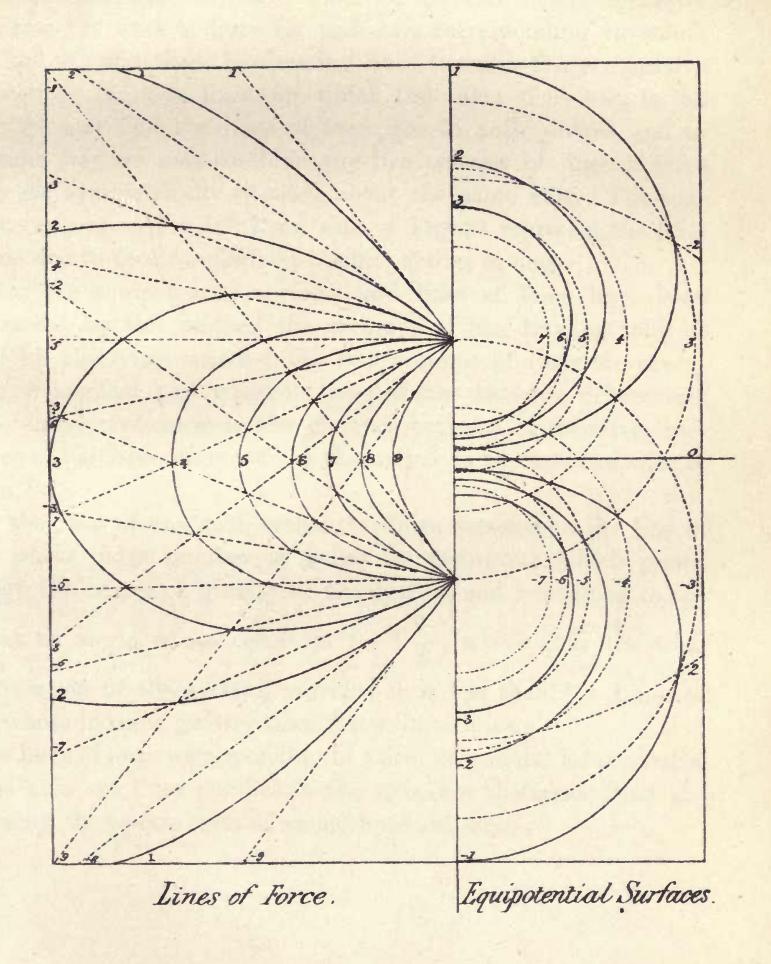
The dotted straight lines on the left hand side of Fig. 21 represent the lines of force due to each of two electrified points whose charges are 10 and −10 respectively. If there are two centres of force on the axis of the figure we may draw the lines of force for each axis corresponding to values of Ψ₁ and Ψ₂, and then, by drawing lines through the consecutive intersections of these lines, for which the value of Ψ₁ + Ψ₂ is the same, we may find the lines of force due to both centres, and in the same way we may combine any two systems of lines of force which are symmetrically situated about the same axis. The continuous curves on the left hand side of Fig. 21 represent the lines of force due to the two electrified points acting at once.
图 21 左边的虚直线表示由两个电荷分别为 10 和 −10 的带电点各自产生的力线。如果在图形的轴上有两个力心,我们可以为每个轴画出对应于 Ψ₁ 和 Ψ₂ 值的力线,然后通过画经过这些线的连续交点(对这些交点 Ψ₁ + Ψ₂ 的值相同)的线,我们可以求出由两个力心共同产生的力线;用同样方式,我们可以组合任何两个关于同一轴对称分布的力线体系。图 21 左边的连续曲线表示由两个带电点同时作用产生的力线。
After the equipotential surfaces and lines of force have been constructed by this method the accuracy of the drawing may be tested by observing whether the two systems of lines are everywhere orthogonal, and whether the distance between consecutive equipotential surfaces is to the distance between consecutive lines of force as half the distance from the axis is to the assumed unit of length.
等势面和力线用这种方法构造出来之后,可以通过观察两个线体系是否处处正交、以及相邻等势面之间的距离与相邻力线之间的距离之比是否等于距轴距离的一半与所设单位长度之比,来检验图的准确性。
In the case of any such system of finite dimensions the line of force whose index number is Ψ has an asymptote which passes through the centre of gravity of the system, and is inclined to the axis at an angle whose cosine is 1 − 2Ψ/E, where E is the total electrification of the system, provided Ψ is less than E. Lines of force whose index is greater than E are finite lines. The lines of force corresponding to a field of uniform force parallel to the axis are lines parallel to the axis, the distances from the axis being the square roots of an arithmetical series.
在任何这种有限尺寸体系的情形中,指标数为 Ψ 的力线有一条渐近线,它通过体系的重心,且与轴成角,其角的余弦为 1 − 2Ψ/E(E 是体系的总带电),只要 Ψ 小于 E。指标大于 E 的力线是有限线。对应于与轴平行的均匀力场的力线是平行于轴的线,它们距轴的距离是一个等差级数的平方根。
第七章 · 电像理论Chapter VII — Theory of Electrical Images
电像法导论Introduction
99. The calculation of the distribution of electrification on the surface of a conductor when electrified bodies are placed near it is in general an operation beyond the powers of existing mathematical methods.
99. 当带电体被放在一个导体附近时,计算导体表面上带电的分布,一般说来是一项超出已有数学方法能力范围的工作。
When the conductor is a sphere, and when the distribution of electricity on external bodies is given, a solution, depending on an infinite series was obtained by Poisson. This solution agrees with that which was afterwards given in a far simpler form by Sir W. Thomson, and which is the foundation of his method of Electric Images.
当导体是球、且外部物体上电的分布给定时,泊松得到了一个依赖于无穷级数的解。这个解与后来 W. 汤姆孙爵士以远为简单的形式给出的解相一致,后者是他的电像法(method of Electric Images)的基础。
By this method he has solved problems in electricity which have never been attempted by any other method, and which, even after the solution has been pointed out, no other method seems capable of attacking. This method has the great advantage of being intelligible by the aid of the most elementary mathematical reasoning, especially when it is considered in connection with the diagrams of equipotential surfaces described in Arts. 93–96.
用这个方法,他解决了从未被任何其他方法尝试过、而且在解被指出之后似乎也没有其他方法能够攻克的一些电学问题。这个方法有一个很大的优点:借助最基本的数学推理就能理解,尤其是把它与第 93–96 条所述等势面的图结合起来考虑时。
100. The idea of an image is most easily acquired by considering the optical phenomena on account of which the term image was first introduced into science.
100. 「像」(image)的观念,通过考虑光学现象最容易获得——正是由于这些现象,「像」一词才首次被引入科学。
We are accustomed to make use of the visual impressions we receive through our eyes in order to ascertain the positions of distant objects. We are doing this all day long in a manner sufficiently accurate for ordinary purposes. Surveyors and astronomers by means of artificial instruments and mathematical deductions do the same thing with greater exactness. In whatever way, however, we make our deductions we find that they are consistent with the hypothesis that an object exists in a certain position in space, from which it emits light which travels to our eyes or to our instruments in straight lines.
我们习惯于利用通过眼睛接收的视觉印象来确定远处物体的位置。我们整天都在以对一般目的足够准确的方式做这件事。测量员和天文学家借助人工仪器和数学推演,以更高的精确度做同样的事。然而,无论我们以什么方式进行推演,都会发现它们与这样一个假设相一致:物体存在于空间中的某个位置,并从那里发出沿直线传播到我们眼睛或仪器的光。
But if we stand in front of a plane mirror and make observations on the apparent direction of the objects reflected therein, we find that these observations are consistent with the hypothesis that there is no mirror, but that certain objects exist in the region beyond the plane of the mirror. These hypothetical objects are geometrically related to certain real objects in front of the plane of the mirror, and they are called the images of these objects.
但是,如果我们站在平面镜前,观察镜中所反射物体的表观方向,我们就会发现这些观察与这样一个假设相一致:根本没有镜子,而是某些物体存在于镜面之后的区域中。这些假设的物体与镜面前方的某些真实物体有几何关系,它们被称为这些物体的「像」(images)。
We are not provided with a special sense for enabling us to ascertain the presence and the position of distant bodies by means of their electrical effects, but we have instrumental methods by which the distribution of potential and of electric force in any part of the field may be ascertained, and from these data we obtain a certain amount of evidence as to the position and electrification of the distant body.
我们没有一种特殊感官,使我们能借助远处物体的电效应来确定它们的存在和位置,但我们有仪器方法,可以确定场中任何部分电势和电力的分布,而从这些数据中,我们能获得关于远处物体位置和带电的一定证据。
If an astronomer, for instance, could ascertain the direction and magnitude of the force of gravitation at any desired point in the heavenly spaces, he could deduce the positions and masses of the bodies to which the force is due. When Adams and Leverrier discovered the hitherto unknown planet Neptune, they did so by ascertaining the direction and magnitude of the gravitating force due to the unseen planet at certain points of space. In the electrical problem we employed an electrified pith ball, which we moved about in the field at pleasure. The astronomers employed for a similar purpose the planet Uranus, over which, indeed, they had no control, but which moved of itself into such positions that the alterations of the elements of its orbit served to indicate the position of the unknown disturbing planet.
例如,如果一个天文学家能确定天空间中任一所需点处引力的方向和大小,他就能推出产生该力的天体的位置和质量。当亚当斯和勒维耶发现此前未知的海王星时,他们正是通过确定看不见的行星在空间某些点处产生的引力的方向和大小做到的。在电学问题中,我们使用一个带电髓球,随心所欲地在场中移动它。天文学家为类似目的使用了天王星——诚然,他们对它没有控制权,但它自己会移动到这样的位置:其轨道要素的改变指示了未知摄动行星的位置。
逆点与电像Inverse Points and the Electric Image
101. In one of the electrified systems which we have already investigated, that of a spherical conductor A within a concentric spherical conducting vessel B, we have one of the simplest cases of the principle of electric images. The electric field is in this case the region which lies between the two concentric spherical surfaces. The electric force at any point P within this region is in the direction of the radius OP and numerically equal to the charge of the inner sphere, A, divided by the square of the distance, OP, of the point from the common centre. It is evident, therefore, that the force within this region will be the same if we substitute for the electrified spherical surfaces, A and B, any other two concentric spherical surfaces, C and D, one of them, C, lying within the smaller sphere, A, and the other, D, lying outside of B, the charge of C being equal to that of A in the former case. The electric phenomena in the region between A and B are therefore the same as before, the only difference between the cases is that in the region between A and C and also in the region between B and D we now find electric forces acting according to the same law as in the region between A and B, whereas when the region was bounded by the conducting surfaces A and B there was no electrical force whatever in the regions beyond these surfaces.
101. 在我们已经研究过的一个带电体系中——即球形导体 A 处于同心球形导体容器 B 之内的体系——我们得到了电像原理的最简单情形之一。这种情形中的电场是两个同心球面之间的区域。该区域内任一点 P 处的电力沿半径 OP 方向,数值上等于内球 A 的电荷除以该点到共同中心距离 OP 的平方。因此,很明显,如果我们用任何另外两个同心球面 C 和 D(其中一个 C 在较小球 A 之内、另一个 D 在 B 之外)代替带电球面 A 和 B,且 C 的电荷等于前述情形中 A 的电荷,那么这个区域内的力将是相同的。因此,A 和 B 之间区域中的电现象与之前相同,两种情形之间的唯一差别是:在 A 和 C 之间以及 B 和 D 之间的区域中,我们现在发现电力按与 A 和 B 之间区域相同的定律作用,而当区域以导体面 A 和 B 为界时,这些面之外的区域中根本没有电力。
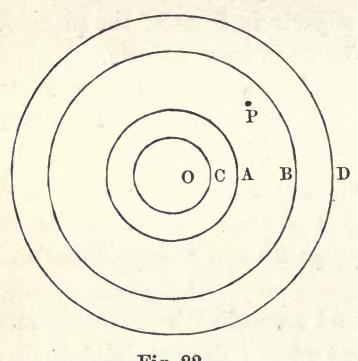
We may even, for mathematical purposes, suppose the inner sphere C to be reduced to a physical point at O, and the outer sphere D to expand to an infinite size, and thus we assimilate the electric action in the region between A and B to that due to an electrified point at O placed in an infinite region. It appears, therefore, that when a spherical surface is uniformly electrified, the electric phenomena in the region outside the sphere are exactly the same as if the spherical surface had been removed, and a very small body placed at the centre of the sphere, having the same electric charge as the sphere.
我们甚至可以为数学目的,设想内球 C 缩小为 O 处的一个物理点、外球 D 扩大到无限大,这样我们就把 A 和 B 之间区域中的电作用,类比于放在无限区域中 O 处的一个带电点的作用。因此,看来当一个球面被均匀带电时,球外区域中的电现象,与把球面移去、并在球心处放一个与球有相同电荷的很小物体时的现象完全相同。
This is a simple instance in which the phenomena in a certain region are consistent with a false hypothesis as to what exists beyond that region. The action of a uniformly electrified spherical surface in the region outside that surface is such that the phenomena may be attributed to an imaginary electrified point at the centre of the sphere. The potential, ψ, of a sphere of radius a, placed in infinite space and charged with a quantity e of electricity, is e/a. Hence if ψ is the potential of the sphere, the imaginary charge at its centre is ψa.
这是一个简单实例,其中某个区域中的现象与关于该区域之外存在什么的错误假设相一致。均匀带电球面在该球面外区域中的作用是这样的:现象可以归因于球心处的一个想象带电点。半径为 a、放在无限空间中、带电量 e 的球的电势 ψ 是 e/a。因此,如果 ψ 是球的电势,那么其球心处的想象电荷是 ψa。
102. Now let us calculate the potential at a point P in a spherical surface whose centre is C and radius CP, due to two electrified points A and B in the same radius produced, and such that the product of their distances from the centre is equal to the square of the radius. Points thus related to one another are called inverse points with respect to the sphere.
102. 现在让我们计算:中心为 C、半径为 CP 的一个球面上的点 P 处,由同一条半径延长线上的两个带电点 A 和 B 产生的电势,其中 A、B 到中心距离的乘积等于半径的平方。彼此这样相关的点,称为关于该球的逆点(inverse points)。
Let a = CP be the radius of the sphere. Let CA = ma, then CB will be a/m. Also the triangle APC is similar to PCB, and AP : PB :: AC : PC, or AP = m·BP. See Euclid vi. prop. E.
设 a = CP 为球的半径。设 CA = ma,那么 CB 将是 a/m。此外,三角形 APC 与 PCB 相似,并且 AP : PB :: AC : PC,即 AP = m·BP。见欧几里得《几何原本》卷六命题 E。
Now let a charge of electricity equal to e be placed at A and a charge e′ = −e/m of the opposite kind be placed at B. The potential due to these charges at P will be V = e/AP + e′/BP = e/(m·BP) − e/(m·BP) = 0; or the potential due to the charges at A and B at any point P of the spherical surface is zero.
现在设一个等于 e 的电荷放在 A 处,一个相反种类的电荷 e′ = −e/m 放在 B 处。这些电荷在 P 处产生的电势将是 V = e/AP + e′/BP = e/(m·BP) − e/(m·BP) = 0;即 A 和 B 处的电荷在球面的任一点 P 处产生的电势为零。
We may now suppose the spherical surface to be a thin shell of metal. Its potential is already zero at every point, so that if we connect it by a fine wire with the earth there will be no alteration of its potential, and therefore the potential at every point, whether within or without the surface, will remain unaltered, and will be that due to the two electrified points A and B.
我们现在可以设想球面是一个薄的金属壳。它的电势在每一点已经为零,所以如果我们用一根细线把它与地相连,它的电势不会有任何改变,因此每一点(无论面内还是面外)的电势都将保持不变,并且就是由两个带电点 A 和 B 产生的电势。
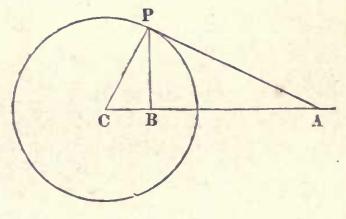
If we now keep the metallic shell in connection with the earth and remove the electrified point B, the potential at every point within the sphere will become zero, but outside it will remain as before. For the surface of the sphere still remains of the same potential, and no change has been made in the distribution of electrified bodies in the region outside the sphere.
如果我们现在让金属壳保持与地相连,并移去带电点 B,球内每一点的电势将变为零,但球外将保持与之前相同。因为球的表面仍保持相同的电势,而球外区域中带电体的分布没有发生任何改变。
Hence, if an electrified point A be placed outside a spherical conductor which is at potential zero, the electrical action at all points outside the sphere will be equivalent to that due to the point A together with another point, B, within the sphere, which is the inverse point to A, and whose charge is to that of A as −1 is to m. The point B with its imaginary charge is called the electric image of A.
因此,如果一个带电点 A 被放在一个处于零电势的球形导体之外,那么球外所有点的电作用,将等价于由点 A 连同球内另一个点 B 产生的电作用,B 是 A 的逆点,其电荷与 A 的电荷之比为 −1 比 m。带想象电荷的点 B 称为 A 的「电像」(electric image)。
In the same way by removing A and retaining B, we may show that if an electrified point B be placed inside a hollow conductor having its inner surface spherical, the electrical action within the hollow is equivalent to that of the point B, together with an imaginary point, A, outside the sphere, whose charge is to that of B as m is to −1.
用同样方式,通过移去 A、保留 B,我们可以证明:如果一个带电点 B 被放在一个内表面为球面的空心导体之内,那么空腔内的电作用等价于点 B 连同球外一个想象点 A 的作用,A 的电荷与 B 的电荷之比为 m 比 −1。
If the sphere, instead of being in connection with the earth, and therefore at potential zero, is at potential ψ, the electrical effects outside the sphere will be the same as if, in addition to the image of the electrified point, another imaginary charge equal to ψa were placed at the centre of the sphere. Within the sphere the potential will simply be increased by ψ.
如果球不是与地相连(从而处于零电势),而是处于电势 ψ,那么球外的电效应将与如下情况相同:除了带电点的像之外,还有一个等于 ψa 的想象电荷放在球心处。球内的电势将简单地增加 ψ。
两球体系Two Spheres
103. As an example of the method of electric images let us calculate the electric state of two spheres whose radii are a and b respectively, and whose potentials are Pa and Pb, the distance between their centres being c. We shall suppose b to be small compared with c.
103. 作为电像法的一个例子,让我们计算两个球的电状态,它们的半径分别为 a 和 b,电势为 Pa 和 Pb,两球心之间的距离为 c。我们设想 b 与 c 相比很小。
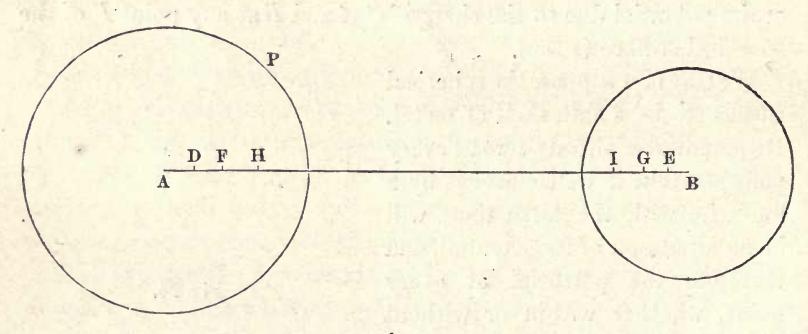
We may consider the actual electrical effects at any point outside the two spheres as due to a series of electric images. In the first place, since the potential of the sphere A is Pa we must place an image at the centre A with a charge aPa. Similarly at B, the centre of the other sphere, we must place a charge bPb.
我们可以把两球之外任一点的实际电效应视为由一系列电像产生。首先,由于球 A 的电势是 Pa,我们必须在中心 A 处放一个电荷为 aPa 的像。类似地,在另一个球的中心 B 处,我们必须放一个电荷 bPb。
Each of these images will have an image of the second order in the other sphere. The image of B in the sphere a will be at D, where AD = a²/c, and the charge D = −(a/c)·bPb. The image of A in the sphere b will be at E, where BE = b²/c, and the charge E = −(b/c)·aPa.
这些像中的每一个,都将在另一个球中有一个二阶像。B 在球 a 中的像将在 D 处,其中 AD = a²/c,电荷 D = −(a/c)·bPb。A 在球 b 中的像将在 E 处,其中 BE = b²/c,电荷 E = −(b/c)·aPa。
Each of these will have an image of the third order. That of E in a will be at F, where AF = a²/AE = a²c/(c² − b²), and F = a²bPa/(c² − b²). That of D in b will be at G, where BG = b²/DB = b²c/(c² − a²), and G = ab²Pb/(c² − a²).
这些中的每一个都将有一个三阶像。E 在 a 中的像将在 F 处,其中 AF = a²/AE = a²c/(c² − b²),F = a²bPa/(c² − b²)。D 在 b 中的像将在 G 处,其中 BG = b²/DB = b²c/(c² − a²),G = ab²Pb/(c² − a²)。
The images of the fourth order will be, of G in a at H, where AH = a²/AG = a²(c² − a²)/[c(c² − a² − b²)], and H = a²b²Pb/[c(c² − a² − b²)]; of F in b at I, where BI = b²/FB = b²(c² − b²)/[c(c² − a² − b²)], and I = a²b²Pa/[c(c² − a² − b²)]. We might go on with a series of images for ever, but if b is small compared with c, the images will rapidly become smaller and may be neglected after the fourth order.
四阶像将是:G 在 a 中的像在 H 处,其中 AH = a²/AG = a²(c² − a²)/[c(c² − a² − b²)],H = a²b²Pb/[c(c² − a² − b²)];F 在 b 中的像在 I 处,其中 BI = b²/FB = b²(c² − b²)/[c(c² − a² − b²)],I = a²b²Pa/[c(c² − a² − b²)]。我们可以永远继续做一系列像下去,但如果 b 与 c 相比很小,这些像会迅速变小,在四阶之后就可以忽略。
If we now write
如果我们现在写
$$q_{aa} = a + \frac{a^2b}{c^2 - b^2} + \&c., \qquad q_{ab} = -\frac{ab}{c} - \frac{a^2b^2}{c(c^2 - a^2 - b^2)} - \&c., \qquad q_{bb} = b + \frac{ab^2}{c^2 - a^2} + \&c.,$$
$$q_{aa} = a + \frac{a^2b}{c^2 - b^2} + \ldots, \qquad q_{ab} = -\frac{ab}{c} - \frac{a^2b^2}{c(c^2 - a^2 - b^2)} - \ldots, \qquad q_{bb} = b + \frac{ab^2}{c^2 - a^2} + \ldots,$$
the whole charge of the sphere a will be Ea = qaaPa + qabPb, and that of the sphere b will be Eb = qabPa + qbbPb.
球 a 的总电荷将是 Ea = qaaPa + qabPb,球 b 的总电荷将是 Eb = qabPa + qbbPb。
104. From these results we may calculate the potentials of the two spheres when their charges are given, and if we neglect terms involving b³ we find
104. 从这些结果我们可以计算电荷给定时两球的电势,而如果忽略含 b³ 的项,我们得到
$$P_a = \frac{1}{a} E_a + \frac{1}{c} E_b, \qquad P_b = \frac{1}{c} E_a + \left\{ \frac{1}{b} - \frac{a^3}{c^2 (c^2 - a^2)} \right\} E_b.$$
$$P_a = \frac{1}{a} E_a + \frac{1}{c} E_b, \qquad P_b = \frac{1}{c} E_a + \left\{ \frac{1}{b} - \frac{a^3}{c^2 (c^2 - a^2)} \right\} E_b.$$
The electric energy of the system is
体系的电能是
$$\tfrac{1}{2}(E_a P_a + E_b P_b) = \tfrac{1}{2} \frac{1}{a} E_a^2 + \frac{1}{c} E_a E_b + \tfrac{1}{2} \left\{ \frac{1}{b} - \frac{a^3}{c^2 (c^2 - a^2)} \right\} E_b^2.$$
$$\tfrac{1}{2}(E_a P_a + E_b P_b) = \tfrac{1}{2} \frac{1}{a} E_a^2 + \frac{1}{c} E_a E_b + \tfrac{1}{2} \left\{ \frac{1}{b} - \frac{a^3}{c^2 (c^2 - a^2)} \right\} E_b^2.$$
The repulsion, R, between the two spheres is measured by the rate at which the energy diminishes as c increases; therefore,
两球之间的斥力 R,由能量随 c 增大而减小的速率来量度;因此,
$$R = \frac{E_b}{c^2} \left\{ E_a - E_b \frac{a^3 (2 c^2 - a^2)}{c (c^2 - a^2)^2} \right\}.$$
$$R = \frac{E_b}{c^2} \left\{ E_a - E_b \frac{a^3 (2 c^2 - a^2)}{c (c^2 - a^2)^2} \right\}.$$
In order that the force may be repulsive it is necessary that the charges of the spheres should be of the same sign, and Ea must be greater than Eb·a³(2c² − a²)/[c(c² − a²)²]. Hence the force is always attractive,—1. When either sphere is uninsulated; 2. When either sphere has no charge; 3. When the spheres are very nearly in contact, if their potentials are different. When the potentials of the two spheres are equal the force is always repulsive.
为使力是斥力,必须两球的电荷同号,且 Ea 必须大于 Eb·a³(2c² − a²)/[c(c² − a²)²]。因此,在以下情形中力总是吸引的:——1. 当任一球不绝缘时;2. 当任一球无电荷时;3. 当两球几乎接触、且它们的电势不同时。当两球的电势相等时,力总是斥力。
球面上的电力Electric Force at the Surface
105. To determine the electric force at any point just outside of the surface of a conducting sphere connected with the earth arising from the presence of an electrified point A outside the sphere. The electrical conditions at all points outside the sphere are equivalent, as we have seen, to those due to the point A together with its image at B. If e is the charge of the point A (Fig. 23), the force due to it at P is e/AP² in the direction AP. Resolving this force in a direction parallel to AC and along the radius, its components are (e/AP³)AC in the direction parallel to AC and (e/AP³)CP in the direction CP. The charge of the image of A at B is −e·CP/CA, and the force due to the image at P is e(CP/CA)(1/BP²) in the direction PB.
105. 确定一个与地相连的导体球表面之外紧靠表面的任一点处、由球外带电点 A 的存在而产生的电力。球外所有点的电条件(如我们所见)等价于由点 A 连同它在 B 处的像产生的条件。如果 e 是点 A(图 23)的电荷,它在 P 处产生的力是 e/AP²、沿 AP 方向。把这个力沿平行于 AC 的方向和沿半径方向分解,其分量是沿平行于 AC 方向的 (e/AP³)AC 和沿 CP 方向的 (e/AP³)CP。A 在 B 处像的电荷是 −e·CP/CA,像在 P 处产生的力是 e(CP/CA)(1/BP²)、沿 PB 方向。
If a is the radius of the sphere and if CA = f = ma and AP = r, then CB = a/m and BP = r/m; and if e is the charge of the point A, the charge of its image at B is −e/m. The force at P due to the charge e at A is e/r² in the direction AP. Resolving this force in the direction of the radius and a direction parallel to AC, its components are (e/r²)(ma/r) in the direction AC, and (e/r²)(a/r) in the direction CP. The force at P due to the image −e/m at B is (e/m)(1/BP²) or em/r² in the direction PB. Resolving this in the same directions as the other force, its components are (em/r²)(BC/BP) = ema/r³ in the direction CA, and (em/r²)(CP/BP) = em²a/r³ in the direction PC.
如果 a 是球的半径,且 CA = f = ma、AP = r,那么 CB = a/m、BP = r/m;如果 e 是点 A 的电荷,它在 B 处像的电荷是 −e/m。电荷 e 在 A 处对 P 产生的力是 e/r²、沿 AP 方向。把这个力沿半径方向和沿平行于 AC 的方向分解,其分量是沿 AC 方向的 (e/r²)(ma/r),和沿 CP 方向的 (e/r²)(a/r)。像 −e/m 在 B 处对 P 产生的力是 (e/m)(1/BP²) 或 em/r²、沿 PB 方向。把它沿与另一个力相同的方向分解,其分量是沿 CA 方向的 (em/r²)(BC/BP) = ema/r³,和沿 PC 方向的 (em/r²)(CP/BP) = em²a/r³。
The components in the direction parallel to AC are equal but in opposite directions. The resultant force is therefore in the direction of the radius, which confirms what we have already proved, that the sphere is an equipotential surface to which the resultant force is everywhere normal. The resultant force is therefore in the direction PC, and is equal to (ea/r³)(m² − 1) in the direction PC, that is to say, towards the centre of the sphere.
沿平行于 AC 方向的分量相等但方向相反。因此合力沿半径方向,这印证了我们已证明的:球是一个等势面,合力处处垂直于它。因此合力沿 PC 方向,等于沿 PC 方向的 (ea/r³)(m² − 1),也就是朝向球心。
From this we may ascertain the surface density of the electrification at any point of the sphere, for, by Coulomb's law, if σ is the surface density, 4πσ = R, where R is the resultant force acting outwards. Hence, as the resultant force in this case acts inwards, the surface density is everywhere negative, and is
由此我们可以确定球上任一点处带电的面密度,因为由库仑定律,如果 σ 是面密度,则 4πσ = R,其中 R 是向外作用的合力。因此,由于这种情形中合力向内作用,面密度处处为负,并且是
$$\sigma = -\frac{1}{4\pi} \frac{ea}{r^3} (m^2 - 1).$$
$$\sigma = -\frac{1}{4\pi} \frac{ea}{r^3} (m^2 - 1).$$
Hence the surface density is inversely as the cube of the distance from the inducing point A.
因此,面密度与到施感点 A 的距离的立方成反比。
106. In the case of the two spheres A and B (Fig. 24), whose radii are a and b and potentials Pa and Pb, the distance between their centres being c, we may determine the surface density at any point of the sphere A by considering it as due to the action of a charge aPa at A, together with that due to the pairs of points B, D and E, F &c., the successive pairs of images. Putting r = PB, r₁ = PE, r₂ = PG, &c., we find
106. 在两球 A 和 B(图 24)的情形中,它们的半径为 a 和 b、电势为 Pa 和 Pb,两球心距离为 c,我们可以通过把球 A 上任一点的面密度视为由 A 处电荷 aPa 的作用、连同各对点 B、D 和 E、F 等(逐对的像)的作用来确定。令 r = PB、r₁ = PE、r₂ = PG 等,我们得到
$$\sigma = \frac{1}{4\pi} P_a \left[ \frac{1}{a} + \frac{b}{r_1^3} \frac{\{(c^2 - b^2)^2 - a^2 c^2\}}{a^2 c} + \&c. \right] - \frac{1}{4\pi} P_b \left[ \frac{b}{ar^3} (c^2 - a^2) + \frac{b^2 c^2}{r_2^3 (c^2 - a^2)} \left\{ \left( \frac{c^2 - a^2 - b^2}{c^2 - a^2} \right)^2 - \frac{a^2}{c^2} \right\} + \&c. \right].$$
$$\sigma = \frac{1}{4\pi} P_a \left[ \frac{1}{a} + \frac{b}{r_1^3} \frac{\{(c^2 - b^2)^2 - a^2 c^2\}}{a^2 c} + \ldots \right] - \frac{1}{4\pi} P_b \left[ \frac{b}{ar^3} (c^2 - a^2) + \frac{b^2 c^2}{r_2^3 (c^2 - a^2)} \left\{ \left( \frac{c^2 - a^2 - b^2}{c^2 - a^2} \right)^2 - \frac{a^2}{c^2} \right\} + \ldots \right].$$
If we call B the inducing body and A the induced body, then we may consider the electrification induced on A as consisting of two parts, one depending on the potential of B and the other on its own potential.
如果我们称 B 为施感体、A 为被感体,那么我们可以把在 A 上感生的带电视为由两部分组成:一部分依赖于 B 的电势,另一部分依赖于它自身的电势。
The part depending on Pb is called by some writers on electricity the induced electrification of the first species. When A is not insulated it constitutes the whole electrification, and if Pb is positive it is negative over every part of the surface, but greatest in numerical value at the point nearest to B.
依赖于 Pb 的部分,被某些电学作者称为第一类感生带电(induced electrification of the first species)。当 A 不绝缘时,它构成整个带电;而如果 Pb 为正,它在表面的每一部分都是负的,但在最靠近 B 的点处数值最大。
The part depending on Pa is called the induced electrification of the second species. It can only exist when A is insulated, and it is everywhere of the same sign as Pa. If A is insulated and without charge, then the induced electrifications of the first and second species must be equal and opposite. The surface-density is negative on the side next to B and positive on the side furthest from B, but though the total quantities of positive and negative electrification are equal, the negative electrification is more concentrated than the positive, so that the neutral line which separates the positive from the negative electrification is not the equator of the sphere, but lies nearer to B.
依赖于 Pa 的部分称为第二类感生带电(induced electrification of the second species)。它只有当 A 绝缘时才存在,并且处处与 Pa 同号。如果 A 绝缘且无电荷,那么第一类和第二类感生带电必须相等且相反。面密度在靠近 B 的一侧为负、在离 B 最远的一侧为正,但尽管正负带电的总量相等,负电比正电更集中,所以把正电与负电分开的中性线不是球的赤道,而是更靠近 B。
The condition that there shall be both positive and negative electrification on the sphere is that the value of σ at the points nearest to B and farthest from B shall have opposite signs. If a and b are small compared with c, we may neglect all the terms of the coefficients of Pa and Pb after the first. The values of r lie between c+a and c−a. Hence, if Pa is between Pb·b(c−a)/(c+a)² and Pb·b(c+a)/(c−a)², there will be both positive and negative electrification on A, divided by a neutral line, but if Pa is beyond these limits, the electrification of every part of the surface will be of one kind; negative if Pa is below the lower limit, and positive if it is above the higher limit.
球上同时存在正电和负电的条件,是 σ 在最靠近 B 和最远离 B 的点处的值符号相反。如果 a 和 b 与 c 相比很小,我们可以忽略 Pa 和 Pb 的系数中第一项之后的所有项。r 的值介于 c+a 和 c−a 之间。因此,如果 Pa 介于 Pb·b(c−a)/(c+a)² 和 Pb·b(c+a)/(c−a)² 之间,A 上就将同时有正电和负电、被一条中性线分开;但如果 Pa 超出这些界限,表面每一部分的带电都将是同一种;如果 Pa 低于下界则为负,如果高于上界则为正。
第八章 · 静电容量Chapter VIII — On Electrostatic Capacity
电容与电容器Capacity and Condensers
107. The capacity of a conductor is measured by the charge of electricity which will raise its potential to the value unity, the potential of all other conductors in the field being kept at zero. The capacity of a conductor depends not only on its own form and size, but on the form and position of the other conductors in the field. The nearer the uninsulated conductors are placed the greater is the capacity of the charged conductor.
107. 一个导体的电容,由把它的电势升到 1、而场中所有其他导体的电势保持为零所需的电荷来量度。导体的电容不仅取决于它自身的形式和大小,还取决于场中其他导体的形式和位置。不绝缘的导体放置得越近,带电导体的电容就越大。
An apparatus consisting of two insulated conductors, each presenting a large surface to the other with a small distance between them, is called a condenser, because a small electromotive force is able to charge such an apparatus with a large quantity of electricity.
由两个彼此以很大表面相对、且相距很近的绝缘导体组成的装置,称为电容器(condenser),因为一个很小的电动势就能给这种装置充上大量的电。
The simplest form of condenser, that to which the name is most commonly applied, consists of two disks placed parallel to each other, the medium between them being air. When one of these disks is connected to the zinc and the other to the copper electrode of a voltaic battery, the disks become charged with negative and positive electricity respectively, and the amount of the charge is the greater the nearer the disks are placed to each other, being approximately inversely as the distance between them. Hence by bringing the disks very close to each other, connecting them with the electrodes of the battery and then disconnecting them from the battery, we have two large charges of opposite kinds insulated on the disks. If we now remove one of the disks from the other we do work against the electric attraction which draws them together, and we may thus increase the energy of the system so much that, though the original electromotive force was only that of a single voltaic cell, either of the disks when separated may be raised to so high a potential that the gold leaves of an electrometer connected with it are deflected.
最简单的电容器形式(名称最常用到的那种)由两个彼此平行放置的圆盘组成,它们之间的介质是空气。当一个盘与伏打电池的锌电极相连、另一个与铜电极相连时,两个盘就分别带上负电和正电,而且电荷量随两盘放得越近而越大,近似地与它们之间的距离成反比。因此,通过把两盘放得非常近、把它们与电池电极相连、然后断开与电池的连接,我们就在两盘上绝缘了两个相反种类的大电荷。如果我们现在把一个盘从另一个盘移开,我们就克服把它们拉到一起的电吸引做了功,因而可以使体系的能量增大到这样的程度:尽管原始电动势只是单个伏打电池的电动势,分开后的任一盘都可以被升到如此高的电势,以致与它相连的验电器的金箔发生偏转。
It was in this way that Volta demonstrated that the electrification due to a voltaic cell is of the same kind as that due to friction, the copper electrode being positive with respect to the zinc electrode. In this condenser the capacity of each disk depends principally on the distance between it and the other disk, but it also depends in a smaller degree on the nature of the electric field at the back of the disk.
正是用这种方式,伏打证明了伏打电池产生的带电与摩擦产生的带电属于同一种类,铜电极相对于锌电极为正。在这个电容器中,每个盘的电容主要取决于它与另一个盘之间的距离,但在较小程度上也取决于盘背面电场的性质。
There are other forms of condensers, however, in which one of the conductors is almost or altogether surrounded by the other. In this case the capacity of the inner conductor is almost or altogether independent of everything but the outer conductor. This is the case in the Leyden jar, and in a cable with a copper core surrounded by an insulator the outside of which is protected by a sheathing of iron wires.
然而,还有另一些形式的电容器,其中一个导体几乎或完全被另一个包围。在这种情形中,内导体的电容几乎或完全独立于外导体之外的一切。莱顿瓶就是这种情况,铜芯被绝缘体包围、外面由铁线护套保护的电缆也是这种情况。
108. But in most cases the charge of each conductor depends not only on the difference between its potential and that of the other conductor, but also in part on the difference between its potential and that of some other body, such as the earth, or the walls of the room where the experiment is made. The charges of the two conductors may, therefore, in the simpler cases be written
108. 但在大多数情况下,每个导体的电荷不仅取决于它与另一个导体电势之差,还部分取决于它与某个其他物体(如大地、或进行实验的房间的墙壁)电势之差。因此,两个导体的电荷在较简单的情形中可以写成
$$Q = K(P-p) + HP, \dots (1)$$
$$Q = K(P-p) + HP, \dots (1)$$
$$q = K(p-P) + hp, \dots (2)$$
$$q = K(p-P) + hp, \dots (2)$$
where P and p are the potentials, that of the walls of the room being zero, Q and q the charges of the two conductors respectively, K is the capacity of the condenser in so far as it depends on the mutual relation of the two conductors, and H and k represent those parts of the capacity of each conductor which depend on their relation to external objects, such as the walls of the room.
其中 P 和 p 是电势(房间墙壁的电势为零),Q 和 q 分别是两个导体的电荷,K 是电容器就两个导体相互关系而言的电容,H 和 k 表示每个导体电容中依赖于它们与外部物体(如房间墙壁)关系的那些部分。
If we connect the second conductor with the earth we make p zero while Q remains the same, and we get for the new values of P, Q, and q,
如果我们把第二个导体与地相连,就使 p 为零而 Q 保持不变,我们得到 P、Q 和 q 的新值为
$$P_1 = P - \frac{K}{K+H}p, \qquad Q_1 = (K+H)P_1, \qquad q_1 = -KP_1. \quad (3)$$
$$P_1 = P - \frac{K}{K+H}p, \qquad Q_1 = (K+H)P_1, \qquad q_1 = -KP_1. \quad (3)$$
If we now insulate the second conductor and connect the first with the earth we make P zero, and
如果我们现在使第二个导体绝缘、并把第一个与地相连,就使 P 为零,并且
$$p_2 = -\frac{K}{K+h} P_1, \qquad Q_2 = -Kp_2, \qquad q_2 = (K+h) p_2. \quad (4)$$
$$p_2 = -\frac{K}{K+h} P_1, \qquad Q_2 = -Kp_2, \qquad q_2 = (K+h) p_2. \quad (4)$$
If we again insulate the first conductor and put the second to earth,
如果我们再次使第一个导体绝缘、并把第二个接地,
$$P_3 = -\frac{K}{K+H}p_2, \qquad Q_3 = (K+H)P_3, \qquad q_3 = -KP_3. \quad (5)$$
$$P_3 = -\frac{K}{K+H}p_2, \qquad Q_3 = (K+H)P_3, \qquad q_3 = -KP_3. \quad (5)$$
From this it appears that if we connect first the one and then the other conductor with the earth the values of the potentials and charges will be diminished in the ratio of K²/((K+H)(K+h)) to unity.
由此看来,如果我们先把一个、再把另一个导体与地相连,电势和电荷的值将按 K²/((K+H)(K+h)) 比 1 的比例减小。
两个电容器的比较Comparison of two condensers
109. Let us suppose the condensers to be Leyden jars having an inner and an outer coating. Let the inner coating of the first jar and the outer coating of the second be connected with a source of electricity and brought to the potential P, while the outer coating of the first and the inner coating of the second are connected with the earth. Then if Q₁ and Q₂ are the charges of the inner coatings of the two jars, Q₁ = (K₁ + H₁)P, Q₂ = −K₂P. ... (7)
109. 让我们设想电容器是莱顿瓶,各有一个内涂层和一个外涂层。设第一个瓶的内涂层和第二个瓶的外涂层与电源相连、被带到电势 P,而第一个瓶的外涂层和第二个瓶的内涂层与地相连。那么如果 Q₁ 和 Q₂ 是两个瓶内涂层的电荷,则 Q₁ = (K₁ + H₁)P,Q₂ = −K₂P。... (7)
Now let the outer coatings of both jars be connected with the earth, and let the inner coatings be connected with each other. Required the common potential of the inner coatings. Here we have p₁′ = p₂′ = 0, Q₁ + Q₂ = Q₁′ + Q₂′, (8) P₁′ = P₂′ = P′, ... (9) and we have to find P′. Equation (8) becomes, in virtue of (9),
现在让两个瓶的外涂层都与地相连,并让两个内涂层彼此相连。求内涂层的共同电势。这里我们有 p₁′ = p₂′ = 0,Q₁ + Q₂ = Q₁′ + Q₂′,(8) P₁′ = P₂′ = P′,... (9),我们需要求 P′。由 (9),方程 (8) 变为
$$(K_1+H_1-K_2)P=(K_1+H_1+K_2+H_2)P'.$$
$$(K_1+H_1-K_2)P=(K_1+H_1+K_2+H_2)P'.$$
If K₁ + H₁ = K₂ the discharge is complete.
如果 K₁ + H₁ = K₂,则放电是完全的。
电桥法The Bridge Method
110. The following method, by which the existence of a determinate relation between the capacities of four condensers may be verified, has been employed by Sir W. Thomson.* It corresponds in electrostatics to Wheatstone's Bridge in current electricity.
110. 以下方法由 W. 汤姆孙爵士*采用,借以验证四个电容器的电容之间存在确定关系。它在静电学中对应于电流电学中的惠斯通电桥(Wheatstone's Bridge)。
In Fig. 25 the condensers are represented as Leyden jars. Two of these, P and Q, are placed with their external coatings in contact with an insulating stand β; the other two, R and S, have their external coatings connected to the earth. The inner coatings of P and R are permanently connected; so are those of Q and S. In performing the experiment the internal coatings of P and R are first charged to a potential, A, while those of Q and S are charged to a different potential, C. During this process the stand β is connected to the earth. The stand β is then disconnected from the earth and connected to one electrode of an electrometer, the other electrode being connected to earth. Since β is already reduced to potential zero by connection with the earth, there will be no disturbance of the electrometer unless there is leakage in some of the jars. We shall assume, however, that there is no leakage, and that the electrometer remains at zero.
在图 25 中,电容器表示为莱顿瓶。其中两个 P 和 Q 以其外涂层与绝缘座 β 接触放置;另外两个 R 和 S 的外涂层与地相连。P 和 R 的内涂层永久相连;Q 和 S 的内涂层也是如此。进行实验时,先把 P 和 R 的内涂层充到电势 A,而把 Q 和 S 的内涂层充到不同的电势 C。在这个过程中,座 β 与地相连。然后座 β 断开与地的连接、接到静电计的一个电极上,另一个电极接地。由于 β 已通过与地相连而降为零电势,除非某个瓶有漏电,静电计不会有扰动。然而,我们将假定没有漏电、静电计保持为零。
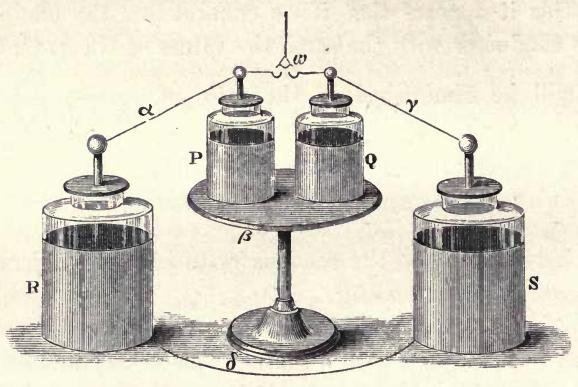
The inner coatings of the four jars are now made to communicate with each other by dropping the small insulated wire w so as to fall on the two hooks connected with a and γ. Since the potentials of a and γ are different a discharge will occur, and the potential of β will in general be affected, and this will be indicated by the electrometer. If, however, there is a certain relation among the capacities of the jars the potential of β will remain zero.
现在让四个瓶的内涂层通过把小的绝缘线 w 放下、落到与 a 和 γ 相连的两个钩子上而彼此连通。由于 a 和 γ 的电势不同,将发生放电,β 的电势一般会受到影响,这将由静电计指示出来。然而,如果各瓶电容之间存在某种关系,β 的电势将保持为零。
111. Let us ascertain what this relation must be. In Fig. 26 the same electrical arrangement is represented under a simpler form, in which the condensers consist each of a pair of disks. Under this form the analogy with Wheatstone's Bridge becomes apparent to the eye. We have to consider the potentials and charges of four conductors. The first consists of the inner coatings of P and R, together with the connecting wire. We shall call this conductor a, its charge a, and its potential A. The second consists of the outer coatings of P and Q, together with the insulating stand β. We shall call this conductor β, its charge b, and its potential B. The third consists of the inner coatings of Q and S and the connecting wire γ. We shall call this γ, its charge c, and its potential C. The fourth consists of the outer coatings of R and S and of the earth with which they are kept connected. We might use the letters δ, d, and D with reference to this conductor, but as its potential is always zero and its charge equal and opposite to that of the other conductors we shall not require to consider it.
111. 让我们确定这个关系必须是什么。在图 26 中,同一电学装置以更简单的形式表示,其中每个电容器由一对圆盘组成。在这种形式下,与惠斯通电桥的类比一眼可见。我们必须考虑四个导体的电势和电荷。第一个由 P 和 R 的内涂层连同连接线组成。我们称这个导体为 a,其电荷为 a、电势为 A。第二个由 P 和 Q 的外涂层连同绝缘座 β 组成。我们称这个导体为 β,其电荷为 b、电势为 B。第三个由 Q 和 S 的内涂层及连接线 γ 组成。我们称之为 γ,其电荷为 c、电势为 C。第四个由 R 和 S 的外涂层及与它们保持相连的大地组成。我们可以用字母 δ、d 和 D 表示这个导体,但由于它的电势始终为零、电荷与其他导体相等且相反,我们无需考虑它。
The charge of any one of the conductors depends on its own potential together with the potentials of the two adjacent conductors, and also, but in a very slight degree, on that of the opposite conductor. Let the coefficients of induction between the different pairs of the four conductors be as in the following scheme,—
任一导体的电荷取决于它自身的电势、连同两个相邻导体的电势,并且(但在很小程度上)也取决于对面导体的电势。设四个导体不同对之间的感应系数如下表所示——
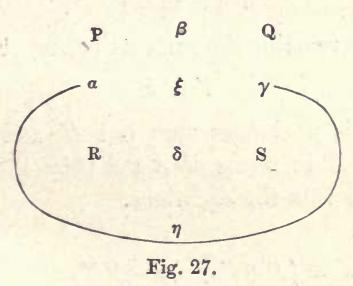
in which ξ and η are very small compared with P, Q, R, and S. The coefficient of capacity of any one of the conductors will exceed the sum of its three coefficients of induction by a quantity which will be small if the capacity of the knobs of the jars and their connecting wires are small compared with the whole capacities of the jars. Let us denote this excess by the symbols α, β, γ, δ, which belong to the conductors. The capacities therefore will be,
其中 ξ 和 η 与 P、Q、R、S 相比非常小。任一导体的电容系数将超过它的三个感应系数之和,超出量在瓶的球形接头及其连接线的电容与瓶的总电容相比很小时是很小的。让我们用属于各导体的符号 α、β、γ、δ 表示这个超出量。因此电容将是,
$$P+R+a+\eta, \qquad P+Q+\beta+\xi, \qquad Q+S+\gamma+\eta, \qquad R+S+\delta+\xi,$$
$$P+R+a+\eta, \qquad P+Q+\beta+\xi, \qquad Q+S+\gamma+\eta, \qquad R+S+\delta+\xi,$$
and the charges will therefore be,
因此电荷将是,
$$\begin{aligned} \text{for } a, &\quad a = (P + R + \alpha + \eta) A - PB - RD - \eta C, \\ \text{for } \beta, &\quad b = (P + Q + \beta + \xi) B - PA - QC - \xi D, \\ \text{for } \gamma, &\quad c = (Q + S + \gamma + \eta) C - QB - SD - \eta A, \\ \text{for } \delta, &\quad d = (R + S + \delta + \xi) D - RA - SC - \xi B. \end{aligned}$$
$$\begin{aligned} \text{对 } a, &\quad a = (P + R + \alpha + \eta) A - PB - RD - \eta C, \\ \text{对 } \beta, &\quad b = (P + Q + \beta + \xi) B - PA - QC - \xi D, \\ \text{对 } \gamma, &\quad c = (Q + S + \gamma + \eta) C - QB - SD - \eta A, \\ \text{对 } \delta, &\quad d = (R + S + \delta + \xi) D - RA - SC - \xi B. \end{aligned}$$
In the first part of the experiment the potentials of a and γ are A and C respectively, while those of β and δ are zero. Hence, at first, a = (P + R + α + η)A − ηC, b = (Q + S + γ + η)A − ηC, c = (Q + S + γ + η)C − ηA. We need not determine the charge of δ.
在实验的第一部分,a 和 γ 的电势分别是 A 和 C,而 β 和 δ 的为零。因此,起初 a = (P + R + α + η)A − ηC,b = (Q + S + γ + η)A − ηC,c = (Q + S + γ + η)C − ηA。我们无需确定 δ 的电荷。
Now let a communication be made between a and γ, and let us denote the charges and potentials of the conductors after the discharge by accented letters. The potentials of a and γ will become equal; let us call their common potential y, then A′ = C′ = y. The sum of their charges remains the same, or a′+c′ = a+c. The charge of β remains the same as before, or b′ = b, but its potential is no longer zero, but B′, and we have to determine the value of B′ in terms of A and C by eliminating the other quantities entering into the equations.
现在让 a 和 γ 之间建立连通,并用带撇的字母表示放电后各导体的电荷和电势。a 和 γ 的电势将变得相等;设它们的共同电势为 y,那么 A′ = C′ = y。它们电荷之和保持不变,即 a′+c′ = a+c。β 的电荷与之前相同,即 b′ = b,但它的电势不再是零,而是 B′,我们需要通过消去进入方程的其他量来确定 B′ 用 A 和 C 表示的值。
After discharge, a′ = (P + R + α)y − PB′, b′ = (P + Q + β + ξ)B′ − (P + Q)y, c′ = (Q + S + γ)y − QB′.
放电后,a′ = (P + R + α)y − PB′,b′ = (P + Q + β + ξ)B′ − (P + Q)y,c′ = (Q + S + γ)y − QB′。
Hence, the equation a′+c′=a+c becomes (P+R+Q+S+α+γ)y−(P+Q)B′ = (P+R+α)A+(Q+S+γ)C, and b′=b becomes (P+Q+β+ξ)B′−(P+Q)y = −PA−QC.
因此,方程 a′+c′=a+c 变为 (P+R+Q+S+α+γ)y−(P+Q)B′ = (P+R+α)A+(Q+S+γ)C,而 b′=b 变为 (P+Q+β+ξ)B′−(P+Q)y = −PA−QC。
Eliminating y from these equations, we find
从这些方程中消去 y,我们得到
$$B'\{(P+Q)(R+S) + (P+Q)(\alpha+\beta+\gamma+\xi) + (R+S+\alpha+\gamma)(\beta+\xi)\} = \{Q(R+\alpha) - P(S+\gamma)\}(A-C).$$
$$B'\{(P+Q)(R+S) + (P+Q)(\alpha+\beta+\gamma+\xi) + (R+S+\alpha+\gamma)(\beta+\xi)\} = \{Q(R+\alpha) - P(S+\gamma)\}(A-C).$$
If, therefore, the electrometer is not disturbed by the discharge, B′ = 0, and
因此,如果静电计不因放电而受扰动,则 B′ = 0,并且
$$P : Q :: R+\alpha : S+\gamma.$$
$$P : Q :: R+\alpha : S+\gamma.$$
第九章 · 电流Chapter IX — The Electric Current
对流电流与传导电流Currents of Convection and Conduction
112. Let A and B be two metal bodies connected respectively with the inner and outer coatings of a Leyden jar, the inner coating of the jar being positive, so that the potential of A is higher than that of B. Let C be a gilt pith ball suspended by a silk thread. If C is brought into contact with A and B alternately, it will receive a small charge of positive electricity from A every time it touches it, and will communicate positive electricity to B when it touches B.
112. 设 A 和 B 为两个金属体,分别与一个莱顿瓶的内涂层和外涂层相连,瓶的内涂层为正,所以 A 的电势高于 B。设 C 是一个用丝线悬挂的镀金髓球。如果让 C 交替地接触 A 和 B,它每次接触 A 时都会从 A 得到一小份正电,并在接触 B 时把正电传给 B。
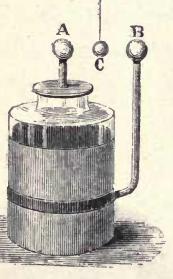
There will thus be a transference of positive electricity from A to B along the path travelled over by the pith ball, and this is what occurs in every electric current, namely, the passage of electricity along a definite direction. During the motion of the pith ball from A to B it is charged positively, and the electric force between A and B tends to move it in the direction from A to B. After touching B, it becomes charged negatively, so that the electric force, during its return journey, acts from B to A. Hence the ball is acted on by the electric force always in the direction in which it is moving at the time, so that if it is properly suspended the electric force will not only keep up the backward and forward motion, but will communicate to the moving ball an amount of energy which it will expend in a series of rattling blows against the balls A and B. The current of positive electricity from A to B is thus kept up by means of the electromotive force from A to B.
这样就会沿髓球行经的路径有正电从 A 转移到 B,而这正是在每个电流中发生的事,即电沿确定方向的通过。髓球从 A 移到 B 期间它带正电,A 和 B 之间的电力趋向于沿从 A 到 B 的方向移动它。接触 B 之后,它变为带负电,所以电力在它返回途中从 B 作用到 A。因此,球始终沿它当时运动的方向受电力作用,所以如果悬挂得当,电力不仅会维持往返运动,还会把一定能量传给运动中的球,使球在一连串碰撞 A 和 B 的咔嗒声中消耗这些能量。从 A 到 B 的正电流就这样靠从 A 到 B 的电动势维持。
113. The phenomenon we have been describing may be called a current of Convection. The motion of the electrification takes place in virtue of the motion of the electrified body which conveys or carries the electricity as it moves from one place to another. But if, instead of the pith ball, we take a metal wire carried by an insulating handle, and cause the two ends of the wire to touch A and B respectively, there will be a transference of electricity from A to B along the wire, though the wire itself does not move. What takes place in the wire is called a current of Conduction. The effects of the current of conduction on the electrical state of A and B are of precisely the same kind as those of the current of convection. In both cases there is a transference of electrification from one place to another along a continuous path.
113. 我们一直在描述的现象可以称为对流电流(current of Convection)。带电的运动是借助带电体本身的运动而发生的,带电体在从一处移到另一处时运送电。但如果我们不用髓球、而取一根用绝缘手柄拿着的金属线,并使线的两端分别接触 A 和 B,那么就会有电沿线从 A 转移到 B,尽管线本身并不移动。线中发生的事称为传导电流(current of Conduction)。传导电流对 A 和 B 电状态的效果,与对流电流的效果完全相同。在这两种情形中,都有带电沿连续路径从一处到另一处的转移。
114. In many cases we have to consider the whole quantity of electricity which passes rather than the rate at which it passes. This is especially the case when the current lasts only a very short time, or when the current is considered merely as the transition from one permanent state of the system to another. In these cases it is convenient to speak of the total current as the Electric Displacement, the word displacement indicating the final result of a motion without reference to the rate at which it takes place. The passage of a given quantity of electricity along a given path is called an Electric Discharge.
114. 在许多情况下,我们必须考虑通过的电的总量、而不是通过的速率。当电流只持续很短时间、或电流仅被视为体系从一种永久状态到另一种永久状态的过渡时尤其如此。在这些情形中,把总电流称为电位移(Electric Displacement)是方便的,「位移」一词指示运动的最终结果、而不涉及它发生的速率。给定电量沿给定路径的通过称为电放电(Electric Discharge)。
物质的分类:金属、电解质、介电体Classification of Bodies
115. For the sake of distinction we shall consider a portion of matter whose ends are formed by two equipotential surfaces having different potentials, and whose sides are formed by lines of electric current or displacement. The ends of the body are called its Electrodes, that at which electricity enters is called the Anode, and that at which it leaves the body is called the Cathode. The excess of the potential of the anode over that of the cathode is called the External Electromotive Force. The form of the body may vary from that of a long wire surrounded by air or other insulating matter to that of a thin sheet of the substance, the electricity passing through the thickness of the sheet. Bodies may be divided into three great classes according to the mode in which they are acted on by electromotive force,—Metals, Electrolytes, and Dielectrics.
115. 为区别起见,我们考虑一部分物质,其两端由两个具有不同电势的等势面形成,其侧面由电流线或位移线形成。物体的两端称为电极(Electrodes),电进入的一端称为阳极(Anode),电离开物体的一端称为阴极(Cathode)。阳极电势超过阴极电势的量称为外部电动势(External Electromotive Force)。物体的形式可以变化,从被空气或其他绝缘物质包围的长导线,到该物质的薄片(电通过片的厚度)。物体按受电动势作用的方式可以分为三大类——金属、电解质和介电体。
116. First Class.—Metals. The first class includes all the metals, whether in the solid or liquid state, together with some other substances not regarded by chemists as metals. In these the smallest external electromotive force is capable of producing an electric current, and this current continues to flow as long as the electromotive force continues to act, without producing any change in the chemical properties of the substance. The strength of the permanent current is proportional to the electromotive force. The ratio of the numerical value of the electromotive force to that of the current is called the Resistance of the conductor. The same thing may be otherwise stated by saying that the flow of the current is opposed by an internal electromotive force, proportional to the strength of the current, and to a quantity called the Resistance of the conductor, depending on its form and nature. When the strength of the current is such that this internal electromotive force balances the external electromotive force the current neither increases nor diminishes in strength. It is then said to be a steady current.
116. 第一类——金属。第一类包括所有金属(无论固态还是液态),连同化学家不视为金属的某些其他物质。在这些物质中,最小的外部电动势都能产生电流,而且只要电动势继续作用,电流就继续流动,不引起物质化学性质的任何改变。永久电流的强度与电动势成正比。电动势数值与电流数值之比称为导体的电阻(Resistance)。这也可以换一种说法:电流的流动受到一个内部电动势的阻碍,该电动势与电流强度、以及一个称为导体电阻、取决于其形式和性质的量成正比。当电流强度使这个内部电动势与外部电动势平衡时,电流既不增大也不减小。这时它被称为稳定电流(steady current)。
These relations were first established by Dr. G. S. Ohm, in a work published in 1827. They are expressed by the formula, Electromotive force = Current × Resistance, which is called Ohm's Law.
这些关系最初由 G. S. 欧姆博士在 1827 年出版的著作中确立。它们由公式表示:电动势 = 电流 × 电阻,这称为欧姆定律(Ohm's Law)。
117. Generation of Heat by the current. During the flow of a steady current through a conductor of uniform material of the first class heat is generated in the conductor, but the substance of the conductor will not be affected in any way, for if the heat is allowed to escape as fast as it is generated, the temperature and every other physical condition of the conductor remains the same. The whole work done by the external electromotive force in urging electricity through the body is therefore spent in generating heat. The dynamical equivalent of the heat generated is therefore equal to the electrical work spent, that is, to the product of the electromotive force into the quantity of electricity transmitted by the current.
117. 电流产生热。在第一类均匀材料的导体中流过稳定电流期间,导体中会产生热,但导体的物质不会以任何方式受影响,因为如果让热以产生它的同样速度逸出,导体的温度和所有其他物理条件都保持不变。因此,外部电动势驱使电通过物体所做的全部功,都用于产生热。因此,所产生热的动力学当量等于所消耗的电功,即电动势与电流所传电量之积。
Now, the electromotive force is, by Ohm's law, the product of the strength of the current into the resistance, and the quantity of electricity is, by the definition of a current, the product of the current into the time during which it flows, so that we find, Heat generated measured in dynamical units = Square of Current × Resistance × Time. This relation was first established by Dr. Joule, and is therefore called Joule's law. It was also established independently by Lenz.
现在,由欧姆定律,电动势是电流强度与电阻之积,而电量(由电流的定义)是电流与它流动时间之积,所以我们得到:以动力学单位量度的所生热量 = 电流的平方 × 电阻 × 时间。这个关系最初由焦耳博士确立,因此称为焦耳定律(Joule's law)。它也被楞次独立确立。
118. Second Class.—Electrolytes. The second class of substances consists of compound bodies, generally in the liquid form, called Electrolytes. When an electric current passes through fused chloride of silver, which is an electrolyte, chlorine appears at the anode where the current enters, and silver at the cathode where the current leaves the electrolyte. The quantities of these two substances are such that if combined they would form chloride of silver. The composition of those portions of the electrolyte which lie between the electrodes remains unaltered. Hence, if we fix our attention upon a portion of the electrolyte between two fixed planes perpendicular to the direction of the current, the quantity of silver or of chlorine which enters the portion through one plane must be equal to the quantity which leaves it through the other plane. It follows from this that in every part of the electrolyte the silver is moving in the direction of the current, and the chlorine in the opposite direction.
118. 第二类——电解质。第二类物质由化合物组成,一般为液态,称为电解质(Electrolytes)。当电流通过熔融的氯化银(一种电解质)时,氯在电流进入的阳极处出现,银在电流离开电解质的阴极处出现。这两种物质的量是:如果把它们化合,就会形成氯化银。位于两电极之间的那些电解质部分的成分保持不变。因此,如果我们把注意力集中在垂直于电流方向的两个固定平面之间的一部分电解质上,通过一个平面进入该部分的银或氯的量,必须等于通过另一个平面离开它的量。由此得出,在电解质的每一部分中,银沿电流方向运动,氯沿相反方向运动。
This operation, in which a compound body is decomposed by an electric current, is called Electrolysis, and the mode in which the current is transmitted is called Electrolytic Conduction. The compound body is called an Electrolyte, and the components into which it is separated are called Ions. That which appears at the anode is called the Anion, and that which appears at the cathode is called the Cation.
化合物被电流分解的这种操作称为电解(Electrolysis),电流被传递的方式称为电解传导(Electrolytic Conduction)。化合物称为电解质,它被分离成的组分称为离子(Ions)。在阳极出现的那种称为阴离子(Anion),在阴极出现的那种称为阳离子(Cation)。
The quantity of the substance which is decomposed is proportional to the total quantity of electricity which passes through it, and is independent of the time during which the electricity is passing. The quantity corresponding to the passage of one unit of electricity is called the Electrochemical Equivalent of the substance. Thus, when one unit of electricity is passed through fused chloride of silver, one electrochemical equivalent of silver appears at the cathode and one electrochemical equivalent of chlorine at the anode, and one electrochemical equivalent of chloride of silver disappears.
被分解物质的量与通过它的总电量成正比,并且与电通过的时间无关。与一单位电通过相对应的量称为该物质的电化当量(Electrochemical Equivalent)。因此,当一单位电通过熔融氯化银时,阴极处出现一个电化当量的银、阳极处出现一个电化当量的氯,而一个电化当量的氯化银消失。

119. The electrochemical equivalents of the same substance, as deduced from experiments on different electrolytes which contain it, are consistent with each other. Thus the electrochemical equivalent of chlorine is the same, whether we deduce it from experiments on chloride of silver, or from experiments on hydrochloric acid, and that of silver is the same, whether we deduce it from experiments on chloride of silver, or from experiments on nitrate of silver. These laws of electrolysis were established by Faraday.* If they are strictly true the conduction of electricity through an electrolyte is always electrolytic conduction, that is to say, the electric current is always associated with a flow of the components of the electrolyte in opposite directions.
119. 同一物质的电化当量,从含它的不同电解质的实验推出时,彼此一致。因此,氯的电化当量无论是从氯化银实验、还是从盐酸实验推出,都是相同的;银的电化当量无论从氯化银实验、还是从硝酸银实验推出,也都是相同的。这些电解定律由法拉第*确立。如果它们严格成立,那么电通过电解质的传导就总是电解传导,也就是说,电流总是伴随电解质组分沿相反方向的流动。
Such a flow of the components necessarily involves their appearance in a separate form at the anode and the cathode. To effect this separation a certain electromotive force is required depending on the energy of combination of the electrolyte. Thus the electromotive force of one of Daniell's cells is not sufficient to decompose dilute sulphuric acid. If, therefore, an electrolytic cell, consisting of a vessel of acidulated water, in which two platinum plates are placed as electrodes, is inserted in the circuit of a single Daniell's cell, along with a galvanometer to measure the current, it will be found that though there is a transient current at the instant the circuit is closed, this current rapidly diminishes in intensity, so as to become in a very short time too weak to be measured except by a very sensitive galvanometer. Neither oxygen nor hydrogen, the chemical components of water, appear in a gaseous form at the electrodes, but the electrodes themselves acquire new properties, showing that a chemical action has taken place at the surface of the platinum plates.
组分这样的流动必然涉及它们在阳极和阴极以分离形式出现。为实现这种分离,需要一个取决于电解质化合能的电动势。因此,一个丹聂耳电池的电动势不足以分解稀硫酸。所以,如果把一个电解槽(由盛酸化水的容器组成,其中放两块铂片作电极)连同测量电流的电流计,接入单个丹聂耳电池的回路,就会发现:尽管在回路闭合的瞬间有一个瞬态电流,这个电流的强度迅速减小,以致在很短时间后就弱到只有非常灵敏的电流计才能测出。水的化学组分氧和氢都不以气态在电极处出现,但电极本身获得了新的性质,表明铂片表面发生了化学作用。
120. If the Daniell's cell is taken out of the circuit, and the circuit again closed, the galvanometer indicates a current passing through the electrolytic cell in the opposite direction to the original current. This current rapidly diminishes in strength and soon vanishes, so that the whole quantity of electricity which is transmitted by it is never greater than that of the primitive current. This reverse current indicates that the platinum plates have acquired a difference of properties by being used as electrodes. They are said to be polarized. The cathode is polarized positively and the anode negatively, so that an electromotive force is exerted in the circuit opposite to that of the Daniell's cell. This electromotive force, which is called the electromotive force of polarization, is the cause of the rapid diminution in the strength of the original current, and of its final cessation. A chemical examination of the platinum plates shows that a certain quantity of hydrogen has been deposited on the cathode. This hydrogen is not in the ordinary gaseous form, but adheres to the surface of the platinum so firmly that it is not easy to remove the last traces of it.
120. 如果把丹聂耳电池从回路中取出,再闭合回路,电流计指示一个沿与原始电流相反方向通过电解槽的电流。这个电流强度迅速减小、很快消失,所以它所传的总电量从不大于原始电流的电量。这个反向电流表明铂片因被用作电极而获得了性质的差异。它们被称为被极化了。阴极被极化为正、阳极为负,所以在回路中施加了一个与丹聂耳电池相反的电动势。这个称为极化电动势(electromotive force of polarization)的电动势,是原始电流强度迅速减小、并最终停止的原因。对铂片作化学检验表明,一定量的氢沉积在阴极上。这种氢不是普通的气态形式,而是如此牢固地附着在铂表面上,以致难以除去它的最后痕迹。
121. Faraday's law that conduction takes place in electrolytes only by electrolysis was long supposed not to be strictly true. In the experiment in which a single Daniell's cell furnishes the electromotive force in a circuit containing an electrolyte and a galvanometer, it is found that the current soon becomes very feeble but never entirely vanishes, so that if the electromotive force is maintained long enough, a very considerable quantity of electricity may be passed through the electrolyte without any visible decomposition.
121. 法拉第关于电解质中的传导只通过电解进行的定律,长期以来被认为并不严格成立。在单个丹聂耳电池提供回路电动势(回路含一个电解质和一个电流计)的实验中,发现电流很快就变得非常微弱、但从不完全消失,所以如果电动势维持足够长时间,可以有相当多的电通过电解质而没有可见的分解。
Hence it was argued that electrolytes conduct electricity in two different ways, by electrolysis in a very conspicuous manner and also, but in a very slight degree, in the manner of metals, without decomposition. But Helmholtz has recently* shown that the feeble permanent current can be explained in a different manner, and that we have no evidence that an electrolyte can conduct electricity without electrolysis.
因此有人论证说,电解质以两种不同方式导电:以非常显著的方式电解,同时也(但在很小程度上)以金属的方式、无分解地导电。但亥姆霍兹近来*指出,微弱的永久电流可以用另一种方式解释,而且我们没有证据表明电解质能无电解地导电。
122. In the case of platinum plates immersed in dilute sulphuric acid, if the liquid is carefully freed from all trace of oxygen or of hydrogen in solution, and if the surfaces of the platinum plates are also freed from adhering oxygen or hydrogen, the current continues only till the platinum plates have become polarized and no permanent current can be detected, even by means of a sensitive galvanometer. When the experiment is made without these precautions, there is generally a certain amount of oxygen or of hydrogen in solution in the liquid, and this, when it comes in contact with the hydrogen or the oxygen adhering to the platinum surface, combines slowly with it, as even the free gases do in presence of platinum. The polarization is thus diminished, and the electromotive force is consequently enabled to keep up a permanent current, by what Helmholtz has called electrolytic convection.
122. 在浸于稀硫酸中的铂片情形中,如果液体被仔细地除去溶液中所有痕量的氧或氢,并且铂片表面也被除去附着的氧或氢,那么电流只持续到铂片被极化为止,之后即使借助灵敏的电流计也检测不到永久电流。当实验不做这些预防时,液体中通常有一定量的氧或氢处于溶解状态,这些气体在与附着在铂表面上的氢或氧接触时,会像自由气体在铂存在时那样缓慢地与它化合。极化由此减小,电动势因而能够维持一个永久电流,这就是亥姆霍兹所谓的电解对流(electrolytic convection)。
Besides this, it is probable that the molecular motion of the liquid may be able occasionally to dislodge molecules of oxygen or of hydrogen adhering to the platinum plates. These molecules when thus absorbed into the liquid will travel according to the ordinary laws of diffusion, for it is only when in chemical combination that their motions are governed by the electromotive force. They will therefore tend to diffuse themselves uniformly through the liquid, and will thus in time reach the opposite electrode, where, in contact with a platinum surface, they combine with and neutralize part of the other constituent adhering to that surface. In this way a constant circulation is kept up, each of the constituents travelling in one direction by electrolysis, and back again by diffusion, so that a permanent current may exist without any visible accumulation of the products of decomposition. We may therefore conclude that the supposed inaccuracy of Faraday's law has not yet been confirmed by experiment.
除此之外,很可能液体的分子运动偶尔能够把附着在铂片上的氧或氢分子撞离。这些分子被这样吸收进液体后,将按普通扩散定律运动,因为只有在化合状态下它们的运动才受电动势支配。因此它们将趋向于在液体中均匀扩散,从而最终到达对面的电极,在那里与铂表面接触时,它们与附着在该表面上的另一组分的部分化合并中和。这样,一个持续的循环就得以维持,每种组分沿一个方向电解、又沿相反方向扩散回来,所以可以存在永久电流而不见分解产物的任何可见积累。因此我们可以断定,法拉第定律所谓的不精确性尚未被实验证实。
123. The verification of Ohm's law as applied to electrolytic conduction is attended with considerable difficulty, because the varying polarization of the electrodes introduces a variable electromotive force, and renders it difficult to ascertain the true electromotive force at any instant. By using electrodes in the form of plates, having an area large compared with the section of the electrolyte, and employing currents alternately in opposite directions, the effect of polarization may be diminished relatively to that of true resistance. It appears from experiments conducted in this way that Ohm's law is true for electrolytes as well as for metals, that is to say, that the current is always proportional to the electromotive force, whatever be the amount of that force. The reason that the external resistance of an electrolyte appears greater for small than for large electromotive forces is that the external electromotive force between the metallic electrodes is not the true electromotive force acting on the electrolyte. There is, in general, a force of polarization acting in the opposite direction to the external electromotive force, and it is only the excess of the external force above the force of polarization that really acts on the electrolyte. It appears, therefore, that the very smallest electromotive force, if it really acts on the electrolyte, is able to produce conduction by electrolysis. How, then, is this to be reconciled with the fact that in order to produce complete decomposition a very considerable electromotive force is required?
123. 欧姆定律应用于电解传导的验证,伴随相当大的困难,因为电极变化的极化引入了一个可变的电动势,使任一时刻真正电动势难以确定。通过使用面积比电解质截面大得多的板状电极、并交替使用相反方向的电流,可以相对真实电阻减小极化的影响。从以这种方式进行的实验看来,欧姆定律对电解质和金属一样成立,也就是说,无论电动势多大,电流总与电动势成正比。电解质对小电动势的外电阻显得比大电动势大的原因,是金属电极之间的外部电动势并不是作用于电解质的真正电动势。一般存在一个沿与外部电动势相反方向的极化力,而真正作用于电解质的只是外部力超过极化力的量。因此,看来即使是最小的电动势,只要真正作用于电解质,就能通过电解产生传导。那么,这如何与「要产生完全分解需要相当大的电动势」这一事实协调呢?
124. Clausius* has pointed out that on the old theory of electrolysis, according to which the electromotive force was supposed to be the sole agent in tearing asunder the components of the molecules of the electrolyte, there ought to be no decomposition and no current as long as the electromotive force is below a certain value, but that as soon as it has reached this value a vigorous decomposition ought to commence, accompanied by a strong current. This, however, is by no means the case, for the current is strictly proportional to the electromotive force for all values of that force.
124. 克劳修斯*指出,在旧的电解理论中,电动势被认为是在撕裂电解质分子组分的唯一作用者,那么只要电动势低于某个值,就不应有分解、也不应有电流,而一旦达到这个值,就应开始猛烈的分解、伴随强电流。然而,这绝非实际情况,因为对电动势的所有值,电流都严格地与电动势成正比。
125. Clausius explains this in the following way:—According to the theory of molecular motion of which he has himself been the chief founder, every molecule of the fluid is moving in an exceedingly irregular manner, being driven first one way and then another by the impacts of other molecules which are also in a state of agitation. This molecular agitation goes on at all times independently of the action of electromotive force. The agitation being exceedingly irregular, the encounters of the molecules take place with various degrees of violence, and it is probable that even at low temperature some of the encounters are so violent that one or both of the compound molecules are split up into their constituents. Each of these constituent molecules then knocks about among the rest till it meets with another molecule of the opposite kind and unites with it to form a new molecule of the compound. In every compound, therefore, a certain proportion of the molecules at any instant are broken up into their constituent atoms. At high temperatures the proportion becomes so large as to produce the phenomenon of dissociation studied by M. St. Claire Deville.
125. 克劳修斯以下述方式解释这一点:——根据他自己作为主要创始人的分子运动理论,流体的每个分子都以极其不规则的方式运动,被其他也处于躁动状态的分子的撞击驱动着忽而这样、忽而那样。这种分子躁动在任何时候都独立于电动势的作用而进行。由于躁动极其不规则,分子的相遇以不同的猛烈程度发生,很可能即使在低温下,某些相遇也猛烈到使一个或两个化合物分子分裂成其组分。然后这些组分分子各自在其余分子中到处碰撞,直到遇到一个相反种类的分子、并与它结合形成化合物的新分子。因此,在每种化合物中,任一时刻都有一定比例的分子分裂成其组成原子。在高温下,这个比例变得如此之大,以致产生圣克莱尔·德维尔所研究的离解现象。
Now Clausius supposes that it is on the constituent molecules in their intervals of freedom that the electromotive force acts, deflecting them slightly from the paths they would otherwise have followed, and causing the positive constituents to travel, on the whole, more in the positive than in the negative direction, and the negative constituents more in the negative direction than in the positive. The electromotive force, therefore, does not produce the disruptions and reunions of the molecules, but finding these disruptions and reunions already going on, it influences the motion of the constituents during their intervals of freedom. The amount of this influence is proportional to the electromotive force when the temperature is given. The higher the temperature, however, the greater the molecular agitation, and the more numerous are the free constituents. Hence the conductivity of electrolytes increases as the temperature rises.
现在克劳修斯设想,电动势正是作用在处于自由间隔中的组分分子上,使它们略微偏离本来会遵循的路径,并导致正组分总体上更多沿正方向而不是负方向运动,负组分更多沿负方向而不是正方向运动。因此,电动势并不产生分子的分裂和再结合,而是在发现这些分裂和再结合已经进行时,影响组分在其自由间隔中的运动。当温度给定时,这种影响的大小与电动势成正比。然而,温度越高,分子躁动越大,自由组分越多。因此电解质的电导率随温度升高而增大。
This effect of temperature is the opposite of that which takes place in metals, the resistance of which increases as the temperature rises. This difference of the effect of temperature is sometimes used as a test whether a conductor is of the metallic or the electrolytic kind. The best test, however, is the existence of polarization, for even when the quantity of the free ions is too small to be observed or measured, their presence may be indicated by the electromotive force which they excite.
温度的这种效应与金属中发生的情况相反,金属的电阻随温度升高而增大。温度效应的这种差异有时被用作检验一个导体是金属类还是电解类的判据。然而,最好的检验是极化的存在,因为即使自由离子的量太小而无法观察或测量,它们的存在也可以由它们激发的电动势来指示。
126. Kohlrausch* finds that if the electromotive force is one volt per centimetre in length of the electrolyte, then if the electrolyte differs but slightly from pure water at 18°C the velocity of hydrogen is about 0.0029 centimetres per second, and that the actual force on a gramme of hydrogen in the solution required to make it move at the rate of one centimetre per second through the solution is equal to the weight of 330,000,000 kilogrammes.
126. 科尔劳施*发现,如果电动势为电解质每厘米长度一伏特,那么当电解质与 18°C 的纯水相差很小时,氢的速度约为每秒 0.0029 厘米;而使一克氢以每秒一厘米的速率通过溶液运动所需的实际力,等于 3.3 亿公斤的重量。
127. The specific molecular conductivity (l) of an electrolyte is the sum of the velocities of its components, and the actual conductivity of any weak solution is found by multiplying the number l by the number of grammes of the substance in a litre and dividing by the molecular weight of the substance, that of hydrogen being 1.
127. 电解质的比分子电导率(l)是其组分速度之和,而任何稀溶液的实际电导率,是把数 l 乘以一升中该物质的克数、再除以该物质的分子量(氢的分子量为 1)求得。
128. We have reason to believe that water is not an electrolyte, and that it is not a conductor of the electric current. It is exceedingly difficult to obtain water free from foreign matter. Kohlrausch, however, has obtained water so pure that its resistance was enormous compared with ordinary distilled water. When exposed to the air for 4·3 hours its conductivity rose 70 per cent, and in 1060 hours it was increased nearly fortyfold. Water kept in glass vessels very soon dissolves enough of foreign matter to enable it to conduct freely.
128. 我们有理由相信水不是电解质,也不导电。获得不含杂质的水极其困难。然而,科尔劳施得到了如此纯净的水,其电阻与普通蒸馏水相比巨大。暴露在空气中 4.3 小时后,其电导率上升了 70%,而在 1060 小时内增加了近四十倍。保存在玻璃容器中的水很快溶解了足够的杂质,使它能够自由导电。
Kohlrausch has determined the resistance of water containing a very small percentage of different electrolytes, and he finds that the results agree very well with the hypothesis that the velocity with which each ion travels through the liquid is proportional to the electromotive force, the velocity corresponding to unit of electromotive force being different for different ions, but the same for the same ion, whatever the other ion may be with which it is combined.
科尔劳施测定了含极少量不同电解质的水的电阻,他发现结果与以下假设非常吻合:每个离子穿过液体的速度与电动势成正比,对应于单位电动势的速度对不同离子不同,但对同一离子相同,无论与它化合的另一离子是什么。
129. The oxygen and hydrogen which are given off at the electrodes in so many experiments on water containing foreign ingredients are, therefore, not the ions of water separated by strict electrolysis, but secondary products of the electrolysis of the matter in solution. Thus, if the cation is a metal which decomposes water, it unites with an equivalent of oxygen and allows the two equivalents of hydrogen to escape in the form of gas. The anion may be a compound radicle which cannot exist in a separate state, but which exists in the nascent condition, and contains one equivalent or more of some electronegative element which reacts upon water and liberates oxygen.
129. 因此,在那么多关于含杂质水的实验中在电极处放出的氧和氢,并不是严格电解分离出来的水的离子,而是溶液中物质电解的次级产物。因此,如果阳离子是分解水的金属,它就与一个当量的氧结合,并让两个当量的氢以气体形式逸出。阴离子可能是一个不能以分离状态存在、而只能以初生态存在的化合物基团,它含有一个或多个当量的某种电负性元素,该元素与水反应并释放出氧。
介电体与击穿放电Dielectrics and Disruptive Discharge
130. Third Class.—Dielectrics. The third class of bodies has an electric resistance so much greater than that of metals, or even of electrolytes, that they are often called insulators of electricity. All the gases, many liquids which are not electrolytes, such as spirit of turpentine, naptha, &c., and many solid bodies, such as gutta-percha, caoutchouc in its various forms, amber and resins, crystallized electrolytes, glass when cold, &c., are insulators. They are called insulators because they do not allow a current of electricity to pass through them. They are called dielectrics because certain electrical actions can be transmitted through them.
130. 第三类——介电体。第三类物体的电阻比金属、甚至电解质大得多,因此常被称为电绝缘体。所有气体、许多不是电解质的液体(如松节油精、石脑油等)、以及许多固体(如古塔波胶、各种形式的弹性橡胶、琥珀和树脂、结晶电解质、冷玻璃等)都是绝缘体。它们被称为绝缘体,是因为它们不允许电流通过。它们被称为介电体,是因为某些电作用可以通过它们传递。
According to the theory adopted in this book, when an electromotive force acts on a dielectric it causes the electricity to be displaced within it in the direction of the electromotive force, the amount of the displacement being proportional to the electromotive force, but depending also on the nature of the dielectric, the displacement due to equal electromotive forces being greater in solid and liquid dielectrics than in air or other gases. When the electromotive force is increasing, the increase of electric displacement is equivalent to an electric current in the same direction as the electromotive force. When the electromotive force is constant there is still displacement, but no current. When the electromotive force is diminishing, the diminution of the electric displacement is equivalent to a current in the opposite direction.
根据本书采用的理论,当电动势作用于介电体时,它使电在介电体内沿电动势方向位移,位移量与电动势成正比,但也取决于介电体的性质,相等电动势产生的位移在固体和液体介电体中比在空气或其他气体中大。当电动势增大时,电位移的增大等价于沿电动势同方向的电流。当电动势恒定时,仍有位移、但没有电流。当电动势减小时,电位移的减小等价于沿相反方向的电流。
131. In a dielectric, electric displacement calls into action an internal electromotive force in a direction opposite to that of the displacement, and tending to reduce the displacement to zero. The seat of this internal force is in every part of the dielectric where displacement exists. To produce electric displacement in a dielectric requires an expenditure of work measured by half the product of the electromotive force into the electric displacement. This work is stored up as energy within the dielectric, and is the source of the energy of an electrified system which renders it capable of doing mechanical work.
131. 在介电体中,电位移激起一个沿与位移相反方向、并趋向于把位移减到零的内部电动势。这个内部力的所在处是存在位移的介电体的每一部分。在介电体中产生电位移需要耗费功,功由电动势与电位移乘积的一半来量度。这个功以能量形式储存在介电体内,是带电体系能量的来源,使体系能够做机械功。
The amount of displacement produced by a given electromotive force is different in different dielectrics. The ratio of the displacement in any dielectric to the displacement in a vacuum due to the same electromotive force is called the Specific Inductive Capacity of the dielectric, or more briefly, the Dielectric Constant. This quantity is greater in dense bodies than in a so-called vacuum, and is approximately equal to the square of the index of refraction.
给定电动势产生的位移量在不同介电体中不同。任一介电体中的位移与相同电动势在真空中产生的位移之比,称为该介电体的比感容(Specific Inductive Capacity),或更简要地称为介电常数(Dielectric Constant)。这个量在致密物体中比在所谓真空中大,并且近似等于折射率的平方。
133. If the electromotive force acting at any point of a dielectric is gradually increased, a limit is at length reached at which there is a sudden discharge of electricity through the dielectric, which is then said to be broken down, or pierced. This discharge is called Disruptive Discharge. The strength of the dielectric to resist this discharge is called its Electric Strength.
133. 如果作用于介电体任一点的电动势逐渐增大,最终会达到一个极限,在该极限处有电突然通过介电体放电,这时介电体被称为被击穿或被刺穿。这种放电称为击穿放电(Disruptive Discharge)。介电体抵抗这种放电的能力称为它的电强度(Electric Strength)。
142. The Electric Glow. It can be proved by the mathematical theory of electricity that if a conductor having on its surface a sharp conical point is placed in a perfectly insulating medium and electrified, the surface-density of the electricity will increase without limit for points nearer and nearer to the conical point, so that at the conical point itself the surface-density, and therefore the electromotive force, would be infinite. But this result depends on the hypothesis that the air or other surrounding dielectric has an invincible insulating power, which is not the case, and therefore as soon as the electromotive force at the conical point reaches a certain limiting value the insulating power of the air gives way, and there is a disruptive discharge of electricity into the air. A small portion of air close to the conical point thus becomes electrified. The electrified system now consists of the metal conductor with its conical point, together with a rounded mass of electrified air, which covers the point and acts as a sort of sheath to it, so that the boundary of the electrified system is no longer pointed.
142. 电辉(The Electric Glow)。可以用电学数学理论证明:如果一个表面有尖锐锥点的导体放在完全绝缘介质中并带电,那么对于越来越接近锥点的点,电的面密度将无限制地增大,所以锥点本身处的面密度、从而电动势将是无限大。但这个结果依赖于空气或其他周围介电体具有不可战胜的绝缘能力这一假设,而实际情况并非如此,因此一旦锥点处的电动势达到某个极限值,空气的绝缘能力就失效,就有电向空气击穿放电。靠近锥点的一小部分空气由此带电。带电体系现在由带锥点的金属导体、连同覆盖在点上并像某种鞘一样包围它的圆形带电空气质量组成,所以带电体系的边界不再是尖的。
This electrified system, if it were solid, would retain its charge, for the electromotive force is not great enough at any place to produce disruptive discharge, but since the air is fluid, and since the electromotive force is greatest in the line of prolongation of the conical point, the electrified particles of air move off in that direction. When they are gone other unelectrified particles take their place round the point, and the point being no longer protected by electrified air, there is another discharge, as at first.
这个带电体系如果是固体,就会保持它的电荷,因为任何地方电动势都不够大、不足以产生击穿放电;但由于空气是流体,而且电动势在锥点延长线方向上最大,带电空气粒子就沿那个方向移开。它们离开后,其他不带电粒子占据点在周围的位置,而点不再受带电空气保护,就又发生一次放电,与最初一样。
Thus there is continually kept up an influx of uncharged air to the point, a luminous discharge of electricity from the point, called the Electric Glow, and a stream of charged air in the direction of the prolongation of the axis of the cone called the Electric Wind. By checking the influx of air behind the point we may weaken the glow and by increasing the current of air by blowing we may make the glow stronger.
这样就有不断的不带电空气流向点、从点发出的称为电辉(Electric Glow)的发光放电、以及沿锥轴延长线方向的称为电风(Electric Wind)的带电空气流。通过抑制点后方空气的流入,我们可以减弱辉光;通过吹气增大气流,我们可以使辉光更强。
143. The electric wind which blows from the conical point may be made to drive a little windmill, or if the conductor is made of two wires crossed and having their sharpened ends bent backwards, as in Fig. 32, and supported so as to be capable of rotating, the reaction of the electric wind will make the cross rotate in the direction of the arrows. It is only close to the electrified point that the motion of the electrified air is in any degree influenced by its electrification. At a short distance from the point the electrified air becomes mixed with other air, and is carried about by the ordinary currents of the atmosphere as an invisible electric cloud.
143. 从锥点吹出的电风可以用来驱动一个小风车,或者如果导体由两根交叉、且其尖端向后弯的导线做成(如图 32),并支撑得能够旋转,那么电风的反作用将使十字沿箭头方向旋转。只有在靠近带电点处,带电空气的运动才在任何程度上受其带电影响。离点不远,带电空气就与其他空气混合,并作为看不见的电云被普通大气流带走。
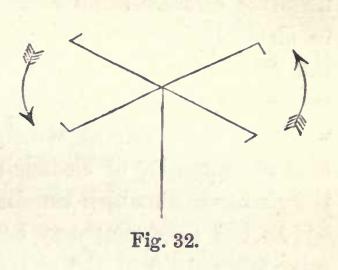
144. When an electrified portion of air comes near the surface of a conductor, it induces on that surface an electrification opposite to its own and is attracted towards the surface, but since the electromotive force is small the electrified particles may remain for a long time in the neighbourhood of the conductor without being drawn into contact with it and discharged. To detect the presence of this electrified atmosphere clinging to a conductor we have only to insulate the conductor and connect it with an electrometer. If we now blow away the electrified air from its surface, the electrometer will indicate the electrification of the conductor itself, which is of course of the opposite kind to that of the electrified air.
144. 当带电的空气部分靠近导体表面时,它在该表面上感生与自身相反的带电,并被吸引向表面;但由于电动势小,带电粒子可以长时间停留在导体附近,而不被拉到与它接触并放电。为检测这种附着在导体上的带电大气的存在,我们只需把导体绝缘、并与静电计相连。如果现在把它表面的带电空气吹走,静电计就会指示导体本身的带电,它当然与带电空气相反。
145. The glow is more easily formed in rare air than in dense air, and more easily when the point is positive than when it is negative. This and many other differences between positive and negative electrification seem to depend upon a condition analogous to electrolytic polarization in the stratum of air in contact with the electrode. It appears that the electromotive force required to cause an electric discharge to take place is somewhat smaller where the electrode at which the discharge begins is negative, but that the quantity of electricity in each discharge is greatest when the electrode at which the discharge begins is positive.
145. 辉光在稀薄空气中比在稠密空气中更容易形成,且当点为正时比当点为负时更容易。这一点以及正负带电之间的许多其他差异,似乎取决于一种类似于与电极接触的空气层中电解极化的条件。看来,引起放电所需的电动势,在放电起始电极带负电处略小一些,但每次放电中的电量在放电起始电极带正电时最大。
146. A fine point may be used instead of a proof plane to determine the nature of the electrification of any part of the surface of a conductor when electricity is induced upon it in presence of another electrified body. For this purpose the point is fixed to the conductor so as to project a few millimetres from its surface. If the part of the surface to which it is fixed is electrified positively the point gives off positive electricity to the air, and the conductor loses positive electricity or gains negative electricity. This may be ascertained either by removing or discharging the inductor and ascertaining the character of the charge of the induced body, or by connecting the induced body with the electrometer and observing the change of potential as the point throws off its electricity. It has been found that some vegetable thorns, prickles, or spines act more perfectly in throwing off electricity than the finest pointed needles which can be procured.
146. 可以用一个细点代替验电板,来确定在另一带电体存在下、导体表面任一部分被感生的带电的性质。为此,把点固定在导体上,使它从表面突出几毫米。如果它所固定的那部分表面带正电,点就向空气放出正电,导体失去正电或获得负电。这可以通过移去或放掉施感体并确定被感体电荷的性质,或通过把被感体与静电计相连、观察点抛出电时电势的变化来确定。人们发现,某些植物刺、棘或针在抛出电方面比能买到的最细的尖针作用得更完美。
147. The Electric Brush. The electric brush is a phenomenon which may be produced by electrifying a blunt point or a small ball in air so as to produce an electric field in which the tension diminishes as the distance from the ball increases, but not so rapidly as in the case of a sharp point. The brush consists of a succession of discharges, ramifying as they diverge from the ball into the air, and terminating either by charging portions of air or by reaching some other conductor. The brush produces a sound, the pitch of which depends on the interval between the successive discharges, and there is no current of air as in the case of the glow.
147. 电刷(The Electric Brush)。电刷是这样一种现象:在空气中使一个钝点或小球带电,从而产生一个张力随离球距离增大而减小、但不如尖点情形减小得那么快的电场。电刷由一连串放电组成,放电在从球向空气发散时分叉,并或者以给空气各部分充电、或者以到达某个其他导体而终止。电刷产生一种声音,其音高取决于相邻放电之间的间隔,而且不像辉光情形那样有气流。
148. The Electric Spark. When the tension in the space between the two electrodes is considerable all the way between them, as in the case of two balls whose distance is not very great compared with their radii, the discharge, when it occurs, usually takes the form of a spark, by which nearly the whole electrification is discharged at once. In this case, when any part of the dielectric has given way, the part next to it in the direction of the electric force is put into a state of greater tension, so that it also gives way, and so the discharge proceeds right through the dielectric. We may compare this breaking down of the dielectric to what occurs when we make a little rent perpendicular to the edge of a piece of paper and then apply tension to the paper in the direction of the edge. The paper is torn through, the disruption beginning at the little rent, but diverging occasionally so as to take in weak places in the paper. The electric spark in the same way begins at the point where the electric tension first overcomes the 'electric strength' of the dielectric, and proceeds from that point, in an apparently irregular path, so as to take in other weak points, such as particles of dust floating in the air.
148. 电火花(The Electric Spark)。当两电极之间空间的张力在它们之间全程都相当大时(例如两个距离与半径相比不太大的球),放电发生时通常采取火花的形式,几乎全部带电一次放掉。在这种情形中,当介电体的某一部分失效后,沿电力方向紧挨着它的部分就被置于更大的张力状态,使它也失效,于是放电一直穿过介电体。我们可以把介电体的这种击穿,比作当我们在一张纸边缘垂直地撕一个小口、然后沿边缘方向对纸施加张力时所发生的事。纸被撕穿,破裂从小口开始,但偶尔分叉、以便把纸上的薄弱处也包括进去。电火花以同样方式始于电张力最先克服介电体「电强度」的点,并从该点以表面上不规则的路径前进,以便把其他薄弱点(如漂浮在空气中的灰尘粒子)也包括进去。
149. The investigation of the phenomena of the luminous electric discharge has been greatly assisted by the use of the spectroscope. The light of the spark or other discharge is made to fall on the slit of the collimator of the spectroscope, and after being analysed by the prisms is observed through the telescope. The light as thus analysed is found to consist of a great number of bright lines and bands forming what is called the spectrum of the light. By comparing light from different sources it is found that these bright lines may be divided into groups, each group being due to the presence of a particular substance in the medium through which the discharge takes place.
149. 光谱仪的使用极大地帮助了发光放电现象的研究。让火花或其他放电的光落到光谱仪准直管的狭缝上,经棱镜分析后通过望远镜观察。这样分析的光被发现由大量亮线和亮带组成,形成所谓光谱。通过比较来自不同光源的光发现,这些亮线可以分为若干组,每组归因于放电所经介质中某种特定物质的存在。
By using the method introduced by Mr. Lockyer of forming an image of the spark upon the slit by means of a lens, we may obtain at one view a comparison of the constituents of the medium which are rendered luminous by the dielectric discharge at the different points of its path. Close to either electrode the lines are principally due to the metal or metals of which that electrode consists. At greater distances these lines become fainter, thinner, and less numerous, but the spectrum belonging to the gas through which the discharge takes place remains visible.
通过使用洛克耶先生引入的、用透镜在狭缝上形成火花像的方法,我们可以在一个视图中比较介质中因介电放电而在其路径不同点处发光的组分。靠近任一电极处,线主要归因于该电极由之构成的金属。在较远处,这些线变得更暗、更细、更少,但属于放电所经气体的光谱仍可见。
It thus appears that the electric discharge separates an appreciable amount of matter even from the hardest metals and carries the particles through the air to a distance of several millimetres from the surface of the metal. It also appears by a comparison of sparks from different electrodes and through different gases that no part of the light is emitted by any substance common to all the different cases, but that every line is due to one or other of the chemical substances present. It follows from this that neither the electric fluid, if there be such a substance, nor any etherial medium such as is supposed to pervade all ordinary matter is rendered luminous during the discharge, for if it were so its spectrum would be visible in all discharges.
因此看来,放电甚至从最硬的金属中分离出可察觉量的物质,并把粒子带过空气、带到离金属表面几毫米的距离。通过比较不同电极、穿过不同气体的火花还看出,光的任何部分都不是由所有不同情形共有的任何物质发出的,而是每条线都归因于所存在的这种或那种化学物质。由此得出,无论是电流体(如果有这种物质的话)、还是被认为遍及所有普通物质的任何以太介质,在放电期间都不发光,因为如果是这样,它的光谱就会在所有放电中可见。
稳定电流与伏打电池Steady Currents and the Voltaic Battery
150. On Steady Currents. In the case of the current between two insulated conductors at different potentials the operation is soon brought to an end by the equalization of the potentials of the two bodies, and the current is therefore essentially a Transient current. But there are methods by which the difference of potential of the conductors may be maintained constant, in which case the current will continue to flow with uniform strength as a Steady Current. The most convenient method of producing a steady current is by means of the Voltaic Battery.
150. 稳定电流(On Steady Currents)。在两个不同电势的绝缘导体之间的电流情形中,操作很快因两物体电势的均等而结束,因此电流本质上是瞬态电流。但有一些方法可以使导体的电势差保持恒定,在这种情况下电流将以均匀强度继续流动,成为稳定电流(Steady Current)。产生稳定电流最方便的方法是用伏打电池(Voltaic Battery)。
For the sake of distinctness we shall describe Daniell's Constant Battery:—A solution of sulphate of zinc is placed in a cell of porous earthenware, and this cell is placed in a vessel containing a saturated solution of sulphate of copper. A piece of zinc is dipped into the sulphate of zinc, and a piece of copper is dipped into the sulphate of copper. Wires are soldered to the zinc and to the copper above the surface of the liquid. This combination is called a cell or element of Daniell's battery.
为清楚起见,我们描述丹聂耳恒压电池(Daniell's Constant Battery):——把硫酸锌溶液放在一个多孔陶土槽中,把这个槽放在盛有饱和硫酸铜溶液的容器中。把一块锌浸入硫酸锌、一块铜浸入硫酸铜。在液面之上把导线焊接到锌和铜上。这种组合称为丹聂耳电池的一个电池(cell)或元素。
151. If the cell is insulated by being placed on a non-conducting stand, and if the wire connected with the copper is put in contact with an insulated conductor A, and the wire connected with the zinc is put in contact with B, another insulated conductor of the same metal as A, then it may be shewn by means of a delicate electrometer that the potential of A exceeds that of B by a certain quantity. This difference of potentials is called the Electromotive Force of Daniell's Cell.
151. 如果通过把电池放在不导电的座上来绝缘它,并使与铜相连的导线接触绝缘导体 A、与锌相连的导线接触 B(另一个与 A 同金属的绝缘导体),那么可以用灵敏的静电计证明 A 的电势比 B 高出某个量。这个电势差称为丹聂耳电池的电动势(Electromotive Force)。
If A and B are now disconnected from the cell and put in communication by means of a wire, a transient current passes through the wire from A to B, and the potentials of A and B become equal. A and B may then be charged again by the cell, and the process repeated as long as the cell will work. But if A and B be connected by means of the wire C, and at the same time connected with the battery as before, then the cell will maintain a constant current through C, and also a constant difference of potentials between A and B. This difference will not, as we shall see, be equal to the whole electromotive force of the cell, for part of this force is spent in maintaining the current through the cell itself.
如果现在断开 A 和 B 与电池的连接、并用导线使它们连通,一个瞬态电流就通过导线从 A 流到 B,A 和 B 的电势变得相等。然后电池可以再给 A 和 B 充电,只要电池能工作,这个过程就可以重复。但如果 A 和 B 用导线 C 连接,同时像之前那样与电池相连,那么电池将维持通过 C 的恒定电流、以及 A 和 B 之间的恒定电势差。这个差(如我们将看到的)不等于电池的全部电动势,因为其中一部分力用于维持通过电池本身的电流。
A number of cells placed in series so that the zinc of the first cell is connected by metal with the copper of the second, and so on, is called a Voltaic Battery. The electromotive force of such a battery is the sum of the electromotive forces of the cells of which it is composed. If the battery is insulated it may be charged with electricity as a whole, but the potential of the copper end will always exceed that of the zinc end by the electromotive force of the battery, whatever the absolute value of either of these potentials may be.
若干个电池串联放置——使第一个电池的锌用金属与第二个电池的铜相连,以此类推——称为伏打电池组(Voltaic Battery)。这种电池组的电动势是组成它的各电池电动势之和。如果电池组被绝缘,它可以作为整体带电,但铜端的电势将总是超过锌端、超出电池组的电动势,无论这两个电势的绝对值是多少。
152. Let us now consider a voltaic battery with its ends insulated from each other. The copper end will be positively or vitreously electrified, and the zinc end will be negatively or resinously electrified. Let the two ends of the battery be now connected by means of a wire. An electric current will commence, and will in a very short time attain a constant value. It is then said to be a Steady Current.
152. 现在让我们考虑一个两端彼此绝缘的伏打电池组。铜端将带正电(玻璃电),锌端将带负电(树脂电)。现在用导线连接电池组的两端。电流将开始,并在很短时间后达到恒定值。这时它被称为稳定电流(Steady Current)。
153. Magnetic Action of the Current. Oersted discovered that a magnet placed near a straight electric current tends to place itself at right angles to the plane passing through the magnet and the current. If a man were to place his body in the line of the current so that the current from copper through the wire to zinc should flow from his head to his feet, and if he were to direct his face towards the centre of the magnet, then that end of the magnet which tends to point to the north would, when the current flows, tend to point towards the man's right hand. Thus we see that the electric current has a magnetic action which is exerted outside the current, and by which its existence can be ascertained and its intensity measured without breaking the circuit or introducing anything into the current itself. The amount of the magnetic action has been ascertained to be strictly proportional to the strength of the current as measured by the products of electrolysis in the voltameter, and to be quite independent of the nature of the conductor in which the current is flowing, whether it be a metal or an electrolyte.
153. 电流的磁作用(Magnetic Action of the Current)。奥斯特发现,放在直线电流附近的磁体趋向于把自己置于垂直于通过磁体和电流的平面的位置。如果一个人把身体放在电流线上,使从铜经导线到锌的电流从他头流向脚,并让脸朝向磁体中心,那么当电流流动时,磁体趋向于指北的那一端将趋向于指向这个人的右手。因此我们看到,电流有一种施加于电流之外的磁作用,借助它可以确定电流的存在并测量其强度,而不必断开电路或把任何东西引入电流本身。已确定磁作用的量与用伏特计中电解产物量度的电流强度严格成正比,并且完全独立于电流所流经导体的性质,无论它是金属还是电解质。
154. An instrument which indicates the strength of an electric current by its magnetic effects is called a Galvanometer. Galvanometers in general consist of one or more coils of silk-covered wire within which a magnet is suspended with its axis horizontal. When a current is passed through the wire the magnet tends to set itself with its axis perpendicular to the plane of the coils. The galvanometer is the most convenient instrument for measuring the strength of electric currents. We shall therefore assume the possibility of constructing such an instrument in studying the laws of these currents, and when we say that an electric current is of a certain strength we suppose that the measurement is effected by the galvanometer.
154. 通过电流磁效应指示电流强度的仪器称为电流计(Galvanometer)。电流计一般由一个或多个丝包导线线圈组成,线圈内悬挂一个轴水平的磁体。当电流通过导线时,磁体趋向于使自己的轴垂直于线圈平面。电流计是测量电流强度最方便的仪器。因此,在研究这些电流的定律时,我们将假定能够构造这种仪器,而当我们说电流有一定强度时,我们设想测量是由电流计完成的。
欧姆定律与线性导体Ohm's Law and Linear Conductors
155. On Systems of Linear Conductors. Any conductor may be treated as a linear conductor if it is arranged so that the current must always pass in the same manner between two portions of its surface which are called its electrodes. For instance, a mass of metal of any form the surface of which is entirely covered with insulating material except at two places, at which the exposed surface of the conductor is in metallic contact with electrodes formed of a perfectly conducting material, may be treated as a linear conductor. For if the current be made to enter at one of these electrodes and escape at the other the lines of flow will be determinate, and the relation between electromotive force, current and resistance will be expressed by Ohm's Law, for the current in every part of the mass will be a linear function of E. But if there be more possible electrodes than two, the conductor may have more than one independent current through it.
155. 线性导体体系(On Systems of Linear Conductors)。任何导体,只要安排得使电流总是以相同方式在称为其电极的两部分表面之间通过,就可以当作线性导体来处理。例如,任何形状的金属块,其表面除两处外全部覆盖绝缘材料、而这两处暴露的导体表面与由完全导电材料构成的电极有金属接触,就可以当作线性导体。因为如果让电流从一个电极进入、从另一个流出,流线将是确定的,电动势、电流和电阻之间的关系将由欧姆定律表示,因为该块每一部分中的电流都将是 E 的线性函数。但如果有超过两个的可能电极,导体可能有不止一个独立的电流通过它。
156. Ohm's Law. Let E be the electromotive force in a linear conductor from the electrode A₁ to the electrode A₂. Let C be the strength of the electric current along the conductor, that is to say, let C units of electricity pass across every section in the direction A₁A₂ in unit of time, and let R be the resistance of the conductor, then the expression of Ohm's Law is E = CR. (1)
156. 欧姆定律(Ohm's Law)。设 E 是线性导体中从电极 A₁ 到电极 A₂ 的电动势。设 C 是沿导体的电流强度,也就是说,让 C 个单位电在单位时间内沿 A₁A₂ 方向穿过每个截面,并设 R 是导体的电阻,那么欧姆定律的表达式是 E = CR。(1)
The Resistance of a conductor is defined to be the ratio of the electromotive force to the strength of the current which it produces. The introduction of this term would have been of no scientific value unless Ohm had shewn, as he did experimentally, that it corresponds to a real physical quantity, that is, that it has a definite value which is altered only when the nature of the conductor is altered. In the first place, then, the resistance of a conductor is independent of the strength of the current flowing through it. In the second place the resistance is independent of the electric potential at which the conductor is maintained, and of the density of the distribution of electricity on the surface of the conductor. It depends entirely on the nature of the material of which the conductor is composed, the state of aggregation of its parts and its temperature. The resistance of a conductor may be measured to within one ten thousandth or even one hundred thousandth part of its value, and so many conductors have been tested that our assurance of the truth of Ohm's Law is now very high.
导体的电阻被定义为电动势与它所产生的电流强度之比。除非欧姆像他实验所做的那样证明电阻对应于一个真实的物理量——即它具有一个确定值、只在导体的性质改变时才改变——引入这个术语本没有科学价值。那么,首先,导体的电阻独立于流过它的电流强度。其次,电阻独立于导体所维持的电势、以及导体表面上电分布的密度。它完全取决于导体由之构成的材料的性质、其各部分的聚集状态及其温度。导体的电阻可以测到其值的万分之一、甚至十万分之一,而且已经有如此多的导体被检验过,以致我们现在对欧姆定律真实性的确信度非常高。
157. Linear Conductors arranged in Series. Let A₁, A₂ be the electrodes of the first conductor and let the second conductor be placed with one of its electrodes in contact with A₂, so that the second conductor has for its electrodes A₂, A₃. The electrodes of the third conductor may be denoted by A₃ and A₄. Let the electromotive force along each of these conductors be denoted by E₁₂, E₂₃, E₃₄, and so on for the other conductors. Let the resistance of the conductors be R₁₂, R₂₃, R₃₄, &c. Then, since the conductors are arranged in series so that the same current C flows through each, we have by Ohm's Law, E₁₂ = CR₁₂, E₂₃ = CR₂₃, E₃₄ = CR₃₄. ... (2)
157. 串联的线性导体(Linear Conductors arranged in Series)。设 A₁、A₂ 为第一个导体的电极,并设第二个导体以其一个电极与 A₂ 接触放置,所以第二个导体的电极是 A₂、A₃。第三个导体的电极可记为 A₃ 和 A₄。设沿这些导体各自的电动势记为 E₁₂、E₂₃、E₃₄,其他导体以此类推。设导体的电阻为 R₁₂、R₂₃、R₃₄ 等。那么,由于导体串联排列、使同一电流 C 通过每个导体,由欧姆定律我们有 E₁₂ = CR₁₂,E₂₃ = CR₂₃,E₃₄ = CR₃₄。... (2)
If E is the resultant electromotive force, and R the resultant resistance of the system, we must have by Ohm's Law, E = CR. ... (3) Now E = E₁₂ + E₂₃ + E₃₄, the sum of the separate electromotive forces, = C(R₁₂ + R₂₃ + R₃₄) by equations (2). Comparing this result with (3), we find R = R₁₂ + R₂₃ + R₃₄. ... (5) Or, the resistance of a series of conductors is the sum of the resistances of the conductors taken separately.
如果 E 是合成电动势、R 是体系的合成电阻,那么由欧姆定律我们必须有 E = CR。... (3) 现在 E = E₁₂ + E₂₃ + E₃₄,即各单独电动势之和,= C(R₁₂ + R₂₃ + R₃₄)(由方程 (2))。把这个结果与 (3) 比较,我们得到 R = R₁₂ + R₂₃ + R₃₄。... (5) 或者,一系列导体的电阻是各导体单独电阻之和。
158. Resistance of a Multiple Conductor. Let a number of conductors ABZ, ACZ, ADZ be arranged side by side with their extremities in contact with the same two points A and Z. They are then said to be arranged in multiple arc. Let the resistances of these conductors be R₁, R₂, R₃ respectively, and the currents C₁, C₂, C₃, and let the resistance of the multiple conductor be R, and the total current C. Then, since the potentials at A and Z are the same for all the conductors, they have the same difference, which we may call E. We then have E = C₁R₁ = C₂R₂ = C₃R₃ = CR, but C = C₁ + C₂ + C₃, whence 1/R = 1/R₁ + 1/R₂ + 1/R₃. ... (7)
158. 多支路导体的电阻(Resistance of a Multiple Conductor)。设若干导体 ABZ、ACZ、ADZ 并排排列,其端点与相同的两个点 A 和 Z 接触。这时它们被称为按多支路排列。设这些导体的电阻分别为 R₁、R₂、R₃,电流为 C₁、C₂、C₃,并设多支路导体的电阻为 R、总电流为 C。那么,由于所有导体在 A 和 Z 处的电势相同,它们具有相同的差,我们可以称之为 E。于是我们有 E = C₁R₁ = C₂R₂ = C₃R₃ = CR,但 C = C₁ + C₂ + C₃,由此 1/R = 1/R₁ + 1/R₂ + 1/R₃。... (7)
Or, the reciprocal of the resistance of a multiple conductor is the sum of the reciprocals of the component conductors. If we call the reciprocal of the resistance of a conductor the conductivity of the conductor, then we may say that the conductivity of a multiple conductor is the sum of the conductivities of the component conductors.
或者,多支路导体电阻的倒数是各组成导体倒数之和。如果我们把导体电阻的倒数称为导体的电导率,那么我们可以说多支路导体的电导率是各组成导体电导率之和。
159. Longitudinal Resistance of Conductors of Uniform Section. Let the resistance of a cube of a given material to a current parallel to one of its edges be ρ, the side of the cube being unit of length, ρ is called the 'specific resistance of that material for unit of volume.' Consider next a prismatic conductor of the same material whose length is l, and whose section is unity. This is equivalent to l cubes arranged in series. The resistance of the conductor is therefore lρ. Finally, consider a conductor of length l and uniform section s. This is equivalent to s conductors similar to the last arranged in multiple arc. The resistance of this conductor is therefore R = lρ/s.
159. 均匀截面导体的纵向电阻(Longitudinal Resistance of Conductors of Uniform Section)。设给定材料的一个立方体对平行于它一条棱的电流的电阻为 ρ,立方体的边为单位长度,ρ 称为「该材料单位体积的比电阻」。接下来考虑同材料、长为 l、截面为 1 的棱柱形导体。这等价于 l 个串联排列的立方体。因此导体的电阻是 lρ。最后,考虑长为 l、均匀截面为 s 的导体。这等价于 s 个与上一个类似、按多支路排列的导体。因此这个导体的电阻是 R = lρ/s。
When we know the resistance of a uniform wire we can determine the specific resistance of the material of which it is made if we can measure its length and its section. The sectional area of small wires is most accurately determined by calculation from the length, weight, and specific gravity of the specimen.
当我们知道一根均匀导线的电阻时,如果能测量它的长度和截面,就可以确定它由之构成的材料的比电阻。细导线的截面积,最准确地由试样的长度、重量和比重计算确定。
第十章 · 流经非均匀介质的电流现象Chapter X — Phenomena of an Electric Current in Heterogeneous Media
热电现象Thermo-electric Phenomena
160. Seebeck, in 1822, discovered that if a circuit is formed of two different metals, and if the two junctions of the metals are kept at different temperatures, an electric current tends to flow round the circuit. If the metals are iron and copper at temperatures below 280° C., the current flows from copper to iron through the hotter junction. There is therefore, in general, an electromotive force acting in a definite direction round the circuit, whenever the two junctions are at different temperatures.
160. 塞贝克在 1822 年发现,如果一个回路由两种不同金属构成,并且两个金属接点保持在不同的温度,就有电流趋向于绕回路流动。如果金属是铁和铜、温度低于 280°C,那么电流通过较热接点从铜流向铁。因此,一般说来,只要两个接点处于不同温度,就有一个沿确定方向绕回路作用的电动势。
In a circuit formed of any number of metals all at the same temperature, there can be no current, for if there were a current it might be constantly employed to work a machine or to generate heat in a conductor, and this without any energy being supplied to the system from without, for in order to keep the circuit at a constant temperature nothing is required except to prevent heat from entering or leaving it. Hence at any given temperature the electromotive force in a circuit of three metals, A, B, C must be zero for the whole circuit. Hence if the electromotive force from C to A is a, and that from C to B is b, and that from B to A is x, then in the circuit A, B, C, the total electromotive force is a − b − x = 0, so that x, the electromotive force from B to A is represented by a − b, where a and b are quantities determined by observation of the electromotive force from any third metal C to the metals A and B. We may express this by saying that the quantities a and b are the potentials of the metals A and B with respect to a third metal C at the given temperature.
在一个由任意多种金属、且都处于相同温度构成的回路中,不可能有电流,因为如果有电流,它就可以不断地被用来驱动机器或在导体中产生热,而这无需任何能量从外部供给体系,因为要使回路保持恒温,只需要防止热进入或离开它。因此,在任一给定温度下,三种金属 A、B、C 的回路中整个回路的电动势必须为零。因此,如果从 C 到 A 的电动势是 a、从 C 到 B 的是 b、从 B 到 A 的是 x,那么在回路 A、B、C 中,总电动势是 a − b − x = 0,所以 x(从 B 到 A 的电动势)由 a − b 表示,其中 a 和 b 是由观察从任一第三种金属 C 到金属 A 和 B 的电动势确定的量。我们可以这样说:量 a 和 b 是金属 A 和 B 在给定温度下相对于第三种金属 C 的电势。
161. In a circuit of a single metal, no current will be formed in it, however the temperature and the section of the conducting circuit may vary in different parts. Since in this case there is necessarily conduction of heat, and consequently dissipation of energy, we cannot, as in the former case, consider the result as self-evident. The electromotive force, for instance, between two portions of the circuit at given temperatures might depend on the length or the mode of variation of the section of the intermediate portion of the circuit. In fact the experiments of Le Roux and others have shewn that the law of Magnus is no longer applicable in a circuit in which there is a very abrupt variation of temperature. We must therefore modify the statement of the law of Magnus as follows:—The electromotive force from one point of a conductor of homogeneous metal to another depends only on the temperature of these points unless at any part of the conductor a sensible variation of temperature occurs between points whose distance is within the limits of molecular action.
161. 在单一金属的回路中,无论温度和导体回路的截面在不同部分如何变化,回路中都不会形成电流。由于在这种情况下必然有热传导、从而有能量耗散,我们不能像前一种情况那样认为结果是自明的。例如,回路中给定温度的两部分之间的电动势,可能取决于中间部分回路的长度或截面变化的方式。事实上,勒鲁等人的实验已经表明,马格努斯定律在温度有非常突然变化的回路中不再适用。因此,我们必须如下修改马格努斯定律的陈述:——均匀金属导体从一点到另一点的电动势,只取决于这些点的温度,除非导体任何部分在分子作用范围之内的点之间发生了可察觉的温度变化。
162. Let us now consider a linear circuit made up of alternate pieces of two metals, say lead and iron. We shall assume lead to be the standard metal, and study the properties of iron in relation to lead. In the figure the pieces of iron are distinguished by shading. Let the temperatures of the junctions be those indicated in the figure, in which the temperatures of the extremities of each piece of iron differ by one degree, but the temperatures of the extremities of each of the intermediate pieces of lead are equal. The total electromotive force round the circuit is the sum of the electromotive forces due to the thermo-electric action of the different pairs of junctions.
162. 现在让我们考虑一个由两种金属(比如铅和铁)的交替片段构成的线性回路。我们将假定铅为标准金属,研究铁相对铅的性质。在图中,铁片用阴影区分。设接点的温度为图中所示,其中每片铁两端温度相差一度,但每片中间铅的两端温度相等。绕回路的总电动势是不同对接点的热电作用产生的电动势之和。
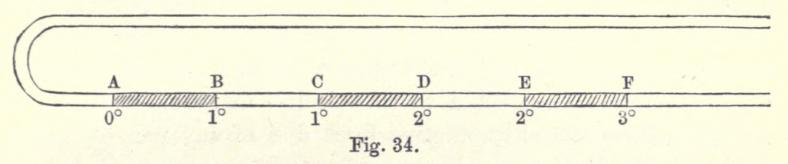
Hence if a diagram is constructed in which the axis OZ is marked with the degrees of the thermometric scale and in which the area 0°PQ1° represents the electromotive force when the junctions are at 0° and 1° and so on, then the electromotive force when the junctions are at any given temperatures will be represented by the area included between the axis, the ordinates at the given temperatures and the line PQRST.
因此,如果构造一个图,其中轴 OZ 标以温标度数,面积 0°PQ1° 表示接点在 0° 和 1° 时的电动势,以此类推,那么接点在任一给定温度时的电动势,将由轴、给定温度处的纵坐标和线 PQRST 之间的面积表示。
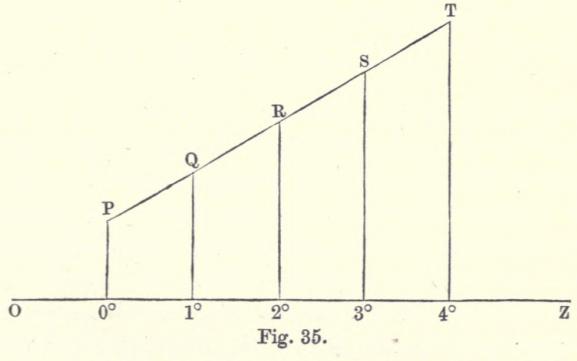
163. Any ordinate such as 0°P, 1°Q, &c., is called the Thermoelectric Power of iron with respect to lead at 0°, 1°, &c., and is reckoned positive when, for a small difference of temperature, the current is from lead to iron through the hot junction. We may also on the same diagram construct other lines, the ordinates of which represent the thermo-electric powers of any other metals with respect to lead, being reckoned positive and measured upwards when for a small difference of temperatures the current sets from lead to that metal through the hot junction. Such a diagram is called a thermo-electric diagram, and from it we can deduce the electromotive force due to any pair of metals with their junctions at any given temperatures.
163. 任何纵坐标如 0°P、1°Q 等,称为铁在 0°、1° 等温度下相对于铅的热电功率(Thermoelectric Power),并且当对小温差、电流通过热接点从铅流向铁时计为正。我们还可以在同一图上构造其他线,其纵坐标表示任何其他金属相对于铅的热电功率,当对小温差、电流通过热接点从铅流向该金属时计为正、向上量度。这样的图称为热电图(thermo-electric diagram),从中我们可以推出任一对金属、其接点在任一给定温度下的电动势。
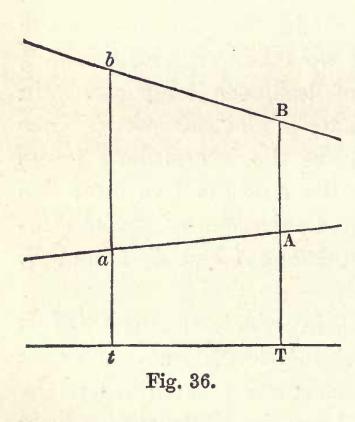
Thus if aA is the line representing the metal A, and bB another representing the metal B, and T, t the temperatures of the junctions, the electromotive force of the circuit is represented by the area ABbaA and it acts in the direction indicated, namely, from the metal A to the metal B through the hot junction.
因此,如果 aA 是表示金属 A 的线,bB 是另一条表示金属 B 的线,T、t 是接点的温度,那么回路的电动势由面积 ABbaA 表示,它沿所示方向作用,即通过热接点从金属 A 到金属 B。
164. Thermo-electric Inversion. Cumming in 1823 discovered several cases in which the thermo-electric order of two metals as observed at ordinary temperatures becomes inverted at high temperatures. The lines corresponding to these metals on the thermo-electric diagram must therefore cross one another at some intermediate temperature, called the Neutral Temperature for these metals. Tait has recently investigated the lines which represent a considerable number of metals in the thermo-electric diagram, and he finds that for most metals they are nearly if not exactly straight lines. The lines for iron and nickel however have considerable sinuosities, so that they may intersect the straight lines belonging to another metal in several different points corresponding to several different neutral temperatures.
164. 热电反转(Thermo-electric Inversion)。卡明在 1823 年发现了若干情形,其中两种金属在普通温度下观察到的热电顺序在高温下发生反转。因此,热电图上对应于这些金属的线必须在某个中间温度处相交,该温度称为这些金属的中性温度(Neutral Temperature)。泰特近来研究了热电图上表示相当多金属的线,他发现对大多数金属它们几乎(如果不完全)是直线。然而,铁和镍的线有相当大的弯曲,所以它们可能与属于另一金属的直线在几个不同点相交,对应于几个不同的中性温度。
珀耳帖效应与汤姆孙效应Thermal Effects of the Current
165. By applying the principle of the conservation of energy to the case of a thermo-electric current, it is easy to see that certain thermal effects must accompany the electric current. Let us consider what takes place while one unit of electricity is transmitted across any section of the circuit. The work done on the electric current is the product of the electromotive force into the quantity of electricity transmitted, and since this latter quantity is unity, the work is numerically equal to the electromotive force, and is represented by the area ABba in the thermoelectric diagram. If the current is allowed to flow without anything to impede it except the resistance of the circuit, the whole of the work will be converted into heat. Thus for every unit of electricity which is transmitted, a certain amount of work is done by the thermo-electric forces on the current. The only source of this work is the heat of the thermo-electric couple, and therefore, by the principle of the conservation of energy, we conclude that an amount of heat, dynamically equivalent to this work, must have disappeared in some part of the circuit.
165. 把能量守恒原理应用于热电电流的情形,就很容易看出某些热效应必然伴随电流。让我们考虑一单位电通过回路任一截面期间发生的事。对电流所做的功是电动势与所传电量之积,而由于后一个量是 1,功在数值上等于电动势,并由热电图中的面积 ABba 表示。如果让电流流动、除回路电阻外没有任何东西阻碍它,那么全部功将转化为热。因此,每传一单位电,热电力就对电流做一定量的功。这个功的唯一来源是热电偶的热,因此,由能量守恒原理,我们断定:在回路某部分必定消失了一个在动力学上等价于这个功的热量。
166. Now Peltier* in 1834 found that when an electric current is made to pass from one metal to another which has a higher thermo-electric power, the junction is cooled, or, since there is no permanent change in the metals, there is a disappearance of heat. When the current is made to flow in the opposite direction the junction is heated, indicating a generation of heat. This thermal effect of the current at the junction is of quite a different kind from the ordinary generation of heat by the current while it overcomes the resistance of a conductor. The latter, which we may call with Thomson the frictional generation of heat, is the same when the direction of the current is reversed, and varies as the square of the strength of the current. The former, which we shall call the Peltier effect, is reversed when the current is reversed, and depends simply on the strength of the current.
166. 现在珀耳帖*在 1834 年发现,当使电流从一种金属流向另一种热电功率较高的金属时,接点被冷却,即(由于金属没有永久变化)有热的消失。当使电流沿相反方向流动时,接点被加热,表明有热的产生。电流在接点处的这种热效应,与电流在克服导体电阻时产生的普通热完全不同。后者(我们可以随汤姆孙称之为摩擦生热)在电流方向反转时相同,且随电流强度的平方变化。前者(我们将称之为珀耳帖效应)在电流反转时也反转,并且只取决于电流强度。
167. But Thomson has shewn that besides the Peltier effect, there must in certain metals be another reversible thermal effect of the current. The current must generate or absorb heat when it passes from hotter to colder or from colder to hotter parts of the same metal. Thus, let a thermo-electric couple of copper and iron be kept with one junction AB at the neutral temperature which is about 280° C., and the other, ab, at some lower temperature. The thermo-electric current is from copper to iron at the hot junction AB and from iron to copper at the cold junction ab. Now the Peltier effect at the hot junction, AB, is zero, for that junction is at the neutral temperature, and the Peltier effect at the cold junction, ab, is a generation of heat, for the current is there passing from the metal of higher to the metal of lower thermo-electric power. Hence the absorption of heat which must exist in order to account for the work done by the current must take place in some other part of the circuit, either in the copper where the current is flowing from cold to hot, or in the iron where it is flowing from hot to cold, or in both metals. This thermal effect of the current was predicted by Thomson as the result of reasoning similar to that here given. He afterwards verified this prediction experimentally, and found that in iron unequally heated a current from hot to cold cools the metal, while a current from cold to hot heats it, and that the reverse thermal effect takes place in copper. We shall refer to this thermal effect as the Thomson effect.
167. 但汤姆孙已经指出,除了珀耳帖效应之外,在某些金属中必定还有电流的另一种可逆热效应。当电流从同一金属较热部分流向较冷部分、或从较冷部分流向较热部分时,它必定产生或吸收热。因此,设一个铜-铁热电偶保持一个接点 AB 在中性温度(约 280°C)、另一个接点 ab 在某个较低温度。热电电流在热接点 AB 处从铜流向铁、在冷接点 ab 处从铁流向铜。现在热接点 AB 处的珀耳帖效应为零,因为该接点处于中性温度;而冷接点 ab 处的珀耳帖效应是产生热,因为电流在那里从热电功率较高的金属流向较低的金属。因此,为解释电流所做功而必须存在的吸热,必定发生在回路的其他某部分——或者在电流从冷流向热的铜中,或者在电流从热流向冷的铁中,或者在两种金属中。电流的这种热效应是汤姆孙作为类似于此处的推理结果而预言的。他后来实验验证了这一预言,发现:在受热不均匀的铁中,从热到冷的电流使金属冷却,而从冷到热的电流使它加热;在铜中发生相反的热效应。我们把这种热效应称为汤姆孙效应(Thomson effect)。
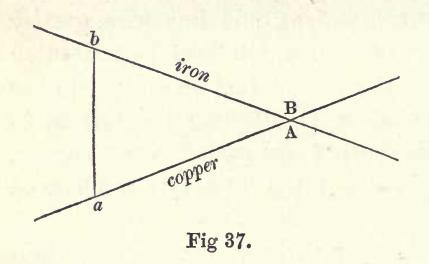
168. Thomson has shewn that a very close analogy subsists between these thermo-electric phenomena and those of a fluid circulating in a tube consisting of two vertical branches connected by two horizontal branches. A fluid, heated in one part of the circuit, and passing on into cooler parts of the system, will give out heat, and when it passes from colder to warmer parts will absorb heat, the amount of heat emitted or absorbed depending on the specific heat of the fluid. According to this analogy, positive or vitreous electricity carries heat with it in copper as if it were a real fluid, but in iron it behaves as if its specific heat were a negative quantity which cannot be the case in a real fluid. Hence Thomson expresses the fact by saying that negative or resinous electricity carries heat with it in iron. Neither kind of electricity, therefore, can be regarded in this respect as a real fluid. We may therefore adhere to the usual convention, and speaking of the positive electricity only, we may say that in copper it behaves as if its specific heat were positive, and in iron as if it were negative.
168. 汤姆孙已经指出,这些热电现象与流体在由两个竖直支路、两个水平支路连接的管中循环的现象之间存在着非常密切的类比。流体在回路某部分被加热、再进入体系较冷部分时,会放出热;当它从较冷部分流到较暖部分时会吸收热,放出或吸收的热量取决于流体的比热。根据这个类比,正电(玻璃电)在铜中像真实流体一样携带着热,但在铁中它表现得好像比热是负量——这在真实流体中是不可能的。因此汤姆孙这样说:负电(树脂电)在铁中携带着热。因此,在这个方面,任何一种电都不能被视为真实流体。因此我们可以坚持通常的约定,只谈正电,说它在铜中表现得好像比热为正、在铁中好像为负。
169. M. Le Roux,* who has made some very careful experiments on the Thomson effect, finds that in lead the specific heat of electricity is either zero or very small indeed. Professor Tait has therefore adopted lead as the standard metal in his thermo-electric measurements.
169. 勒鲁先生*对汤姆孙效应做了一些非常仔细的实验,发现铅中电的比热要么为零、要么确实非常小。因此泰特教授在他的热电测量中采用铅作为标准金属。
170. We may express both the Peltier and the Thomson effects by stating that when an electric current is flowing from places of smaller to places of greater thermo-electric power, heat is absorbed, and when it is flowing in the reverse direction heat is generated, and this, whether the difference of thermo-electric power in the two places arises from a difference in the nature of the metal or from a difference of temperature in the same metal.
170. 我们可以把珀耳帖效应和汤姆孙效应一起表述为:当电流从热电功率较小处流向较大处时,热被吸收;当它沿相反方向流动时,热被产生——无论两处热电功率之差是来自金属性质的不同、还是来自同一金属温度的不同。
电解与能量守恒Electrolysis and the Conservation of Energy
187. On the Conservation of Energy in Electrolysis. Consider an electric current flowing in a circuit consisting partly of metals and partly of electrolytes placed in series. During the passage of one unit of electricity through any section of the circuit one electrochemical equivalent of each of the electrolytes is electrolysed. There is therefore a definite amount of chemical action corresponding to a definite quantity of electricity passed through the circuit. The energy equivalent to any chemical process can be ascertained either directly or indirectly. When the process is such that it will go on of itself and if the only effect external to the system is the giving off of heat generated during the process, then the intrinsic energy of the system must be diminished during the process by a quantity of energy equivalent to the heat given out.
187. 电解中的能量守恒(On the Conservation of Energy in Electrolysis)。考虑电流在部分由金属、部分由串联放置的电解质组成的回路中流动。在一单位电通过回路任一截面期间,每个电解质都有一个电化当量被电解。因此,有确定量的化学作用对应于通过回路的确定电量。任何化学过程的能量当量都可以直接或间接确定。当过程是能自行进行的、并且体系外部唯一的效果是放出过程中产生的热时,那么体系的内能必须在过程中减少一个等价于所放出热的能量。
188. It has been proved experimentally by Joule that the heat developed throughout the whole electric circuit is the same for the same amount of chemical action whatever be the resistance of the circuit provided no other form of energy than heat is given off by the system. Thus in a battery the electrodes of which are connected by a short thick wire the current is very strong and the heat is generated principally in the cells of the battery and to a much smaller extent in the wire; but if the wire is long and thin, the heat generated in the wire is far greater than that generated in the cells, but if we take into account the heat generated in the wire as well as that generated in the cells, we find that the whole heat generated for each grain of zinc dissolved is the same in both cases.
188. 焦耳已实验证明,只要体系除热外不放任何其他形式的能量,那么整个回路中产生的热对相同的化学作用量是相同的,无论回路的电阻如何。因此,在一个电极由短而粗的导线连接的电池中,电流很强、热主要产生在电池的各电池中、较小程度上产生在导线中;但如果导线长而细,导线中产生的热就远大于各电池中产生的热;然而如果我们把导线中产生的热连同各电池中产生的热一起考虑,我们就会发现每溶解一格令锌所产生的总热在两种情况下相同。
189. If, however, the circuit includes a cell in which dilute acid is electrolysed into oxygen and hydrogen the heat generated in the circuit per grain of zinc dissolved, is less than before, by the quantity of heat which would be generated if the oxygen and hydrogen evolved in the electrolytic cell were made to combine. Or if the circuit includes an electromagnetic engine which is employed to do work, the heat generated in the circuit is less than that corresponding to the zinc consumed by an amount equal to the heat which would be generated if the work done by the engine were entirely expended in friction.
189. 然而,如果回路包含一个电解槽,其中稀酸被电解成氧和氢,那么每溶解一格令锌、回路中产生的热就比之前少,少的量等于如果让电解槽中放出的氧和氢化合所会产生的热。或者,如果回路包含一个用来做功的电磁发动机,那么回路中产生的热比对应于所消耗锌的热少,少的量等于如果发动机所做的功完全消耗在摩擦中所会产生的热。
190. If the arrangement is such that the amount of chemical action depends entirely on the quantity of electricity transmitted we can determine the electromotive force of the circuit by the following method, first given by Thomson. Let the resistance of the circuit be made so great that the heat generated by the current in the electrolytes may be neglected. Let E be the electromotive force of the circuit; then the work done in driving one unit of electricity through the circuit is numerically equal to E. But during this process one electrochemical equivalent of the electrolyte undergoes the chemical process which goes on in the cell. Hence, if the energy given out during this process is entirely expended in maintaining the current, the dynamical value of the process must be numerically equal to E, the electromotive force of the circuit, or, as Thomson stated it, 'The electromotive force of an electrochemical apparatus is in absolute measure equal to the mechanical equivalent of the chemical action on one electrochemical equivalent of the substance.'
190. 如果装置使化学作用的量完全取决于所传的电量,我们就可以用以下汤姆孙首先给出的方法确定回路的电动势。让回路的电阻大到电流在电解质中产生的热可以忽略。设 E 是回路的电动势;那么驱动一单位电通过回路所做的功在数值上等于 E。但在这个过程中,一个电化当量的电解质经历了电池中进行的化学过程。因此,如果过程中放出的能量完全用于维持电流,那么该过程的动力学值必须在数值上等于 E(回路的电动势),或者,如汤姆孙所述:「电化学装置的电动势,在绝对量度上等于一个电化当量物质上化学作用的机械当量。」
191. If the action in the cell consists in part of irreversible processes, such as 1. The frictional generation of heat by resistance in the electrolyte, 2. Diffusion of the primary or secondary products of electrolysis through the electrolyte, or 3. Any other action which is not reversed when the direction of the current is reversed, there will be a certain amount of dissipation of energy and the electromotive force of the circuit will be less than the loss of intrinsic energy corresponding to the electrolysis of one electrochemical equivalent. It is only the strictly reversible processes that must be taken into account in calculating the electromotive force of the circuit.
191. 如果电池中的作用部分由不可逆过程组成,例如 1. 电解质中电阻的摩擦生热,2. 电解初级或次级产物通过电解质的扩散,或 3. 电流方向反转时不反转的任何其他作用,那么就将有一定量的能量耗散,回路的电动势将小于对应于电解一个电化当量的内能损失。在计算回路电动势时,只须考虑严格可逆的过程。
192. The determination of the total electromotive force in an electrochemical circuit is therefore always possible. If, however, we wish to determine the precise points in the circuit where the different portions of this electromotive force are exerted, we find the investigation much more difficult than in the case of a purely metallic circuit. For the chemical action at the junction of a metal with an electrolyte is generally of such a kind that it cannot take place by itself, that is to say, without an action equivalent to that which takes place at the other electrode.
192. 因此,确定电化学回路中总电动势总是可能的。然而,如果我们想确定回路中这一电动势不同部分所施加的精确点,我们会发现研究比纯金属回路情形困难得多。因为金属与电解质接点处的化学作用,一般属于不能自行发生的一类,也就是说,没有与另一电极处所发生的作用等价的作用,它就不能发生。
恒定伏打电池On Constant Voltaic Elements
193. When a series of experiments is made with a voltaic battery in which polarization occurs, the polarization diminishes during the time that the current is not flowing, so that when it begins to flow again the current is stronger than after it has flowed for some time. If, on the other hand, the resistance of the circuit is diminished by allowing the current to flow through a short shunt, then, when the current is again made to flow through the ordinary circuit, it is at first weaker than its normal strength on account of the great polarization produced by the use of the short circuit. To get rid of these irregularities in the current, which are exceedingly troublesome in experiments involving exact measurements, it is necessary to get rid of the polarization, or at least to reduce it as much as possible.
193. 当用发生极化的伏打电池组做一系列实验时,极化在电流不流动的期间减小,所以当电流再次开始流动时,比它已流动一段时间后更强。另一方面,如果通过让电流流过一个短分流器来减小回路的电阻,那么当电流再次通过普通回路时,它起初比正常强度弱,因为使用短路产生了很大的极化。为了消除电流中这些在涉及精确测量的实验中极其麻烦的不规则性,必须消除极化、或至少尽可能减小它。
It does not appear that there is much polarization at the surface of the zinc plate when immersed in a solution of sulphate of zinc or in dilute sulphuric acid. The principal seat of polarization is at the surface of the negative metal. When the fluid in which the negative metal is immersed is dilute sulphuric acid, it is seen to become covered with bubbles of hydrogen gas, arising from the electrolytic decomposition of the fluid. Of course these bubbles, by preventing the fluid from touching the metal, diminish the surface of contact and increase the resistance of the circuit. But besides the visible bubbles it is certain that there is a thin coating of hydrogen, probably not in a free state, adhering to the surface of the metal.
看来锌板浸在硫酸锌溶液或稀硫酸中时,其表面并没有多少极化。极化的主要所在处是负金属的表面。当负金属浸入的流体是稀硫酸时,可见它被电解分解流体产生的氢气泡覆盖。当然,这些气泡通过阻止流体接触金属,减小了接触面、增大了回路电阻。但除了可见的气泡,肯定还有一层薄的氢(可能不处于自由状态)附着在金属表面上。
In all forms of Daniell's battery the final result is that the sulphate of copper finds its way to the zinc and spoils the battery. To retard this result indefinitely, Sir W. Thomson has constructed Daniell's battery in the form shewn in Fig. 41. In each cell the copper plate is placed horizontally at the bottom, and a saturated solution of sulphate of zinc is poured over it. The zinc is in the form of a grating and is placed horizontally near the surface of the solution. A glass tube is placed vertically in the solution with its lower end just above the surface of the copper plate. Crystals of sulphate of copper are dropped down this tube, and, dissolving in the liquid, form a solution of greater density than that of sulphate of zinc alone, so that it cannot get to the zinc except by diffusion. To retard this process of diffusion, a siphon, consisting of a glass tube stuffed with cotton wick, is placed with one extremity midway between the zinc and copper, and the other in a vessel outside the cell, so that the liquid is very slowly drawn off near the middle of its depth.
在所有形式的丹聂耳电池中,最终结果都是硫酸铜找到通往锌的途径、损坏电池。为无限期延缓这一结果,W. 汤姆孙爵士以图 41 所示的形式构造了丹聂耳电池。在每个电池中,铜板水平放在底部,饱和硫酸锌溶液倒在它上面。锌呈格栅形,水平放在靠近溶液表面的位置。一根玻璃管竖直放在溶液中,下端刚好在铜板表面之上。硫酸铜晶体沿这根管落下,在液体中溶解,形成比单独硫酸锌密度更大的溶液,所以它除了通过扩散无法到达锌。为延缓扩散过程,一个由塞满棉芯的玻璃管构成的虹吸管,其一端放在锌和铜之间、另一端在电池外的容器中,使液体在靠近其深度中部处被非常缓慢地抽出。
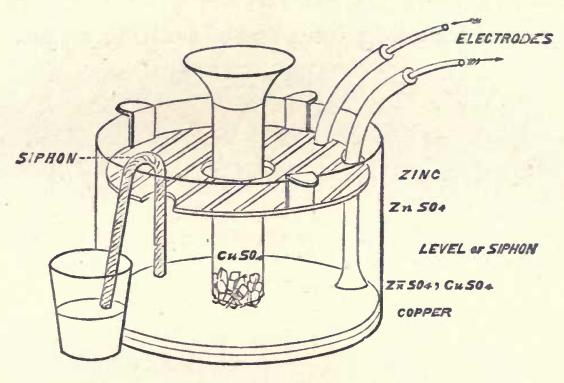
Daniell's battery is by no means the most powerful in common use. The electromotive force of Grove's cell is 192,000,000, of Daniell's 107,900,000, and that of Bunsen's 188,000,000. The resistance of Daniell's cell is in general greater than that of Grove's or Bunsen's of the same size. These defects, however, are more than counterbalanced in all cases where exact measurements are required, by the fact that Daniell's cell exceeds every other known arrangement in constancy of electromotive force. It has also the advantage of continuing in working order for a long time, and of emitting no gas.
丹聂耳电池绝不是常用电池中最强的。格罗夫电池的电动势是 192,000,000,丹聂耳电池是 107,900,000,本生电池是 188,000,000。丹聂耳电池的电阻一般比同尺寸的格罗夫或本生电池大。然而,在需要精确测量的所有情况下,丹聂耳电池在电动势恒定性上超过所有其他已知装置这一事实,足以弥补这些缺点。它还有能长时间保持工作状态、以及不放出气体的优点。
第十一章 · 维持电流的方法Chapter XI — Methods of Maintaining an Electric Current
194. The principal methods of maintaining a steady electric current are—(1) The Frictional Machine. (2) The Voltaic Battery. (3) The Thermo-electric Battery. (4) The Magneto-electric Machine.
194. 维持稳定电流的主要方法是——(1)摩擦起电机。(2)伏打电池组。(3)热电堆。(4)磁电机。
摩擦起电机The Frictional Electric Machine
195. The electrification is here produced between the surfaces of two different substances, such as glass and amalgam or ebonite and fur. By the motion of the machine one of these electrified surfaces is carried away from the other, and both are made to discharge their electrification into the electrodes of the machine, from which the current is conveyed along any required circuit. In the ordinary form of the machine a circular plate or a cylinder of glass is made to revolve about its axis. Let us suppose that the revolving part is a plate of glass. The rubber is fixed so that it presses against the surface of the plate as it rotates. The surface of the rubber is of leather, on which is spread an amalgam of zinc and mercury. By the friction between the glass and the amalgam the surface of the glass becomes electrified positively, and that of the rubber negatively.
195. 这里的带电产生在两种不同物质(如玻璃和汞齐、或硬橡胶和毛皮)的表面之间。通过机器的运动,其中一个带电表面被带离另一个,两者都被迫把它们的带电放给机器的电极,电流从电极沿任何所需回路传送。在机器的普通形式中,一个圆形玻璃板或玻璃圆筒绕其轴旋转。让我们设想旋转部分是一个玻璃板。橡胶固定得在板旋转时压住板的表面。橡胶表面是皮革,上面涂有锌汞齐。通过玻璃和汞齐之间的摩擦,玻璃表面带正电、橡胶表面带负电。
As the plate revolves the electrified surface of the glass is carried away from under the rubber, and another part of the surface of the glass, previously unelectrified, is brought under the rubber to be electrified. As long as the oppositely electrified surfaces of the glass and the rubber remain in contact, the electrical effects in the neighbourhood are very small, but when the glass is removed from the rubber, strong electrical forces are developed. The potential of the rubber becomes negative, and as, on account of the amalgam, it conducts freely its electrification is at once carried off to the negative electrode. At the same time the potential of the electrified glass becomes highly positive, but as the glass is an insulating substance it does not so readily part with its electrification. The positive electrode of the machine is therefore furnished with a comb, consisting of a number of sharp pointed wires terminating near the electrified surface of the glass. As the potential at the surface of the glass is much higher than that of the comb there is a great accumulation of negative electrification at the point of the comb, and this breaks into a negative electric glow accompanied by an electric wind blowing from the comb to the glass. The negatively electrified particles of air spread themselves over the positively electrified surface of the glass, and cause the electrification of the glass to be discharged.
当板旋转时,玻璃的带电表面被从橡胶下带走,玻璃表面的另一部分(先前不带电)被带到橡胶下带电。只要玻璃和橡胶带相反电的表面保持接触,附近的电效应就非常小;但当玻璃从橡胶移开时,就产生了强电力。橡胶的电势变为负,而且由于汞齐,它自由导电,其带电立即被带到负电极。同时,带电玻璃的电势变得高度为正,但由于玻璃是绝缘物质,它不那么容易失去带电。因此,机器的正电极配有一个梳子,由若干终止于玻璃带电表面附近的尖导线组成。由于玻璃表面电势比梳子高得多,梳子尖端有大量负电积累,这爆发出负电辉、伴随从梳子吹向玻璃的电风。带负电的空气粒子散布在玻璃带正电的表面上,使玻璃的带电被放掉。
Thus the rotation of the machine carries the positive electrification of the surface of the glass from the rubber to the comb, and the negative electric wind of the comb either neutralizes the positively electrified surface, or is carried round with it to the rubber, so that there is a continual current of positive electricity kept up from the rubber to the comb, or, what is the same thing, of negative electricity from the comb to the rubber.
因此,机器的旋转把玻璃表面的正带电从橡胶带到梳子,而梳子的负电风或者中和带正电的表面,或者随它绕到橡胶,所以有一个持续的正电流从橡胶保持到梳子,或者说同样的事,有一个持续的负电流从梳子到橡胶。
196. The strength of the current produced depends on the surface-density of the electrification, the area of the electrified surface and the number of turns in a minute. The electromotive force of the machine is the excess of the potential of the comb above that of the rubber. The most convenient test of the electromotive force of an electrical machine is the length of the sparks which it will give.
196. 产生电流的强度取决于带电的面密度、带电表面的面积和每分钟的转数。机器的电动势是梳子电势超过橡胶电势的量。检验起电机电动势最方便的办法是它所能给出的火花长度。
During the passage of the electrified surface from the rubber to the comb it is passing from places of low to places of high potential, and is therefore acted on by a force in the direction opposite to that of its motion. The work done in turning the machine therefore exceeds that necessary to overcome the friction of the rubber, the axle, and other mechanical resistances by the electrical work done in carrying the electricity from the rubber to the comb. In order that the machine may work to the best advantage this slipping back of the electricity must be prevented. In most electrical machines flaps of oiled silk are attached to the rubber so that as the plate revolves the electrified surface as it leaves the rubber is covered with the silk flap which extends from the rubber nearly up to the comb. These silk flaps become negatively electrified and therefore adhere of themselves to the surface of the glass. In this way the slope of the electric potential is equalized and the electromotive force of the machine is raised to its highest possible value. In the best machines, in which the slope of the potential is uniform from the rubber to the comb, the length of the spark must depend principally on the distance between the rubber and the comb.
在带电表面从橡胶到梳子通过期间,它从低电势处通过到高电势处,因此受一个沿与其运动相反方向的力作用。因此,转动机器所做的功,比克服橡胶、轴和其他机械阻力所必需的功,多出把电从橡胶带到梳子所做的电功。为使机器以最佳方式工作,必须防止这种电的后滑。在大多数起电机中,橡胶上附有油绸罩,所以当板旋转时,带电表面一离开橡胶就被从橡胶几乎延伸到梳子的绸罩覆盖。这些绸罩带负电,因此自行粘附在玻璃表面上。这样,电势的坡度被均等化,机器的电动势被提高到其最大可能值。在最好的机器中(其中从橡胶到梳子的电势坡度是均匀的),火花长度必须主要取决于橡胶和梳子之间的距离。
感应起电机Influence Machines
197. In the ordinary frictional electrical machine the work done in overcoming friction is far greater than that done in increasing the electrification. Hence any arrangement by which the electrification may be produced entirely by mechanical work against the electrical forces is of scientific importance if not of practical value. The first machine of this kind seems to have been Nicholson's Revolving Doubler, described in the Philosophical Transactions for 1788 as 'an instrument which by the turning of a Winch produces the two states of Electricity without friction or communication with the Earth.'
197. 在普通摩擦起电机中,克服摩擦所做的功远大于增大带电所做的功。因此,任何完全靠克服电力的机械功产生带电的装置,即使没有实用价值,也有科学意义。第一种这种机器似乎是尼科尔森的旋转倍增器(Revolving Doubler),在 1788 年《哲学汇刊》中被描述为「一种通过转动手柄、无需摩擦或与地相通而产生两种电状态的仪器」。
198. It was by means of the revolving doubler that Volta succeeded in developing from the electrification of the pile an electrification capable of affecting his electrometer. Instruments on the same principle have been invented independently by Mr. C. F. Varley, and Sir W. Thomson. These instruments consist essentially of insulated conductors of various forms, some fixed and others moveable. The moveable conductors are called Carriers, and the fixed ones may be called Inductors, Receivers, and Regenerators. The inductors and receivers are so formed that when the carriers arrive at certain points in their revolution they are almost completely surrounded by a conducting body.
198. 正是借助旋转倍增器,伏打成功地从电堆的带电中发展出足以影响他静电计的带电。同一原理的仪器已由 C. F. 瓦利先生和 W. 汤姆孙爵士独立发明。这些仪器本质上由各种形式的绝缘导体组成,有些固定、有些可动。可动导体称为载子(Carriers),固定导体可称为施感体(Inductors)、接受体(Receivers)和再生器(Regenerators)。施感体和接受体做成:当载子到达其旋转中的某些点时,它们几乎完全被一个导体包围。
200. In Holtz's 'Influence-Machine' a plate of varnished glass is made to rotate in front of a fixed plate of varnished glass. The inductors consist of two pointed pieces of card sometimes covered with tin foil and placed on the further side of the fixed plate so that their points are at opposite extremities of a diameter. Holes are cut in the fixed plate opposite the points of the inductors. The electrodes are first put in connexion with each other and the machine is set in rotation. One of the inductors is then electrified, either by an ordinary machine or by an excited piece of ebonite. Let us suppose it electrified positively. The comb in front of the charged inductor immediately begins to glow and discharges negative electricity against the rotating disk. In this way there is kept up an electric current from the positive to the negative electrode. A rushing noise is heard and in the dark a glow is seen extending itself from the positive comb over the surface of the rotating disk in the direction opposite to its motion. If the electrodes are now gradually separated a succession of sparks will pass between them.
200. 在霍尔茨的「感应起电机」中,一个涂清漆的玻璃板在一块固定的涂清漆玻璃板前旋转。施感体由两片有时覆以锡箔的尖纸片组成,放在固定板的更远一侧,使它们的尖端位于直径的两端。固定板在施感体尖端对面开孔。首先让两个电极彼此相连、并让机器旋转。然后使其中一个施感体带电,或者用普通起电机、或者用一块激发的硬橡胶。假设它带正电。带电施感体前面的梳子立即开始辉光、并向旋转圆盘放出负电。这样就从正电极到负电极维持一个电流。可听到呼呼声,在黑暗中可看到辉光从正梳子沿与圆盘运动相反的方向扩展到旋转圆盘表面。如果现在逐渐分开电极,它们之间会通过一连串火花。
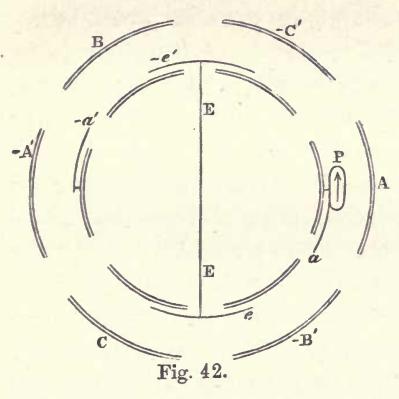
201. In the electrical machines already described sparks occur whenever the carrier comes in contact with a conductor at a different potential from its own. Now we have shewn that whenever this occurs there is a loss of energy, and therefore the whole work employed in turning the machine is not converted into electrification in an available form, but part is spent in producing the heat and noise of electric sparks. I have therefore thought it desirable to shew how an electrical machine may be constructed which is not subject to this loss of efficiency. I do not propose it as a useful form of machine, but as an example of the method by which the contrivance called in heat-engines a regenerator may be applied to an electrical machine to prevent loss of work.
201. 在已经描述的起电机中,每当载子与一个电势不同于它自身的导体接触时,就会产生火花。我们已经指出,每当这发生时就有能量损失,因此转动机器所用的全部功并没有以可用形式转化为带电,而是一部分用于产生电火花的热和噪声。因此,我认为值得说明如何构造一种不受这种效率损失的起电机。我并不是把它作为一种有用的机器形式提出,而是作为一个例子,说明热机中称为再生器的装置如何能应用于起电机以防止功的损失。
库仑扭秤Coulomb's Torsion Balance
202. A great number of the experiments by which Coulomb established the fundamental laws of electricity were made by measuring the force between two small spheres charged with electricity, one of which was fixed while the other was held in equilibrium by two forces, the electrical action between the spheres, and the torsional elasticity of a glass fibre or metal wire.
202. 库仑用以确立电学基本定律的大量实验,是通过测量两个带电小球之间的力来做的,其中一个球固定,另一个球由两个力保持平衡——两球之间的电作用,以及玻璃丝或金属丝的扭转弹性。
The balance of torsion consists of a horizontal arm of gum-lac, suspended by a fine wire or glass fibre, and carrying at one end a little sphere of elder pith, smoothly gilt. The suspension wire is fastened above to the vertical axis of an arm which can be moved round a horizontal graduated circle, so as to twist the upper end of the wire about its own axis any number of degrees. The whole of this apparatus is enclosed in a case. Another little sphere is so mounted on an insulating stem that it can be charged and introduced into the case through a hole, and brought so that its centre coincides with a definite point in the horizontal circle described by the suspended sphere.
扭秤由一个水平的紫胶横臂组成,横臂由一根细导线或玻璃丝悬挂,一端带有一个光滑镀金的小接骨木髓球。悬挂线在上方固定到一个臂的竖直轴上,该臂可绕一个有水平刻度的圆移动,从而把线的上端绕其自身轴扭转任意度数。整个装置封闭在一个匣子里。另一个小球装在一个绝缘杆上,可以带电并通过一个孔引入匣子,使其中心与悬挂球所描画水平圆上的一个确定点重合。
Now suppose both spheres charged, and the suspended sphere in equilibrium in a known position such that the torsion-arm makes an angle $\theta$ with the radius through the centre of the fixed sphere. The distance of the centres is then $2a\sin\tfrac{1}{2}\theta$, where $a$ is the radius of the torsion-arm, and if $F$ is the force between the spheres the moment of this force about the axis of torsion is $Fa\cos\tfrac{1}{2}\theta$. Let both spheres be completely discharged, and let the torsion-arm now be in equilibrium at an angle $\phi$ with the radius through the fixed sphere. Then the angle through which the electrical force twisted the torsion-arm must have been $\theta - \phi$, and if $M$ is the moment of the torsional elasticity of the fibre, we shall have the equation
现在假设两球都带电,悬挂球在一个已知位置平衡,使扭转臂与通过固定球中心的半径成角 $\theta$。球心距离为 $2a\sin\tfrac{1}{2}\theta$,其中 $a$ 是扭转臂的半径;若 $F$ 是两球之间的力,此力关于扭转轴的力矩为 $Fa\cos\tfrac{1}{2}\theta$。让两球完全放电,让扭转臂现在与通过固定球的半径成角 $\phi$ 平衡。那么电力扭转扭转臂的角度必定是 $\theta - \phi$,若 $M$ 是丝的扭转弹性力矩,我们有方程
$$Fa\cos\tfrac{1}{2}\theta = M(\theta - \phi).$$
$$Fa\cos\tfrac{1}{2}\theta = M(\theta - \phi).$$
Hence, if we can ascertain $M$, we can determine $F$, the actual force between the spheres at the distance $2a\sin\tfrac{1}{2}\theta$. To find $M$, the moment of torsion, let $I$ be the moment of inertia of the torsion-arm, and $T$ the time of a double vibration of the arm under the action of the torsional elasticity, then
因此,若能确定 $M$,就能确定 $F$,即两球在距离 $2a\sin\tfrac{1}{2}\theta$ 处的实际力。为求 $M$(扭转力矩),设 $I$ 为扭转臂的转动惯量,$T$ 为臂在扭转弹性作用下双振动的周期,则
$$M = \frac{1}{4\pi^2} IT^2.$$
$$M = \frac{1}{4\pi^2} IT^2.$$
In all electrometers it is of the greatest importance to know what force we are measuring. The force acting on the suspended sphere is due partly to the direct action of the fixed sphere, but partly also to the electrification, if any, of the sides of the case. If the case is made of glass it is impossible to determine the electrification of its surface otherwise than by very difficult measurements at every point. If, however, either the case is made of metal, or if a metallic case which almost completely encloses the apparatus is placed as a screen between the spheres and the glass case, the electrification of the inside of the metal screen will depend entirely on that of the spheres, and the electrification of the glass case will have no influence on the spheres.
在所有静电计中,知道我们测量的是什么力至关重要。作用在悬挂球上的力部分来自固定球的直接作用,部分也来自匣子侧面(如果有)的带电。若匣子是玻璃做的,除了在每一点做非常困难的测量外,无法确定其表面的带电。然而,如果匣子是金属做的,或者把一个几乎完全包围装置的金属匣作为屏蔽放在球和玻璃匣之间,那么金属屏蔽内部的带电将完全取决于球的带电,而玻璃匣的带电对球没有影响。
静电计Electrometers for the Measurement of Potentials
203. In all electrometers the moveable part is a body charged with electricity, and its potential is different from that of certain of the fixed parts round it. When, as in Coulomb's method, an insulated body having a certain charge is used, it is the charge which is the direct object of measurement. We may, however, connect the balls of Coulomb's electrometer, by means of fine wires, with different conductors. The charges of the balls will then depend on the values of the potentials of these conductors and on the potential of the case of the instrument. The charge on each ball will be approximately equal to its radius multiplied by the excess of its potential over that of the case of the instrument, provided the radii of the balls are small compared with their distances from each other and from the sides or opening of the case.
203. 在所有静电计中,可动部分是一个带电体,它的电势不同于周围某些固定部分的电势。当像库仑方法那样使用一个带一定电荷的绝缘体时,电荷是直接测量对象。然而,我们也可以用细导线把库仑静电计的球接到不同导体上。球的电荷将取决于这些导体电势的值和仪器匣子的电势。每个球上的电荷近似等于其半径乘以它超出仪器匣子电势的量,前提是球的半径远小于它们彼此之间以及它们与匣子侧面或开口之间的距离。
Coulomb's form of apparatus, however, is not well adapted for measurements of this kind, owing to the smallness of the force between spheres at the proper distances when the difference of potentials is small. A more convenient form is that of the Attracted Disk Electrometer. The first electrometers on this principle were constructed by Sir W. Snow Harris. They have since been brought to great perfection, both in theory and construction, by Sir W. Thomson. When two disks at different potentials are brought face to face with a small interval between them there will be a nearly uniform electric field in the interval, and the attraction between them can be determined.
然而,库仑形式的装置不太适合这种测量,因为当电势差很小时,在适当距离处球之间的力很小。更方便的形式是吸引圆盘静电计(Attracted Disk Electrometer)。这一原理的最早静电计由 W. 斯诺·哈里斯爵士制造。此后,无论在理论还是构造上,它们都被 W. 汤姆孙爵士完善到很高的程度。当两个电势不同的圆盘面对面放置、间隔很小时,间隔内会有一个几乎均匀的电场,可以确定它们之间的吸引力。
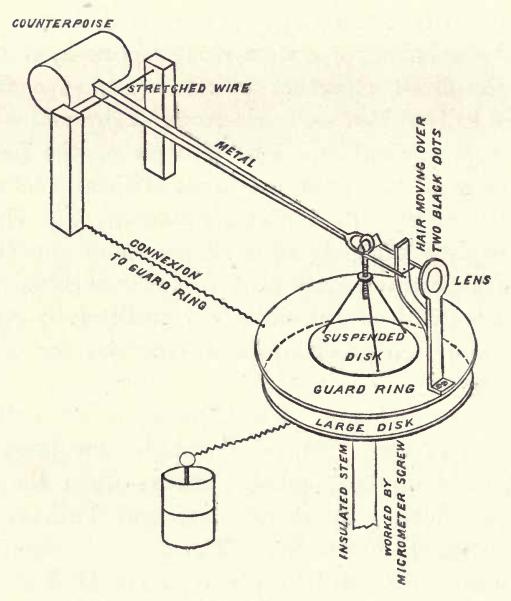
In several forms of the attracted disk electrometer, the attracted disk is placed at one end of an arm which is supported by being attached to a platinum wire passing through its centre of gravity and kept stretched by means of a spring. The other end of the arm carries the hair which is brought to a sighted position by altering the distance between the disks, and so adjusting the force of the electric attraction to a constant value. The whole apparatus is placed in a Leyden jar, of which the inner surface is charged and connected with the attracted disk and guard-ring. The other disk is worked by a micrometer screw and is connected first with the earth and then with the conductor whose potential is to be measured. The difference of readings multiplied by a constant to be determined for each electrometer gives the potential required.
在几种吸引圆盘静电计中,吸引圆盘放在一个臂的一端,臂通过一根穿过其重心的铂丝支撑,并用弹簧保持拉紧。臂的另一端带有一根游丝,通过改变圆盘之间的距离、从而把电吸引力调整到一个恒定值,使游丝到达一个可观测位置。整个装置放在一个莱顿瓶中,其内表面带电并与吸引圆盘和保护环相连。另一个圆盘由一个测微螺旋驱动,先与地相连,再与要测电势的导体相连。读数之差乘以每个静电计各自确定的常数,就得到所需的电势。
This method of using an auxiliary electrification besides the electrification to be measured is called the Heterostatic method of electrometry, in opposition to the Idiostatic method in which the whole effect is produced by the electrification to be measured.
这种除了待测带电之外再使用一个辅助带电的方法,称为静电测量的异位法(Heterostatic method),与之相对的是同体法(Idiostatic method),后者整个效应由待测带电产生。
电势的测量On the Measurement of Electric Potential
206. In order to determine large differences of potential in absolute measure we may employ the attracted disk electrometer, and compare the attraction with the effect of a weight. If at the same time we measure the difference of potential of the same conductors by means of the quadrant electrometer, we shall ascertain the absolute value of certain readings of the scale of the quadrant electrometer, and in this way we may deduce the value of the scale readings of the quadrant electrometer in terms of the potential of the suspended part, and the moment of torsion of the suspension apparatus.
206. 为以绝对测量确定大的电势差,我们可以使用吸引圆盘静电计,并把吸引力与一个重物的效应相比较。如果同时用象限静电计测量同一导体的电势差,我们就能确定象限静电计标尺某些读数的绝对值,从而以悬挂部分的电势和悬挂装置的扭转力矩来表示象限静电计标尺读数的值。
To ascertain the potential of a charged conductor of finite size we may connect the conductor with one electrode of the electrometer, while the other is connected to earth or to a body of constant potential. The electrometer reading will give the potential of the conductor after the division of its electricity between it and the part of the electrometer with which it is put in contact. If $K$ denote the capacity of the conductor, and $K'$ that of this part of the electrometer, and if $V$, $V'$ denote the potentials of these bodies before making contact, then their common potential after making contact will be
为确定一个有限大小带电导体的电势,我们可以把导体接到静电计的一个电极上,而另一个电极接地或接一个恒定电势的物体。静电计读数将给出导体在其电被分配到它自身与所接触静电计部分之间之后的电势。若 $K$ 表示导体的电容,$K'$ 表示静电计该部分的电容,$V$、$V'$ 表示这些物体接触前的电势,那么它们接触后的共同电势将是
$$\overline{V} = \frac{KV + K'V'}{K + K'}.$$
$$\overline{V} = \frac{KV + K'V'}{K + K'}.$$
Hence the original potential of the conductor was
因此导体的原始电势是
$$V = \overline{V} + \frac{K'}{K} (\overline{V} - V').$$
$$V = \overline{V} + \frac{K'}{K} (\overline{V} - V').$$
If the conductor is not large compared with the electrometer, $K'$ will be comparable with $K$, and unless we can ascertain the values of $K$ and $K'$ the second term of the expression will have a doubtful value. But if we can make the potential of the electrode of the electrometer very nearly equal to that of the body before making contact, then the uncertainty of the values of $K$ and $K'$ will be of little consequence.
如果导体不比静电计大得多,$K'$ 将与 $K$ 相当,除非我们能确定 $K$ 和 $K'$ 的值,否则表达式的第二项将有一个不确定的值。但如果我们能使静电计电极的电势在接触前非常接近物体的电势,那么 $K$ 和 $K'$ 值的不确定性就无关紧要了。
207. First Method. Place a sphere, whose radius is small compared with the distance of electrified conductors, with its centre at the given point. Connect it by means of a fine wire with the earth, then insulate it, and carry it to an electrometer and ascertain the total charge on the sphere. Then, if $V$ be the potential at the given point, and $a$ the radius of the sphere, the charge of the sphere will be $-Va = Q$, and if $V'$ be the potential of the sphere as measured by an electrometer when placed in a room whose walls are connected with the earth, then $Q = V'a$, whence $V + V' = 0$, or the potential of the air at the point where the centre of the sphere was placed is equal but of opposite sign to the potential of the sphere after being connected to earth, then insulated, and brought into a room. This method has been employed by M. Delmann of Creuznach in measuring the potential at a certain height above the earth's surface.
207. 第一法。 把一个半径远小于带电导体距离的球,使其球心放在给定点。用一根细导线把它与地相连,然后绝缘它,把它带到静电计处并确定球上的总电荷。那么,若 $V$ 是给定点的电势、$a$ 是球的半径,球的电荷将是 $-Va = Q$;若 $V'$ 是球放在一个墙壁接地的房间中由静电计测得的电势,则 $Q = V'a$,由此 $V + V' = 0$,即球心所在处空气的电势,与球在接地、绝缘并被带入房间后的电势大小相等、符号相反。这一方法已被克罗伊茨纳赫的德尔曼先生用于测量地表上方一定高度处的电势。
Second Method. We have supposed the sphere placed at the given point and first connected to earth, and then insulated, and carried into a space surrounded with conducting matter at potential zero. Now let us suppose a fine insulated wire carried from the electrode of the electrometer to the place where the potential is to be measured. Let the sphere be first discharged completely. This may be done by putting it into the inside of a vessel of the same metal which nearly surrounds it and making it touch the vessel. Now let the sphere thus discharged be carried to the end of the wire and made to touch it. Since the sphere is not electrified it will be at the potential of the air at the place. If the electrode wire is at the same potential it will not be affected by the contact, but if the electrode is at a different potential it will by contact with the sphere be made nearer to that of the air than it was before. By a succession of such operations, the sphere being alternately discharged and made to touch the electrode, the potential of the electrode of the electrometer will continually approach that of the air at the given point.
第二法。 我们曾假设球放在给定点、先接地、然后绝缘、并被带入一个被零电势导电物质包围的空间。现在让我们假设一根细绝缘导线从静电计电极延伸到要测电势的地方。让球先完全放电。这可以通过把它放进一个几乎包围它的同金属容器内部、并让它接触容器来完成。现在让这样放电的球被带到导线末端并让它接触导线。由于球不带电,它处于该处空气的电势。若电极导线处于同一电势,接触不会影响它;但若电极处于不同电势,接触球会使它比之前更接近空气的电势。通过一连串这样的操作(球交替放电并接触电极),静电计电极的电势将不断接近给定点空气的电势。
208. To measure the potential of a conductor without touching it, we may measure the potential of the air at any point in the neighbourhood of the conductor, and calculate that of the conductor from the result. If there be a hollow nearly surrounded by the conductor, then the potential at any point of the air in this hollow will be very nearly that of the conductor. In this way it has been ascertained by Sir W. Thomson that if two hollow conductors, one of copper and the other of zinc, are in metallic contact, then the potential of the air in the hollow surrounded by zinc is positive with reference to that of the air in the hollow surrounded by copper.
208. 为不接触导体而测量其电势,我们可以测量导体附近任一点空气的电势,并由结果计算出导体的电势。若有一个几乎被导体包围的空腔,那么该空腔内任一点空气的电势将非常接近导体的电势。用这种方法,W. 汤姆孙爵士已确定:如果两个空腔导体(一个铜、一个锌)金属接触,那么锌所包围空腔内空气的电势相对于铜所包围空腔内空气的电势为正。
Third Method. If by any means we can cause a succession of small bodies to detach themselves from the end of the electrode, the potential of the electrode will approximate to that of the surrounding air. This may be done by causing shot, filings, sand, or water to drop out of a funnel or pipe connected with the electrode. The point at which the potential is measured is that at which the stream ceases to be continuous and breaks into separate parts or drops.
第三法。 如果以任何方式使一连串小物体从电极末端脱离,电极的电势将接近周围空气的电势。这可以通过使弹丸、锉屑、沙子或水从与电极相连的漏斗或管子中滴落来实现。测量电势的点是流束停止连续、断裂成独立部分或液滴的那一点。
第十二章 · 电阻的测量Chapter XII — The Measurement of Electric Resistance
电阻单位与欧姆Units of Resistance and the Ohm
209. In the present state of electrical science, the determination of the electric resistance of a conductor may be considered as the cardinal operation in electricity, in the same sense that the determination of weight is the cardinal operation in chemistry. The reason of this is that the determination in absolute measure of other electrical magnitudes, such as quantities of electricity, electromotive forces, currents, &c., requires in each case a complicated series of operations, involving generally observations of time, measurements of distances, and determinations of moments of inertia, and these operations must be repeated for every new determination, because it is impossible to preserve a unit of electricity, or of electromotive force, or of current, in an unchangeable state, so as to be available for direct comparison.
209. 在电学的现状下,导体电阻的测定可以看作电学中的基本操作,正如重量的测定是化学中的基本操作一样。原因是:其他电学量(如电量、电动势、电流等)的绝对测量,每种情况都需要一连串复杂的操作,通常涉及时间的观测、距离的测量和转动惯量的测定,而且每次新测定都必须重复这些操作,因为不可能把电量、电动势或电流的单位保存在不变的状态下以供直接比较。
But when the electric resistance of a properly shaped conductor of a properly chosen material has once been determined, it is found that it always remains the same for the same temperature, so that the conductor may be used as a standard of resistance, with which that of other conductors can be compared, and the comparison of two resistances is an operation which admits of extreme accuracy. When the unit of electrical resistance has been fixed on, material copies of this unit, in the form of 'Resistance Coils,' are prepared for the use of electricians, so that in every part of the world electrical resistances may be expressed in terms of the same unit. These unit resistance coils are at present the only examples of material electric standards which can be preserved, copied, and used for the purpose of measurement.
但是,当形状适当、材料选择得当的导体的电阻一旦被确定,就发现它在同一温度下始终不变,因此该导体可以用作电阻标准,其他导体的电阻可与它比较,而两个电阻的比较是一种可达到极高精度的操作。当电阻单位确定后,就以「电阻线圈」的形式制作该单位的实物副本供电学家使用,使世界各地的电阻都能用同一单位表示。这些单位电阻线圈目前是唯一能保存、复制并用于测量的实物电学标准。
210. The unit of resistance may be an entirely arbitrary one, as in the case of Jacobi's Etalon, which was a certain copper wire of 22·4932 grammes weight, 7·61975 metres length, and 0·667 millimetres diameter. Copies of this have been made by Leyser of Leipsig, and are to be found in different places. According to another method the unit may be defined as the resistance of a portion of a definite substance of definite dimensions. Thus, Siemens' unit is defined as the resistance of a column of mercury of one metre long, and one square millimetre section, at the temperature 0°C.
210. 电阻单位可以是一个完全任意的单位,如雅可比标准(Jacobi's Etalon),它是一根重量 22·4932 克、长度 7·61975 米、直径 0·667 毫米的铜线。它的副本由莱比锡的莱泽尔制作,可在不同地方找到。按另一种方法,单位可以定义为某确定物质某确定尺寸部分的电阻。这样,西门子单位被定义为:在 0°C 温度下,一米长、一平方毫米截面的水银柱的电阻。
211. Finally, the unit may be defined with reference to the electrostatic or the electromagnetic system of units. In practice the electromagnetic system is used in all telegraphic operations, and therefore the only systematic units actually in use are those of this system. In the electromagnetic system a resistance is a quantity homogeneous with a velocity, and may therefore be expressed as a velocity.
211. 最后,单位可以参照静电单位制或电磁单位制来定义。实际上,所有电报操作都使用电磁单位制,因此实际使用的唯一系统单位就是这一单位制的单位。在电磁单位制中,电阻是与速度同类的量,因此可以表示为速度。
212. The first actual measurements on this system were made by Weber, who employed as his unit one millimetre per second. Sir W. Thomson afterwards used one foot per second as a unit, but a large number of electricians have now agreed to use the unit of the British Association, which professes to represent a resistance which, expressed as a velocity, is ten millions of metres per second. It is sometimes referred to as the B.A. unit, but in order to connect it with the name of the discoverer of the laws of resistance, it is called the Ohm.
212. 这一单位制上的最早实际测量由韦伯做出,他以每秒一毫米作为他的单位。W. 汤姆孙爵士后来以每秒一英尺作为单位,但大量电学家现已同意使用英国科学促进会的单位,它声称代表的电阻以速度表示是每秒一千万米。它有时被称为 B.A. 单位,但为了把它与电阻定律发现者的名字联系起来,它被称为欧姆。
213. To recollect its value in absolute measure it is useful to know that ten millions of metres is professedly the distance from the pole to the equator, measured along the meridian of Paris. A body, therefore, which in one second travels along a meridian from the pole to the equator would have a velocity which, on the electromagnetic system, is professedly represented by an Ohm. I say professedly, because, if more accurate researches should prove that the Ohm, as constructed from the British Association's material standards, is not really represented by this velocity, electricians would not alter their standards, but would apply a correction.
213. 为记住它的绝对测量值,有用的是知道:一千万米据称是从极点到赤道、沿巴黎子午线测量的距离。因此,一个在一秒内沿子午线从极点运行到赤道的物体,其速度在电磁单位制上据称由一个欧姆表示。我说「据称」,是因为如果更精确的研究证明:由英国科学促进会实物标准构造的欧姆并不真正由这一速度表示,电学家们也不会更改他们的标准,而会施加一个修正。
214. When a material unit representing this abstract quantity has been made, other standards are constructed by copying this unit, a process capable of extreme accuracy—of much greater accuracy than, for instance, the copying of foot-rules from a standard foot. These copies, made of the most permanent materials, are distributed over all parts of the world. But such units as that of Siemens can without very great labour be reconstructed with considerable accuracy, so that as the relation of the Ohm to Siemens unit is known, the Ohm can be reproduced even without having a standard to copy. Finally, the Ohm may be reproduced by the electromagnetic method by which it was originally determined.
214. 当表示这一抽象量的实物单位被制成后,其他标准就通过复制该单位来构造,这一过程能达到极高的精度——比例如从标准英尺复制英尺尺的精度高得多。这些用最耐久材料制成的副本被分发到世界各地。但是,像西门子单位这样的单位,无需很大劳动就能以相当精度重建,因此既然欧姆与西门子单位的关系已知,即使没有标准可复制也能再现欧姆。最后,欧姆可以通过最初确定它所用的电磁方法来再现。
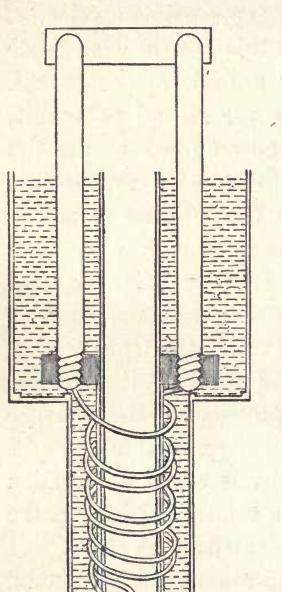
The actual resistance coils constructed to represent the Ohm were made of an alloy of two parts of silver and one of platinum in the form of wires from ·5 millimetres to ·8 millimetres diameter, and from one to two metres in length. These wires were soldered to stout copper electrodes. The wire itself was covered with two layers of silk, imbedded in solid paraffin, and enclosed in a thin brass case, so that it can be easily brought to a temperature at which its resistance is accurately one Ohm. This temperature is marked on the insulating support of the coil.
为表示欧姆而构造的实际电阻线圈,由两份银一份铂的合金制成,呈直径 ·5 毫米到 ·8 毫米、长度一到两米的导线形式。这些导线焊接到粗铜电极上。导线本身覆以两层丝、埋在固体石蜡中、并封闭在薄黄铜套内,因此可以很容易地把它带到其电阻准确为一欧姆的温度。这个温度标记在线圈的绝缘支架上。
电阻线圈与电阻箱On the Forms of Resistance Coils and Boxes
215. A Resistance Coil is a conductor capable of being easily placed in the voltaic circuit, so as to introduce into the circuit a known resistance. The electrodes or ends of the coil must be such that no appreciable error may arise from the mode of making the connexions. For resistances of considerable magnitude it is sufficient that the electrodes should be made of stout copper wire or rod well amalgamated with mercury at the ends, and that the ends should be made to press on flat amalgamated copper surfaces placed in mercury cups.
215. 电阻线圈是一个能方便地放入伏打电路、从而把已知电阻引入电路的导体。线圈的电极或末端必须做到不因连接方式而产生可观的误差。对于相当大的电阻,只要电极由粗铜线或铜棒制成、末端很好地汞齐化,并且末端压在置于水银杯中的扁平汞齐化铜面上即可。
216. For instance, a series of coils of which the resistances are 1, 2, 4, 8, 16, &c., arranged according to the powers of 2, may be placed in a box in series. By inserting plugs between them, any desired resistance up to the sum of all may be introduced into the circuit.
216. 例如,一列电阻为 1、2、4、8、16……(按 2 的幂排列)的线圈可以串联放在一个箱子里。通过在它们之间插入插头,可以把直到全部总和的任何所需电阻引入电路。
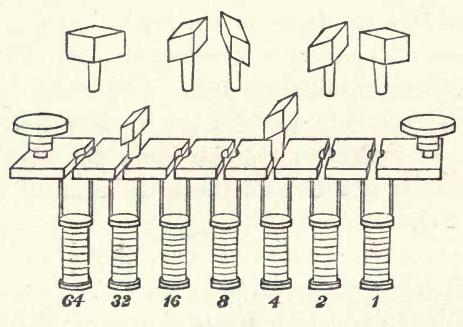
217. The other electrode of the box is a long brass plate, such that by inserting brass plugs between it and the electrodes of the coils it may be connected to the first electrode through any given set of coils. The conductivity of the box is then the sum of the conductivities of the coils. In the figure, in which the resistances of the coils are 1, 2, 4, &c., and the plugs are inserted at 2 and 8, the conductivity of the box is $\frac{1}{2} + \frac{1}{8} = \frac{5}{8}$, and the resistance of the box is therefore $\frac{8}{5}$ or 1·6. This method of combining resistance coils for the measurement of fractional resistances was introduced by Sir W. Thomson under the name of the method of multiple arcs.
217. 箱子的另一个电极是一块长黄铜板,通过在它与各线圈电极之间插入黄铜插头,就能通过任意给定的一组线圈把它与第一个电极相连。此时箱子的电导是各线圈电导之和。在图中,线圈的电阻为 1、2、4……,插头插在 2 和 8 处,箱子的电导为 $\frac{1}{2} + \frac{1}{8} = \frac{5}{8}$,因此箱子的电阻为 $\frac{8}{5}$ 即 1·6。这种为测量分数电阻而组合电阻线圈的方法,由 W. 汤姆孙爵士以多支路法(method of multiple arcs)的名称引入。
电阻的比较On the Comparison of Resistances
219. If $E$ is the electromotive force of a battery, and $R$ the resistance of the battery and its connexions, including the galvanometer used in measuring the current, and if the strength of the current is $I$ when the battery connexions are closed, and $I_1$, $I_2$ when additional resistances $r_1$, $r_2$ are introduced into the circuit, then, by Ohm's Law,
219. 若 $E$ 是电池的电动势,$R$ 是电池及其连接(包括测电流所用电流计)的电阻,电池连接闭合时电流强度为 $I$,在电路中引入附加电阻 $r_1$、$r_2$ 时分别为 $I_1$、$I_2$,则由欧姆定律,
$$E = IR = I_1(R + r_1) = I_2(R + r_2).$$
$$E = IR = I_1(R + r_1) = I_2(R + r_2).$$
Eliminating $E$, the electromotive force of the battery, and $R$ the resistance of the battery and its connexions, we get Ohm's formula $\dfrac{r_1}{r_2} = \dfrac{(I - I_1)I_2}{(I - I_2)I_1}$. This method requires a measurement of the ratios of $I$, $I_1$ and $I_2$, and this implies a galvanometer graduated for absolute measurements. But this is rather to be taken as an example of a faulty method than as a practical method of determining resistance. The electromotive force $E$ cannot be maintained rigorously constant, and the internal resistance of the battery is also exceedingly variable, so that any methods in which these are assumed to be even for a short time constant are not to be depended on.
消去电池电动势 $E$ 和电池及其连接的电阻 $R$,我们得到欧姆公式 $\dfrac{r_1}{r_2} = \dfrac{(I - I_1)I_2}{(I - I_2)I_1}$。这一方法需要测量 $I$、$I_1$、$I_2$ 之比,这意味着一台为绝对测量而刻度的电流计。但是,与其把它当作确定电阻的实用方法,不如把它当作一个有缺陷方法的例子。电动势 $E$ 不能严格保持恒定,电池的内阻也极不稳定,因此任何假定它们即使短时间恒定的方法都不可靠。
220. The comparison of resistances can be made with extreme accuracy by either of two methods, in which the result is independent of variations of $R$ and $E$. The first of these methods depends on the use of the differential galvanometer, an instrument in which there are two coils, the currents in which are independent of each other, so that when the currents are made to flow in opposite directions they act in opposite directions on the needle, and when the ratio of these currents is that of $m$ to $n$ they have no resultant effect on the galvanometer needle.
220. 电阻的比较可以用两种方法之一以极高精度完成,其中结果与 $R$ 和 $E$ 的变化无关。第一种方法依赖于差动电流计的使用,这种仪器有两个线圈,其中的电流彼此独立,因此当电流沿相反方向流动时,它们沿相反方向作用于指针,而当这些电流之比为 $m$ 比 $n$ 时,它们对电流计指针没有合效应。
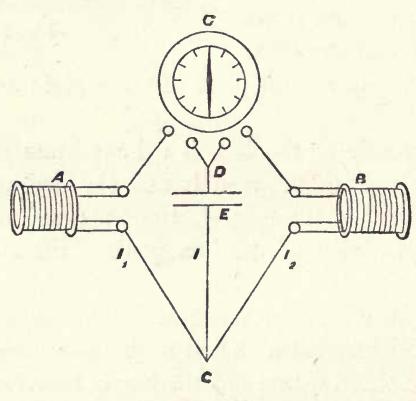
Let $I_1$, $I_2$ be the currents through the two coils of the galvanometer, then the deflexion of the needle may be written $\delta = m I_1 - n I_2$. Now let the battery current $I$ be divided between the coils of the galvanometer, and let resistances $A$ and $B$ be introduced into the first and second coils respectively. Let the remainder of the resistance of their coils and their connexions be $a$ and $\beta$ respectively, and let the resistance of the battery and its connexions between $C$ and $D$ be $r$, and its electromotive force $E$. Then we find, by Ohm's Law, for the difference of potentials between $C$ and $D$,
设 $I_1$、$I_2$ 是通过电流计两个线圈的电流,则指针的偏转可写为 $\delta = m I_1 - n I_2$。现在让电池电流 $I$ 在电流计的两个线圈之间分配,并在第一、第二线圈中分别引入电阻 $A$ 和 $B$。设它们线圈及其连接其余部分的电阻分别为 $a$ 和 $\beta$,电池及其在 $C$ 与 $D$ 之间连接的电阻为 $r$,其电动势为 $E$。则由欧姆定律,对于 $C$ 与 $D$ 之间的电势差,我们求得
$$C-D = I_1(A+a) = I_2(B+\beta) = E-Ir,$$
$$C-D = I_1(A+a) = I_2(B+\beta) = E-Ir,$$
where $D = (A + a)(B + \beta) + r(A + a + B + \beta)$. The deflexion of the galvanometer needle is therefore
其中 $D = (A + a)(B + \beta) + r(A + a + B + \beta)$。因此电流计指针的偏转为
$$\delta = \frac{E}{D} \left\{ m \left( B + \beta \right) - n \left( A + a \right) \right\},$$
$$\delta = \frac{E}{D} \left\{ m \left( B + \beta \right) - n \left( A + a \right) \right\},$$
and if there is no observable deflexion, then we know that the quantity enclosed in brackets cannot differ from zero by more than a certain small quantity. Suppose that $B$ has been adjusted so that there is no apparent deflexion. Now let another conductor $A'$ be substituted for $A$, and let $A'$ be adjusted till there is no apparent deflexion. Then evidently to a first approximation $A' = A$.
如果没有可观测的偏转,那么我们知道括号内的量偏离零不会超过某个小量。假设 $B$ 已调整到没有明显偏转。现在用另一个导体 $A'$ 替代 $A$,并调整 $A'$ 直到没有明显偏转。那么显然在一阶近似上 $A' = A$。
The merit of the method consists in the fact that the thing observed is the absence of any deflexion, or in other words, the method is a Null method, one in which the non-existence of a force is asserted from an observation in which the force, if it had been different from zero by more than a certain small amount, would have produced an observable effect. Null methods are of great value where they can be employed, but they can only be employed where we can cause two equal and opposite quantities of the same kind to enter into the experiment together.
这一方法的优点在于:所观测的是没有任何偏转,换句话说,这是一种零位法(Null method),其中由一次观测断言力的不存在——如果该力偏离零超过某个小量,就会产生可观测的效应。零位法在能应用的地方极有价值,但只能在能让两个相等而相反的同种量一起进入实验的地方应用。
惠斯通电桥Wheatstone's Bridge
221. Wheatstone's Bridge consists essentially of six conductors connecting four points. An electromotive force $E$ is made to act between two of the points by means of a voltaic battery introduced between $B$ and $C$. The current between the other two points $O$ and $A$ is measured by a galvanometer. Under certain circumstances this current becomes zero. The conductors $BC$ and $OA$ are then said to be conjugate to each other, which implies a certain relation between the resistances of the other four conductors, and this relation is made use of in measuring resistances.
221. 惠斯通电桥本质上由连接四个点的六个导体组成。电动势 $E$ 通过引入 $B$ 与 $C$ 之间的伏打电池作用在两点之间。另外两点 $O$ 与 $A$ 之间的电流由电流计测量。在某些情况下这一电流变为零。此时导体 $BC$ 与 $OA$ 被称为彼此共轭,这意味着其他四个导体电阻之间存在某种关系,这一关系被用来测量电阻。
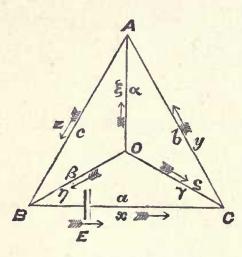
If the current in $OA$ is zero, the potential at $O$ must be equal to that at $A$. Now when we know the potentials at $B$ and $C$ we can determine those at $O$ and $A$ by the rule given at Art. 157, provided there is no current in $OA$,
如果 $OA$ 中的电流为零,$O$ 处的电势必等于 $A$ 处的电势。现在当我们知道 $B$ 和 $C$ 处的电势时,只要 $OA$ 中没有电流,就可以由第 157 节的规则确定 $O$ 和 $A$ 处的电势,
$$O = \frac{B\gamma + C\beta}{\beta + \gamma}, \quad A = \frac{Bb + Cc}{b + c},$$
$$O = \frac{B\gamma + C\beta}{\beta + \gamma}, \quad A = \frac{Bb + Cc}{b + c},$$
whence the condition is $b\beta = c\gamma$, where $b$, $c$, $\beta$, $\gamma$ are the resistances in $CA$, $AB$, $BO$ and $OC$ respectively. To determine the degree of accuracy attainable by this method we must ascertain the strength of the current in $OA$ when this condition is not fulfilled exactly. Let $A$, $B$, $C$ and $O$ be the four points. Let the currents along $BC$, $CA$ and $AB$ be $x$, $y$ and $z$, and the resistances of these conductors $a$, $b$ and $c$. Let the currents along $OA$, $OB$ and $OC$ be $\xi$, $\eta$, $\zeta$, and the resistances $a$, $\beta$ and $\gamma$. Let an electromotive force $E$ act along $BC$. Required the current $\xi$ along $OA$.
由此条件为 $b\beta = c\gamma$,其中 $b$、$c$、$\beta$、$\gamma$ 分别是 $CA$、$AB$、$BO$、$OC$ 中的电阻。为确定此方法可达到的精度,我们必须确定当这一条件未严格满足时 $OA$ 中的电流强度。设 $A$、$B$、$C$、$O$ 为四个点。设沿 $BC$、$CA$、$AB$ 的电流为 $x$、$y$、$z$,这些导体的电阻为 $a$、$b$、$c$。设沿 $OA$、$OB$、$OC$ 的电流为 $\xi$、$\eta$、$\zeta$,电阻为 $a$、$\beta$、$\gamma$。设电动势 $E$ 沿 $BC$ 作用。求沿 $OA$ 的电流 $\xi$。
By considering the system as made up of three circuits $OBC$, $OCA$ and $OAB$ in which the currents are $x$, $y$, $z$ respectively, and applying Kirchhoff's rule to each cycle, we obtain, if we put
通过把系统看作由三个回路 $OBC$、$OCA$、$OAB$ 组成(其中电流分别为 $x$、$y$、$z$),并对每个循环应用基尔霍夫规则,我们得到——若令
$$D = \begin{vmatrix} a+\beta+\gamma & -\gamma & -\beta \\ -\gamma & b+\gamma+a & -a \\ -\beta & -\alpha & c+a+\beta \end{vmatrix},$$
$$D = \begin{vmatrix} a+\beta+\gamma & -\gamma & -\beta \\ -\gamma & b+\gamma+a & -a \\ -\beta & -\alpha & c+a+\beta \end{vmatrix},$$
we find $\xi = \dfrac{E}{D} (b\beta - c\gamma)$. The value of $D$ may be expressed in the symmetrical form, or, since we suppose the battery in the conductor $a$ and the galvanometer in $a$, we may put $B$ the battery resistance for $a$ and $G$ the galvanometer resistance for $a$. We then find
我们求得 $\xi = \dfrac{E}{D} (b\beta - c\gamma)$。$D$ 的值可以表示为对称形式;或者,由于我们假设电池在导体 $a$ 中、电流计在 $a$ 中,我们可以用 $B$(电池电阻)替代 $a$、用 $G$(电流计电阻)替代 $a$。我们于是求得
$$D = BG(b+c+\beta+\gamma) + B(b+\gamma)(c+\beta) + G(b+c)(\beta+\gamma) + bc(\beta+\gamma) + \beta\gamma(b+c).$$
$$D = BG(b+c+\beta+\gamma) + B(b+\gamma)(c+\beta) + G(b+c)(\beta+\gamma) + bc(\beta+\gamma) + \beta\gamma(b+c).$$
If the electromotive force $E$ were made to act along $OA$, the resistance of $OA$ being still $a$, and if the galvanometer were placed in $BC$, the resistance of $BC$ being still $a$, then the value of $D$ would remain the same, and the current in $BC$ due to the electromotive force $E$ acting along $OA$ would be equal to the current in $OA$ due to the electromotive force $E$ acting in $BC$.
如果让电动势 $E$ 沿 $OA$ 作用($OA$ 的电阻仍为 $a$),并把电流计放在 $BC$ 中($BC$ 的电阻仍为 $a$),那么 $D$ 的值将保持不变,而且沿 $OA$ 作用的电动势 $E$ 在 $BC$ 中产生的电流,等于在 $BC$ 中作用的电动势 $E$ 在 $OA$ 中产生的电流。
222. But if we simply disconnect the battery and the galvanometer, and without altering their respective resistances connect the battery to $O$ and $A$ and the galvanometer to $B$ and $C$, then in the value of $D$ we must exchange the values of $B$ and $G$. If $D'$ be the value of $D$ after this exchange, we find $D'-D = (G-B)\{(b+c)(\beta+\gamma) - (b+\gamma)(\beta+c)\} = (B-G)\{(b-\beta)(c-\gamma)\}$. Let us suppose that the resistance of the galvanometer is greater than that of the battery. The rule therefore for obtaining the greatest galvanometer deflexion in a given system is as follows: Of the two resistances, that of the battery and that of the galvanometer, connect the greater resistance so as to join the two greatest to the two least of the four other resistances.
222. 但是,如果我们简单地断开电池和电流计,并在不改变它们各自电阻的情况下把电池接到 $O$ 和 $A$、把电流计接到 $B$ 和 $C$,那么在 $D$ 的值中我们必须交换 $B$ 和 $G$ 的值。若 $D'$ 是这次交换后 $D$ 的值,我们求得 $D'-D = (G-B)\{(b+c)(\beta+\gamma) - (b+\gamma)(\beta+c)\} = (B-G)\{(b-\beta)(c-\gamma)\}$。让我们假设电流计的电阻大于电池的电阻。因此,在给定系统中获得最大电流计偏转的规则如下:在电池电阻和电流计电阻这两个电阻中,把较大的电阻连接得使其他四个电阻中的两个最大者与两个最小者相连。
223. We shall suppose that we have to determine the ratio of the resistances of the conductors $AB$ and $AC$, and that this is to be done by finding a point $O$ on the conductor $BOC$, such that when the points $A$ and $O$ are connected by a wire, in the course of which a galvanometer is inserted, no sensible deflexion of the galvanometer needle occurs when the battery is made to act between $B$ and $C$. Let the whole resistance of $BAC$ be $R$. Let $c = mR$ and $b = (1-m)R$. Let the whole resistance of $BOC$ be $S$. Let $\beta = nS$ and $\gamma = (1-n)S$. The value of $n$ is read off directly, and that of $m$ is deduced from it when there is no sensible deviation of the galvanometer. We find as before
223. 我们将假设需要确定导体 $AB$ 与 $AC$ 的电阻之比,这通过在导体 $BOC$ 上找一个点 $O$ 来完成,使得当点 $A$ 与 $O$ 用一根中间插入电流计的导线相连时,在电池作用于 $B$ 与 $C$ 之间时电流计指针不发生可感偏转。设 $BAC$ 的总电阻为 $R$。设 $c = mR$、$b = (1-m)R$。设 $BOC$ 的总电阻为 $S$。设 $\beta = nS$、$\gamma = (1-n)S$。$n$ 的值直接读出,当电流计无可感偏差时由它推出 $m$ 的值。我们如前求得
$$D = G \{BR + BS + RS\} + m(1-m)R^{2}(B+S) + n(1-n)S^{2}(B+R) + (m+n-2mn)BRS,$$
$$D = G \{BR + BS + RS\} + m(1-m)R^{2}(B+S) + n(1-n)S^{2}(B+R) + (m+n-2mn)BRS,$$
and if $\xi$ is the current in the galvanometer wire $\xi = \dfrac{ERS}{D}(n-m)$. In order to obtain the most accurate results we must make the deviation of the needle as great as possible compared with the value of $(n-m)$. If we also put $m = n$, as is the case if we have made a correct observation, we find the best value of $G$ to be $G = n(1-n)(R+S)$.
若 $\xi$ 是电流计导线中的电流,则 $\xi = \dfrac{ERS}{D}(n-m)$。为获得最精确的结果,我们必须使指针的偏差相对于 $(n-m)$ 的值尽可能大。如果我们还令 $m = n$(当我们做了正确观测时正是如此),我们求得 $G$ 的最佳值为 $G = n(1-n)(R+S)$。
224. We have already explained the general theory of Wheatstone's Bridge, we shall now consider some of its applications. The comparison which can be effected with the greatest exactness is that of two equal resistances. Let us suppose that $\beta$ is a standard resistance coil, and that we wish to adjust $\gamma$ to be equal in resistance to $\beta$. Two other coils, $b$ and $c$, are prepared which are equal or nearly equal to each other, and the four coils are placed with their electrodes in mercury cups so that the current of the battery is divided between two branches, one consisting of $\beta$ and $\gamma$ and the other of $b$ and $c$. The coils $b$ and $c$ are connected by a wire $PR$, as uniform in its resistance as possible, and furnished with a scale of equal parts.
224. 我们已经解释了惠斯通电桥的一般理论,现在考虑它的一些应用。能以最高精度完成的是两个相等电阻的比较。让我们假设 $\beta$ 是一个标准电阻线圈,我们想把 $\gamma$ 调整到与 $\beta$ 电阻相等。另准备两个彼此相等或几乎相等的线圈 $b$ 和 $c$,四个线圈的电极放在水银杯中,使电池电流在两个支路之间分配,一个由 $\beta$ 和 $\gamma$ 组成,另一个由 $b$ 和 $c$ 组成。线圈 $b$ 和 $c$ 用一根电阻尽可能均匀的导线 $PR$ 连接,并配有等分标尺。
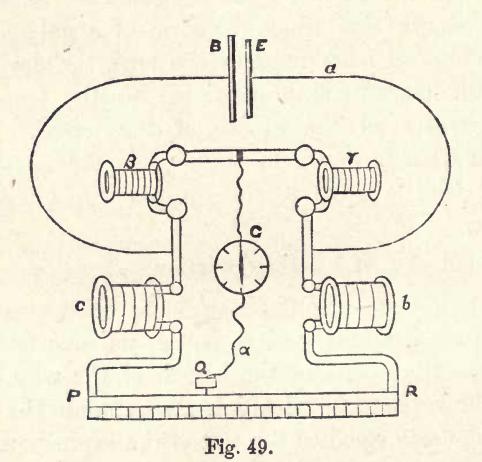
The galvanometer wire connects the junction of $\beta$ and $\gamma$ with a point $Q$ of the wire $PR$, and the point of contact at $Q$ is made to vary till on closing first the battery circuit and then the galvanometer circuit, no deflexion of the galvanometer needle is observed. The coils $\beta$ and $\gamma$ are then made to change places, and a new position is found for $Q$. If this new position is the same as the old one, then we know that $\gamma$ is rightly adjusted. If the resistances of the coils $b$ and $c$ are equal to that of $b$ and $c$ divisions of the wire respectively, then, if $x$ is the scale reading of $Q$ in the first case, and $y$ that in the second,
电流计导线把 $\beta$ 与 $\gamma$ 的连接点接到导线 $PR$ 上的点 $Q$,并改变 $Q$ 处的接触点,直到先闭合电池电路、再闭合电流计电路时,观察不到电流计指针的偏转。然后让线圈 $\beta$ 和 $\gamma$ 交换位置,并为 $Q$ 找一个新的位置。如果这个新位置与旧位置相同,那么我们知道 $\gamma$ 已正确调整。如果线圈 $b$ 和 $c$ 的电阻分别等于导线 $b$ 和 $c$ 分度的电阻,那么,若 $x$ 是第一种情况下 $Q$ 的标尺读数,$y$ 是第二种情况下的读数,
$$\frac{c+x}{b-x} = \frac{\beta}{\gamma}, \qquad \frac{c+y}{b-y} = \frac{\gamma}{\beta},$$
$$\frac{c+x}{b-x} = \frac{\beta}{\gamma}, \qquad \frac{c+y}{b-y} = \frac{\gamma}{\beta},$$
whence $\gamma = \beta \left( 1 + 2 \dfrac{y - x}{b + c} \right)$. When $\gamma$ is adjusted as well as we can, we substitute for $b$ and $c$ other coils of (say) ten times greater resistance. The remaining difference between $\beta$ and $\gamma$ will now produce a ten times greater difference in the position of $Q$ than with the original coils $b$ and $c$, and in this way we can continually increase the accuracy of the comparison. The battery must never be introduced instead of the galvanometer into the wire with a sliding contact, for the passage of a powerful current at the point of contact would injure the surface of the wire.
由此 $\gamma = \beta \left( 1 + 2 \dfrac{y - x}{b + c} \right)$。当 $\gamma$ 已尽可能调整好时,我们用其他电阻(比如)大十倍的线圈替代 $b$ 和 $c$。$\beta$ 与 $\gamma$ 之间剩余的差现在将使 $Q$ 的位置产生比原来线圈 $b$、$c$ 大十倍的差,这样我们就能不断提高比较的精度。绝不可把电池而不是电流计引入带滑动接触的导线,因为接触点处强大电流的通过会损伤导线表面。
225. Thomson's Method for the Determination of the Resistance of the Galvanometer. An arrangement similar to Wheatstone's Bridge has been employed with advantage by Sir W. Thomson in determining the resistance of the galvanometer when in actual use. It was suggested to Sir W. Thomson by Mance's Method. Let the battery be placed, as before, between $B$ and $C$ in the figure of Article 221, but let the galvanometer be placed in $CA$ instead of in $OA$. If $b\beta - c\gamma$ is zero, then the conductor $OA$ is conjugate to $BC$, and, as there is no current produced in $OA$ by the battery in $BC$, the strength of the current in any other conductor is independent of the resistance in $OA$. Hence, if the galvanometer is placed in $CA$ its deflexion will remain the same whether the resistance of $OA$ is small or great. We therefore observe whether the deflexion of the galvanometer remains the same when $O$ and $A$ are joined by a conductor of small resistance, as when this connexion is broken, and if, by properly adjusting the resistances of the conductors, we obtain this result, we know that the resistance of the galvanometer is $b = \dfrac{c\gamma}{\beta}$, where $c$, $\gamma$, and $\beta$ are resistance coils of known resistance.
225. 汤姆孙测定电流计电阻的方法。 W. 汤姆孙爵士曾有利地采用一种类似惠斯通电桥的装置,来测定实际使用中电流计的电阻。这是由曼斯方法向 W. 汤姆孙爵士提示的。如前,把电池放在第 221 节图中的 $B$ 与 $C$ 之间,但把电流计放在 $CA$ 中而不是 $OA$ 中。若 $b\beta - c\gamma$ 为零,则导体 $OA$ 与 $BC$ 共轭,而且由于 $BC$ 中的电池不在 $OA$ 中产生电流,任何其他导体中的电流强度与 $OA$ 中的电阻无关。因此,如果把电流计放在 $CA$ 中,无论 $OA$ 的电阻是小是大,它的偏转都将保持不变。因此我们观察:当 $O$ 和 $A$ 用一个低电阻导体连接时,电流计的偏转是否与这一连接断开时相同;如果通过适当调整各导体电阻得到这一结果,我们就知道电流计的电阻为 $b = \dfrac{c\gamma}{\beta}$,其中 $c$、$\gamma$、$\beta$ 是已知电阻的线圈。
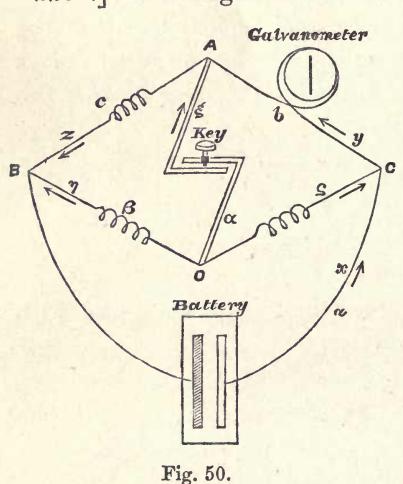
226. Mance's Method of determining the Resistance of the Battery. The measurement of the resistance of a battery when in action is of a much higher order of difficulty, since the resistance of the battery is found to change considerably for some time after the strength of the current through it is changed. In many of the methods commonly used to measure the resistance of a battery such alterations of the strength of the current through it occur in the course of the operations, and therefore the results are rendered doubtful. In Mance's method, which is free from this objection, the battery is placed in $BC$ and the galvanometer in $CA$. The connexion between $O$ and $B$ is then alternately made and broken. If the deflexion of the galvanometer remains unaltered, we know that $OB$ is conjugate to $CA$, whence $c\gamma = aa$, and $a$, the resistance of the battery, is obtained in terms of known resistances $c$, $\gamma$, $a$.
226. 曼斯测定电池电阻的方法。 测定工作中的电池的电阻,难度高得多,因为发现电池电阻在通过它的电流强度改变后相当一段时间内会有显著变化。在常用的许多测电池电阻的方法中,操作过程中会发生这种通过它的电流强度的改变,因此结果变得可疑。在曼斯方法中(它没有这一缺陷),电池放在 $BC$ 中、电流计放在 $CA$ 中。然后交替接通和断开 $O$ 与 $B$ 之间的连接。如果电流计的偏转保持不变,我们就知道 $OB$ 与 $CA$ 共轭,由此 $c\gamma = aa$,电池电阻 $a$ 就由已知电阻 $c$、$\gamma$、$a$ 表出。
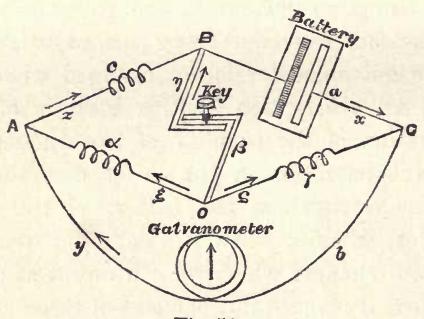
In this method of measuring the resistance of the battery, the current in the battery is not in any way interfered with during the operation, so that we may ascertain its resistance for any given strength of current, so as to determine how the strength of current affects the resistance. The determination of the resistance of the coil of a galvanometer can easily be effected in the ordinary way of using Wheatstone's Bridge by placing another galvanometer in $OA$. By the method now described the galvanometer itself is employed to measure its own resistance.
在这种测电池电阻的方法中,电池中的电流在操作期间没有受到任何干扰,因此我们可以确定它在任何给定电流强度下的电阻,从而确定电流强度如何影响电阻。电流计线圈电阻的测定,可以容易地按使用惠斯通电桥的普通方式、通过在 $OA$ 中放另一个电流计来完成。用现在所述的方法,电流计本身被用来测量它自己的电阻。
电动势的比较On the Comparison of Electromotive Forces
227. The following method of comparing the electromotive forces of voltaic and thermoelectric arrangements, when no current passes through them, requires only a set of resistance coils and a constant battery. Let the electromotive force $E$ of the battery be greater than that of either of the electromotors to be compared, then, if a sufficient resistance, $R_1$, be interposed between the points $A_1$, $B_1$ of the primary circuit $E B_1 A_1 E$, the electromotive force from $B_1$ to $A_1$ may be made equal to that of the electromotor $E_1$. If the electrodes of this electromotor are now connected with the points $A_1$, $B_1$ no current will flow through the electromotor. By placing a galvanometer $G_1$ in the circuit of the electromotor $E_1$, and adjusting the resistance between $A_1$ and $B_1$, till the galvanometer $G_1$ indicates no current, we obtain the equation
227. 当没有电流通过它们时,比较伏打装置和热电装置电动势的下列方法,只需要一组电阻线圈和一个恒定电池。设电池的电动势 $E$ 大于待比较的任一电机的电动势,那么,如果在主电路 $E B_1 A_1 E$ 的点 $A_1$、$B_1$ 之间插入足够的电阻 $R_1$,就可以使从 $B_1$ 到 $A_1$ 的电动势等于电机 $E_1$ 的电动势。如果现在把这个电机的电极接到点 $A_1$、$B_1$,就没有电流通过该电机。通过在电机 $E_1$ 的电路中放一个电流计 $G_1$,并调整 $A_1$ 与 $B_1$ 之间的电阻,直到电流计 $G_1$ 指示没有电流,我们得到方程
$$E_1 = R_1 C,$$
$$E_1 = R_1 C,$$
where $R_1$ is the resistance between $A_1$ and $B_1$, and $C$ is the strength of the current in the primary circuit. In the same way, by taking a second electromotor $E_2$ and placing its electrodes at $A_2$ and $B_2$, so that no current is indicated by the galvanometer $G_2$, $E_2 = R_2 C$. If the observations of the galvanometers $G_1$ and $G_2$ are simultaneous, the value of $C$, the current in the primary circuit, is the same in both equations, and we find $E_1 : E_2 :: R_1 : R_2$. In this way the electromotive force of two electromotors may be compared. This method, in which, at the time of the comparison, there is no current through either of the electromotors, is a modification of Poggendorff's method, and is due to Mr. Latimer Clark.
其中 $R_1$ 是 $A_1$ 与 $B_1$ 之间的电阻,$C$ 是主电路中的电流强度。同样,取第二个电机 $E_2$、把它的电极放在 $A_2$ 和 $B_2$,使电流计 $G_2$ 指示没有电流,则 $E_2 = R_2 C$。如果电流计 $G_1$ 和 $G_2$ 的观测是同时的,主电路中电流 $C$ 的值在两个方程中相同,我们求得 $E_1 : E_2 :: R_1 : R_2$。这样就可以比较两个电机的电动势。这种方法(在比较时没有电流通过任何一个电机)是波根多夫方法的改进,归功于拉蒂默·克拉克先生。
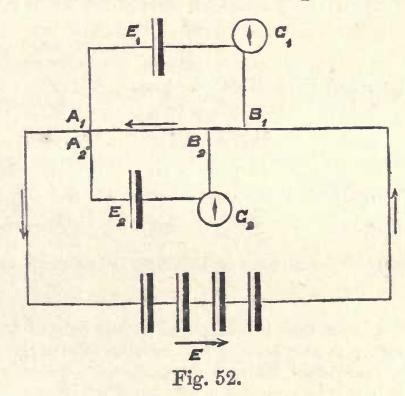
Clark has deduced the following values of electromotive forces: Daniell I (amalgamated zinc, H₂SO₄ + 4 aq., CuSO₄, copper) = 1·079 Volts; Daniell II (H₂SO₄ + 12 aq.) = 0·978; Daniell III (H₂SO₄ + 12 aq., Cu₂(NO₃)₂) = 1·00; Bunsen I (HNO₃, carbon) = 1·964; Bunsen II (HNO₃ sp. g. 1·38) = 1·888; Grove (H₂SO₄ + 4 aq., HNO₃, platinum) = 1·956. A Volt is an electromotive force equal to 100,000,000 units of the centimetre-gramme-second system.
克拉克推导出下列电动势值:丹聂耳 I(汞齐锌,H₂SO₄ + 4 aq.,CuSO₄,铜)= 1·079 伏特;丹聂耳 II(H₂SO₄ + 12 aq.)= 0·978;丹聂耳 III(H₂SO₄ + 12 aq.,Cu₂(NO₃)₂)= 1·00;本生 I(HNO₃,碳)= 1·964;本生 II(HNO₃ 比重 1·38)= 1·888;格罗夫(H₂SO₄ + 4 aq.,HNO₃,铂)= 1·956。一个伏特是等于厘米-克-秒单位制 100,000,000 个单位的电动势。
第十三章 · 物质的电阻Chapter XIII — On the Electric Resistance of Substances
物质的分类Three Classes of Substances
228. There are three classes in which we may place different substances in relation to the passage of electricity through them. The first class contains all the metals and their alloys, some sulphurets, and other compounds containing metals, to which we must add carbon in the form of gas-coke, and selenium in the crystalline form. In all these substances conduction takes place without any decomposition, or alteration of the chemical nature of the substance, either in its interior or where the current enters and leaves the body. In all of them the resistance increases as the temperature rises.
228. 就电流通过它们的情况而言,我们可以把不同物质分为三类。第一类包含所有金属及其合金、某些硫化物以及其他含金属的化合物,此外还要加上煤气焦炭形式的碳和晶体形式的硒。在所有这些物质中,导电发生时没有任何分解或物质化学性质的改变,无论在其内部还是在电流进入和离开物体的地方都是如此。在所有这些物质中,电阻随温度升高而增大。
The second class contains the substances called electrolytes, because the current is associated with a decomposition of them into their chemical constituents. In these substances the resistance diminishes as the temperature rises.
第二类包含称为电解质的物质,因为电流伴随着它们分解为其化学成分。在这些物质中,电阻随温度升高而减小。
The third class contains the substances which, in their ordinary state, are bad conductors, such as the dielectrics and insulating media. It is difficult, on account of the great resistance of these substances, to determine whether the feeble current which we can force through them is or is not associated with electrolysis.
第三类包含在普通状态下是良绝缘体的物质,如电介质和绝缘介质。由于这些物质电阻极大,很难确定我们迫使通过它们的微弱电流是否与电解有关。
金属的电阻On the Electric Resistance of Metals
229. There is no part of electrical research in which more numerous or more accurate experiments have been made than in the determination of the resistance of metals. It is of the utmost importance in the electric telegraph that the metal of which the wires are made should have the smallest attainable resistance. Measurements of resistance must therefore be made before selecting the materials. When any fault occurs in the line, its position is at once ascertained by measurements of resistance, and these measurements require the use of resistance coils, made of metal the electrical properties of which have been carefully tested. The electrical properties of metals and their alloys have been studied with great care by MM. Matthiessen, Vogt, and Hockin, and by MM. Siemens.
229. 电学研究中没有哪一部分比金属电阻的测定做了更多或更精确的实验。在电报中,制成导线的金属应具有尽可能小的电阻,这一点至关重要。因此,在选择材料之前必须做电阻测量。当线路发生任何故障时,其位置立即可通过电阻测量来确定,而这些测量需要使用电阻线圈,这些线圈由电学性质经过仔细检验的金属制成。金属及其合金的电学性质已由马蒂森、福格特、霍金诸位先生和西门子诸位先生极其仔细地研究过。
It appears from the researches of Dr. Matthiessen, that the effect of temperature on the resistance is nearly the same for a considerable number of the pure metals, the resistance at 100°C being to that at 0°C in the ratio of 1·414 to 1, or of 1 to ·707. For pure iron the ratio is 1·645, and for pure thallium 1·458. The resistance of metals has been observed by Dr. C. W. Siemens through a much wider range of temperature, extending from the freezing point to 350°C, and in certain cases to 1000°C. He finds that the resistance increases as the temperature rises, but that the rate of increase diminishes as the temperature rises. The formula, which he finds to agree very closely both with the resistances observed at low temperatures by Dr. Matthiessen and with his own observations through a range of 1000°C, is
从马蒂森博士的研究看来,对于相当多的纯金属,温度对电阻的影响几乎相同,100°C 时的电阻与 0°C 时的电阻之比为 1·414 比 1,即 1 比 ·707。对于纯铁,该比值为 1·645,对于纯铊为 1·458。C. W. 西门子博士在从冰点到 350°C(某些情况到 1000°C)的远更宽温度范围内观测了金属的电阻。他发现电阻随温度升高而增大,但增大的速率随温度升高而减小。他发现一个公式,与马蒂森博士在低温下观测到的电阻、以及他本人在 1000°C 范围内的观测都非常吻合,该公式是
$$r = \alpha T^{\frac{1}{2}} + \beta T + \gamma,$$
$$r = \alpha T^{\frac{1}{2}} + \beta T + \gamma,$$
where $T$ is the absolute temperature reckoned from $-273^{\circ}\mathrm{C}$, and $\alpha$, $\beta$, $\gamma$ are constants. Thus, for Platinum $r = 0.039369T^{\frac{1}{2}} + 0.00216407T - 0.2413$; Copper $r = 0.026577T^{\frac{1}{2}} + 0.0031443T - 0.22751$; Iron $r = 0.072545T^{\frac{1}{2}} + 0.0038133T - 1.23971$. From data of this kind the temperature of a furnace may be determined by means of an observation of the resistance of a platinum wire placed in the furnace.
其中 $T$ 是从 $-273^{\circ}\mathrm{C}$ 起算的绝对温度,$\alpha$、$\beta$、$\gamma$ 是常数。这样,对于铂 $r = 0.039369T^{\frac{1}{2}} + 0.00216407T - 0.2413$;铜 $r = 0.026577T^{\frac{1}{2}} + 0.0031443T - 0.22751$;铁 $r = 0.072545T^{\frac{1}{2}} + 0.0038133T - 1.23971$。由这类数据,炉子的温度可以通过观测放在炉中的铂丝的电阻来确定。
Dr. Matthiessen found that when two metals are combined to form an alloy, the resistance of the alloy is in most cases greater than that calculated from the resistance of the component metals and their proportions. In the case of alloys of gold and silver, the resistance of the alloy is greater than that of either pure gold or pure silver, and, within certain limiting proportions of the constituents, it varies very little with a slight alteration of the proportions. For this reason Dr. Matthiessen recommended an alloy of two parts by weight of gold and one of silver as a material for reproducing the unit of resistance. The effect of change of temperature on electric resistance is generally less in alloys than in pure metals. Hence ordinary resistance coils are made of German silver, on account of its great resistance and its small variation with temperature. An alloy of silver and platinum is also used for standard coils.
马蒂森博士发现,当两种金属结合成合金时,合金的电阻在大多数情况下大于由组分金属的电阻及其比例计算出的电阻。在金银合金的情况下,合金的电阻大于纯金或纯银的电阻,而且在组分比例的某个限制范围内,它随比例的轻微改变变化很小。因此,马蒂森博士推荐以重量两份金一份银的合金作为再现电阻单位的材料。温度变化对电阻的影响在合金中一般小于在纯金属中。因此,普通电阻线圈由德银(German silver)制成,因为它电阻大且随温度变化小。银铂合金也用于标准线圈。
230. In the following table $R$ is the resistance in Ohms of a column one metre long and one gramme weight at 0°C, and $r$ is the resistance in centimetres per second of a cube of one centimetre, according to the experiments of Matthiessen. Silver (hard drawn): $R$ = 0·1689, $r$ = 1609; Copper (hard drawn): 0·1469, 1642; Gold (hard drawn): 0·4150, 2154; Lead (pressed): 2·257, 19847; Mercury (liquid): 13·071, 96146; Gold 2 Silver 1 (hard or annealed): 1·668, 10988; Selenium at 100°C (crystalline form): $r = 6 \times 10^{13}$. It appears from the researches of Matthiessen and Hockin that the resistance of a uniform column of mercury of one metre in length, and weighing one gramme at 0°C, is 13·071 Ohms, whence it follows that if the specific gravity of mercury is 13·595, the resistance of a column of one metre in length and one square millimetre in section is 0·96146 Ohms.
230. 在下表中,$R$ 是 0°C 时长一米、重一克柱体的以欧姆计的电阻,$r$ 是一立方厘米立方体以厘米/秒计的电阻,据马蒂森的实验。银(硬拉):$R$ = 0·1689,$r$ = 1609;铜(硬拉):0·1469,1642;金(硬拉):0·4150,2154;铅(压延):2·257,19847;汞(液态):13·071,96146;金 2 银 1(硬或退火):1·668,10988;100°C 的硒(晶体形式):$r = 6 \times 10^{13}$。从马蒂森和霍金的研究看来,0°C 时长一米、重一克的水银均匀柱体的电阻为 13·071 欧姆,由此得出:如果水银的比重为 13·595,那么长一米、截面一平方毫米的柱体的电阻为 0·96146 欧姆。
电解质的电阻On the Electric Resistance of Electrolytes
231. The measurement of the electric resistance of electrolytes is rendered difficult on account of the polarization of the electrodes, which causes the observed difference of potentials of the metallic electrodes to be greater than the electromotive force which actually produces the current. This difficulty can be overcome in various ways. In certain cases we can get rid of polarization by using electrodes of proper material, as, for instance, zinc electrodes in a solution of sulphate of zinc. By making the surface of the electrodes very large compared with the section of the part of the electrolyte whose resistance is to be measured, and by using only currents of short duration in opposite directions alternately, we can make the measurements before any considerable intensity of polarization has been excited by the passage of the current. Finally, by making two different experiments, in one of which the path of the current through the electrolyte is much longer than in the other, and so adjusting the electromotive force that the actual current, and the time during which it flows, are nearly the same in each case, we can eliminate the effect of polarization altogether.
231. 电解质电阻的测量由于电极的极化而变得困难,极化使观测到的金属电极电势差大于实际产生电流的电动势。这一困难可以用各种方法克服。在某些情况下,我们可以通过使用适当材料的电极来消除极化,例如在硫酸锌溶液中使用锌电极。通过使电极表面相对于待测电阻电解质部分的截面做得很大,并且只用交替反向的短时电流,我们就能在电流通过尚未激起任何可观极化强度之前完成测量。最后,通过做两次不同的实验(其中一次电流通过电解质的路径比另一次长得多),并调整电动势使实际电流及其流动时间在每种情况下几乎相同,我们就能完全消除极化的影响。
232. In the experiments of Dr. Paalzow the electrodes were in the form of large disks placed in separate flat vessels filled with the electrolyte, and the connexion was made by means of a long siphon filled with the electrolyte and dipping into both vessels. Two such siphons of different lengths were used. The observed resistances of the electrolyte in these siphons being $R_1$ and $R_2$, the siphons were next filled with mercury, and their resistances when filled with mercury were found to be $R_1'$ and $R_2'$. The ratio of the resistance of the electrolyte to that of a mass of mercury at 0°C of the same form was then found from the formula $\rho = \dfrac{R_1 - R_2}{R_1' - R_2'}$. To deduce from the values of $\rho$ the resistance of a centimetre in length having a section of a square centimetre, we must multiply them by the value of $r$ for mercury at 0°C.
232. 在帕尔佐博士的实验中,电极是大圆盘形式,放在装满电解质的独立扁平容器中,连接通过一根装满电解质并浸入两个容器的长虹吸管完成。使用了两个不同长度的这种虹吸管。观测到的这些虹吸管中电解质的电阻为 $R_1$ 和 $R_2$,接着用汞装满虹吸管,发现装满汞时它们的电阻为 $R_1'$ 和 $R_2'$。电解质电阻与 0°C 时同形状汞块电阻之比于是由公式 $\rho = \dfrac{R_1 - R_2}{R_1' - R_2'}$ 求得。要从 $\rho$ 的值推出长一厘米、截面一平方厘米的电阻,我们必须把它们乘以 0°C 时汞的 $r$ 值。

The results given by Paalzow are as follow: H₂SO₄ at 15°C, resistance compared with mercury = 96950; H₂SO₄ + 14 H₂O = 14157; H₂SO₄ + 13 H₂O at 22°C = 13310; H₂SO₄ + 499 H₂O at 22°C = 184773; ZnSO₄ + 23 H₂O at 23°C = 194400; ZnSO₄ + 24 H₂O = 191000; ZnSO₄ + 105 H₂O = 354000; CuSO₄ + 45 H₂O at 22°C = 202410; CuSO₄ + 105 H₂O = 339341; MgSO₄ + 34 H₂O at 22°C = 199180; MgSO₄ + 107 H₂O = 324600; HCl + 15 H₂O at 23°C = 13626.
帕尔佐给出的结果如下:H₂SO₄ 在 15°C,与汞相比的电阻 = 96950;H₂SO₄ + 14 H₂O = 14157;H₂SO₄ + 13 H₂O 在 22°C = 13310;H₂SO₄ + 499 H₂O 在 22°C = 184773;ZnSO₄ + 23 H₂O 在 23°C = 194400;ZnSO₄ + 24 H₂O = 191000;ZnSO₄ + 105 H₂O = 354000;CuSO₄ + 45 H₂O 在 22°C = 202410;CuSO₄ + 105 H₂O = 339341;MgSO₄ + 34 H₂O 在 22°C = 199180;MgSO₄ + 107 H₂O = 324600;HCl + 15 H₂O 在 23°C = 13626。
233. MM. F. Kohlrausch and W. A. Nippoldt have determined the resistance of mixtures of sulphuric acid and water. They used alternating magneto-electric currents, and found that Ohm's law was applicable to this electrolyte throughout the range of these electromotive forces. The resistance is a minimum in a mixture containing about one-third of sulphuric acid. The resistance of electrolytes diminishes as the temperature increases.
233. F. 科尔劳施和 W. A. 尼波尔特诸位先生测定了硫酸与水混合物的电阻。他们使用交变磁电电流,并发现欧姆定律在这些电动势的整个范围内都适用于这种电解质。在含约三分之一硫酸的混合物中电阻最小。电解质的电阻随温度升高而减小。
电介质与气体的电阻On the Electrical Resistance of Dielectrics and Gases
234. A great number of determinations of the resistance of gutta-percha, and other materials used as insulating media, in the manufacture of telegraphic cables, have been made in order to ascertain the value of these materials as insulators. The tests are generally applied to the material after it has been used to cover the conducting wire, the wire being used as one electrode, and the water of a tank, in which the cable is plunged, as the other. Thus the current is made to pass through a cylindrical coating of the insulator of great area and small thickness.
234. 为确定杜仲胶及其他用作绝缘介质的材料(在电报电缆制造中)作为绝缘体的价值,已做了大量电阻测定。测试一般在材料用于覆盖导线之后施加,导线用作一个电极,浸没电缆的水箱中的水用作另一个电极。这样电流就通过绝缘体大面积、小厚度的圆柱形涂层。
It is found that when the electromotive force begins to act, the current, as indicated by the galvanometer, is by no means constant. The first effect is of course a transient current of considerable intensity, the total quantity of electricity being that required to charge the surfaces of the insulator with the superficial distribution of electricity corresponding to the electromotive force. This first current therefore is a measure not of the conductivity, but of the capacity of the insulating layer. But even after this current has been allowed to subside the residual current is not constant, and does not indicate the true conductivity of the substance. It is found that the current continues to decrease for at least half an hour, so that a determination of the resistance deduced from the current will give a greater value if a certain time is allowed to elapse than if taken immediately after applying the battery. Thus, with Hooper's insulating material the apparent resistance at the end of ten minutes was four times, and at the end of nineteen hours twenty-three times that observed at the end of one minute.
发现当电动势开始作用时,电流计指示的电流绝不稳定。第一个效应当然是一个相当强的瞬变电流,其总电量等于使绝缘体表面带有与电动势相应的面电荷分布所需的电量。因此这第一个电流不是电导的量度,而是绝缘层电容的量度。但即使让这一电流消退之后,残余电流也不恒定,并不指示该物质的真实电导率。发现电流至少持续减小半小时,因此由电流推出的电阻测定值,如果经过一定时间,会比刚加电池后立即取得的值更大。这样,对于胡珀绝缘材料,十分钟末的表观电阻是一分钟末观测值的四倍,十九小时末是二十三倍。
These phenomena seem to be due to a condition of the gutta-percha, which, for want of a better name, we may call polarization, and which we may compare on the one hand with that of a series of Leyden jars charged by cascade, and, on the other, with Ritter's secondary pile. If a number of Leyden jars of great capacity are connected in series by means of conductors of great resistance, then an electromotive force acting on the series will produce a current, as indicated by a galvanometer, which will gradually diminish till the jars are fully charged. The apparent resistance of such a series will increase, and if the dielectric of the jars is a perfect insulator it will increase without limit. In the case of the cable covered with gutta-percha it is found that after applying the battery for half an hour, and then connecting the wire with the external electrode, a reverse current takes place, which goes on for some time, and gradually reduces the system to its original state. These phenomena are of the same kind with those indicated by the 'residual discharge' of the Leyden jar, except that the amount of the polarization is much greater in gutta-percha than in glass.
这些现象似乎由于杜仲胶的一种状态,由于缺乏更好的名称,我们可以称之为极化,我们一方面可以把它比作一串级联充电的莱顿瓶,另一方面比作里特的二次电堆。如果把许多大电容的莱顿瓶用大电阻的导体串联起来,那么作用在串联上的电动势会产生一个电流计指示的电流,它会逐渐减小直到瓶子充满电。这种串联的表观电阻会增大,而且如果瓶子的电介质是完美绝缘体,它会无限增大。在覆盖杜仲胶的电缆情况下,发现加电池半小时后,再把导线与外电极相连,会发生一个反向电流,持续一段时间,并逐渐使系统回到原始状态。这些现象与莱顿瓶的「残余放电」所指示的现象同类,只是杜仲胶中的极化量比玻璃中大得多。
This state of polarization seems to be a directed property of the material, which requires for its production not only electromotive force, but the passage, by displacement or otherwise, of a considerable quantity of electricity, and this passage requires a considerable time. When the polarized state has been set up, there is an internal electromotive force acting in the substance in the reverse direction. The whole theory of what has been called residual discharge, absorption of electricity, electrification, or polarization, deserves a careful investigation, and will probably lead to important discoveries relating to the internal structure of bodies.
这种极化状态似乎是物质的一种定向性质,它的产生不仅需要电动势,还需要通过位移或其他方式通过相当多的电量,而这一通过需要相当长的时间。当极化状态建立后,物质中有一个沿相反方向作用的内部电动势。关于所谓残余放电、电的吸收、起电或极化的整个理论,值得仔细研究,并很可能导致关于物体内部结构的重要发现。
235. The resistance of the greater number of dielectrics diminishes as the temperature rises. Thus the resistance of gutta-percha is about twenty times as great at 0°C as at 24°C. Messrs. Bright and Clark have found that the following formula gives results agreeing with their experiments. If $r$ is the resistance of gutta-percha at temperature $T$ centigrade, then the resistance at temperature $T+t$ will be $R = r \times 0.8878^t$. Mr. Hockin has verified the curious fact that it is not until some hours after the gutta-percha has taken its temperature that the resistance reaches its corresponding value. The effect of temperature on the resistance of india-rubber is not so great as on that of gutta-percha. The resistance of gutta-percha increases considerably on the application of pressure. The resistance, in Ohms, of a cubic metre of various specimens of gutta-percha used in different cables is as follows: Red Sea $0.267 \times 10^{12}$ to $0.362 \times 10^{12}$; Malta-Alexandria $1.23 \times 10^{12}$; Persian Gulf $1.80 \times 10^{12}$; Second Atlantic $3.42 \times 10^{12}$; Hooper's Persian Gulf Core $74.7 \times 10^{12}$; Gutta-percha at 24°C $3.53 \times 10^{12}$.
235. 大多数电介质的电阻随温度升高而减小。这样,杜仲胶的电阻在 0°C 时约为 24°C 时的二十倍。布莱特和克拉克诸位先生发现下列公式给出的结果与他们的实验一致。若 $r$ 是杜仲胶在摄氏温度 $T$ 时的电阻,那么在温度 $T+t$ 时的电阻将是 $R = r \times 0.8878^t$。霍金先生验证了一个奇妙的事实:直到杜仲胶达到其温度几小时之后,电阻才达到相应的值。温度对印度橡胶电阻的影响不如对杜仲胶那么大。杜仲胶的电阻在施加压力时显著增大。不同电缆中使用的各种杜仲胶样品一立方米的以欧姆计电阻如下:红海 $0.267 \times 10^{12}$ 到 $0.362 \times 10^{12}$;马耳他-亚历山大 $1.23 \times 10^{12}$;波斯湾 $1.80 \times 10^{12}$;第二大西洋 $3.42 \times 10^{12}$;胡珀波斯湾芯 $74.7 \times 10^{12}$;24°C 杜仲胶 $3.53 \times 10^{12}$。
236. The following table, calculated from the experiments of M. Buff, shews the resistance of a cubic metre of glass in Ohms at different temperatures: at 200°C, 227000; at 250°, 13900; at 300°, 1480; at 350°, 1035; at 400°, 735.
236. 下表由布夫先生的实验计算得出,表示不同温度下一立方米玻璃以欧姆计的电阻:200°C 时 227000;250° 时 13900;300° 时 1480;350° 时 1035;400° 时 735。
237. Mr. C. F. Varley has recently investigated the conditions of the current through rarefied gases, and finds that the electromotive force $E$ is equal to a constant $E_0$ together with a part depending on the current according to Ohm's Law, thus $E = E_0 + RC$. For instance, the electromotive force required to cause the current to begin in a certain tube was that of 323 Daniell's cells, but an electromotive force of 304 cells was just sufficient to maintain the current. The intensity of the current was proportional to the number of cells above 304. From these experiments it appears that there is a kind of polarization of the electrodes, the electromotive force of which is equal to that of 304 Daniell's cells, and that up to this electromotive force the battery is occupied in establishing this state of polarization. When the maximum polarization is established, the excess of electromotive force above that of 304 cells is devoted to maintaining the current according to Ohm's Law. The law of the current in a rarefied gas is therefore very similar to the law of the current through an electrolyte in which we have to take account of the polarization of the electrodes.
237. C. F. 瓦利先生最近研究了通过稀薄气体的电流条件,并发现电动势 $E$ 等于一个常数 $E_0$ 加上一个按欧姆定律依赖电流的部分,即 $E = E_0 + RC$。例如,使某个管子中的电流开始所需的电动势是 323 个丹聂耳电池的电动势,但 304 个电池的电动势刚好足以维持电流。电流强度与超过 304 的电池数成正比。从这些实验看来,存在一种电极极化,其电动势等于 304 个丹聂耳电池的电动势,而且直到这一电动势,电池都在忙于建立这种极化状态。当最大极化建立后,超过 304 个电池的电动势剩余部分用于按欧姆定律维持电流。因此,稀薄气体中电流的定律与电解质中电流的定律非常相似,在后者中我们必须考虑电极的极化。
In connexion with this subject we should study Thomson's results, in which the electromotive force required to produce a spark in air was found to be proportional not to the distance, but to the distance together with a constant quantity. The electromotive force corresponding to this constant quantity may be regarded as the intensity of polarization of the electrodes. These researches confirm the statement of Faraday that the electric tension required to cause a disruptive discharge to begin at the electrified surface of a conductor is a little less when the electrification is negative than when it is positive, but that when a discharge does take place, much more electricity passes at each discharge when it begins at a positive surface.
关于这一主题,我们应当研究汤姆孙的结果,其中发现在空气中产生火花所需的电动势不与距离成正比,而与距离加上一个常数量成正比。与该常数量相应的电动势可以看作电极极化的强度。这些研究证实了法拉第的陈述:使破坏性放电在导体带电表面开始所需的电张力(见第 46 节),在带电为负时比为正时略小,但当放电确实发生时,若它从正表面开始,每次放电通过的电要多得多。
238. MM. Wiedemann and Rühlmann have recently investigated the passage of electricity through gases. The electric current was produced by Holtz's machine, and the discharge took place between spherical electrodes within a metallic vessel containing rarefied gas. The discharge was in general discontinuous, and the interval of time between successive discharges was measured by means of a mirror revolving along with the axis of Holtz's machine. It was found that the quantity of electricity in each discharge is independent of the strength of the current and of the material of the electrodes, and that it depends on the nature and density of the gas, and on the distance and form of the electrodes.
238. 维德曼和吕尔曼诸位先生最近研究了电流通过气体。电流由霍尔茨起电机产生,放电发生在装有稀薄气体的金属容器内的球形电极之间。放电一般是不连续的,连续放电之间的时间间隔用一面随霍尔茨起电机轴一起旋转的镜子测量。发现每次放电中的电量与电流强度和电极材料无关,而取决于气体的性质和密度,以及电极的距离和形状。
关于惠斯通电桥的附注Note on Wheatstone's Bridge
[The following method of determining the current in the Galvanometer of Wheatstone's Bridge was given by Professor Maxwell in his last course of lectures, and is a good illustration of the method of treating a system of linear conductors. It has been communicated to the present editor by Professor J. A. Fleming of University College, Nottingham. The method simply assumes Ohm's Law for each conductor, and that the whole electromotive force around a linear circuit is the sum of the electromotive forces in the several conductors forming the circuits, and therefore equal to the sum of the products of the resistance of each conductor and the current flowing in it, the currents being taken in cyclic order.
[以下确定惠斯通电桥电流计中电流的方法,由麦克斯韦教授在他最后一期课程中给出,是处理线性导体系统方法的一个很好示例。它已由诺丁汉大学学院的 J. A. 弗莱明教授转达给现任编者。该方法只对每个导体假定欧姆定律,并假定线性回路周围的总电动势是组成回路的各导体中电动势之和,因此等于每个导体的电阻与其中流动电流乘积之和,电流按循环次序取。
Let P, Q, S, R, G and B (Fig. 53) denote the resistances in the several conductors forming the bridge, and let them be arranged as indicated in the figure. Now the six conductors may be considered as forming three independent circuits viz.:—PGQ, RSG, and QSB. Let x+y, y and z denote the currents in these circuits respectively, each current being considered as flowing in the directions indicated by the arrows. Then the actual current in Q is z−x−y, that in S is z−y and that in G is x. Of the three circuits specified above the E. M. F. in the first two is zero while that in the third is E, the electromotive force of the battery. Hence, applying Ohm's Law to each circuit in order we have
设 P、Q、S、R、G 和 B(图 53)表示组成电桥的各导体中的电阻,并按图中所示排列。现在六个导体可以看作组成三个独立回路,即:PGQ、RSG 和 QSB。设 x+y、y 和 z 分别表示这些回路中的电流,每个电流视为沿箭头所示方向流动。那么 Q 中的实际电流是 z−x−y,S 中的是 z−y,G 中的是 x。在上述三个回路中,前两个的电动势为零,而第三个的电动势为 E,即电池的电动势。因此,依次对每个回路应用欧姆定律,我们有
$$\begin{aligned} (P+G+Q)\overline{x+y} - Gy - Qz &= 0,\\ (R+S+G)y - Sz - G\overline{x+y} &= 0,\\ (Q+S+B)z - Sy - Q\overline{x+y} &= E. \end{aligned}$$
$$\begin{aligned} (P+G+Q)\overline{x+y} - Gy - Qz &= 0,\\ (R+S+G)y - Sz - G\overline{x+y} &= 0,\\ (Q+S+B)z - Sy - Q\overline{x+y} &= E. \end{aligned}$$
or, expanding and rearranging,
或者,展开并重排,
$$\begin{aligned} (P+G+Q)x + (P+Q)y - Qz &= 0,\\ -Gx + (R+S)y - Sz &= 0,\\ -Qx - (S+Q)y + (Q+S+B)z &= E. \end{aligned}$$
$$\begin{aligned} (P+G+Q)x + (P+Q)y - Qz &= 0,\\ -Gx + (R+S)y - Sz &= 0,\\ -Qx - (S+Q)y + (Q+S+B)z &= E. \end{aligned}$$
Solving for $x$ we obtain $x = \dfrac{E\left| \begin{smallmatrix} P+Q & -Q \\ R+S & -S \end{smallmatrix} \right|}{\Delta} = \dfrac{E(QR - PS)}{\Delta}$, where $\Delta$ is the determinant of the system of equations. The condition for no current in the galvanometer is $x = 0$, or $QR - PS = 0$, or $\dfrac{P}{Q} = \dfrac{R}{S}$. To obtain the current equations, the rule is: 'Multiply each cycle sign (i.e. current) by the sum of all the resistances which bound that cycle, and subtract from it the sign of each neighbouring cycle multiplied by the resistance separating the cycles, and equate the result to the E. M. F. in the cycle.' It will be seen that the method is a simple application of Kirchhoff's second law, but the above rule is very convenient in its application.]
解 $x$ 我们得到 $x = \dfrac{E\left| \begin{smallmatrix} P+Q & -Q \\ R+S & -S \end{smallmatrix} \right|}{\Delta} = \dfrac{E(QR - PS)}{\Delta}$,其中 $\Delta$ 是方程组的行列式。电流计中无电流的条件是 $x = 0$,即 $QR - PS = 0$,或 $\dfrac{P}{Q} = \dfrac{R}{S}$。为得到电流方程,规则是:「用环绕该循环的所有电阻之和乘以每个循环符号(即电流),再从中减去每个相邻循环符号乘以分隔这些循环的电阻,并把结果等于该循环中的电动势。」可见该方法是基尔霍夫第二定律的简单应用,但上述规则在应用中非常方便。]
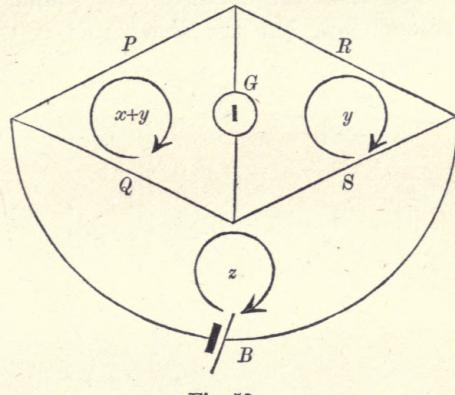
图版 · 力线与等势面Plates — Lines of Force and Equipotential Surfaces